SHIFTING ALLIANCE IN MIDDLE EAST AND INDIA’S STRATEGIC CALCULUS
The Saudi-Pak Strategic Mutual Defense Agreement has significant implications for India's presence in the Middle East. Explore the geopolitical dimensions of this pact and India's strategic calculus.

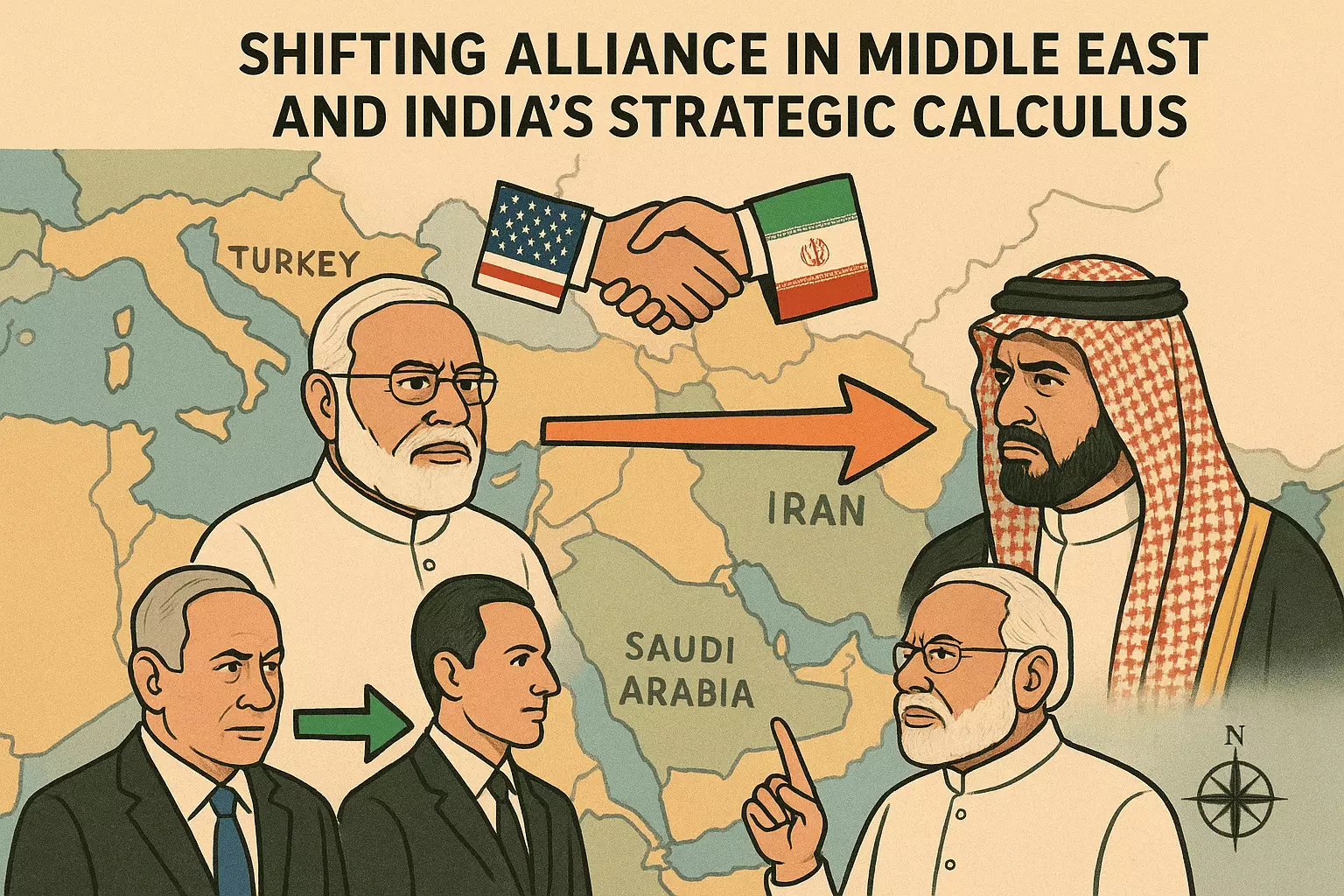
The Saudi-Pak Strategic Mutual Defense Agreement (SMDA) formalizes a prevalent and historic cooperation in West Asia and needs to be dealt with strategic acuity to preclude deterrence of India’s pivot in Mideast.
The signing of the Saudi Arabia - Pakistan Strategic Mutual Defense Agreement on 17 September 2025 is a hallmark of shifting global alignments and the addition of an Islamic nuclear nation in the volatile Middle - East equation. Saudi Arabia, a leading economic power in the Gulf and Pakistan, the sole Islamic nuclear nation have engaged diplomatically throughout history. The SMDA is a mere materialization of the prevalent arrangement between the two countries which till now was an informal partnership. Middle-East has faced epoch-shifting upheavals in the last few years and the India-Pakistan relationship has also exacerbated post Operation Sindoor. This defense pact draws an Indian enemy closer to a warm ally and raises strategic alarms for India. China’s exploitation of economic vulnerabilities of Middle East nations through the Belt and Road Initiative (BRI) has been a significant threat to India’s influence in the region. Thus, as Pakistan draws closer into the geopolitical milieu of the Middle East and Saudi Arabia engages in South Asia’s geopolitical theatre, India risks unsettling the credibility of the India-Middle-East-Europe-Economic Corridor (IMEC) as an alternative to the BRI. Broadly, while the SMDA doesn’t pose direct security threat to India, it deters its very presence in the region as it balances regional actors.
The SMDA and its Geopolitical Implications
The SMDA widens Pak - Saudi Arabia geopolitical breadths and the defense pact focuses on joint military developments, strategic cooperation and joint deterrence against any aggression. One of the most critical hallmarks of this deal is that ‘any aggression against either partner shall be considered an aggression against both’. The semantics might sound familiar at the first glance as they resonate with Article 5 of NATO that mirrors a similar act of joint deterrence against hostilities. Nonetheless, the SMDA includes ‘all military means’ for countering foreign hostilities that ranges from intelligence sharing to the nuclear option as well.
The defense pact between the leading Islamic nations formalizes their long-standing cooperation in the pages of geopolitical antiquities beginning from the ‘Treaty of Friendship’ signed in 1951. Saudi Arabia and Pakistan have a long-standing warm entente designed to build military capacity, production and even joint operations on counter terrorism as seen in the 1979 Mecca-Medina debacle.
The proximate consequences of this deal are a farrago of unpredictability and opportunity. Firstly, the SMDA invites Pakistan to the geopolitical theatre of Middle East, which de facto has engulfed in conflagrations post Israel’s strikes on Hamas in 2023. Besides, Saudi Arabia now too is formally engaged with the lately fragile calculus in South Asia.
This raises not many alarms for India since Saudi Arab is a warm partner with a bulk trade and economic bilateral directed at $41.88 Billion in 2024-25. However, Pakistan’s engagement with a conducive Indian partner in the Middle East calls for vigilance since it risks squandering the credibility of India’s outreach in the Middle - East.
Backdrop of the Pact and Alarms for India
Amid increasing volatility in the Middle East region, a sudden formalization of strategic arrangements between two major Islamic powers has drawn global attention. A central reason of the expansion of alignment between Saudi Arabia and Pakistan in backdrop of an instable Middle East is in mutual interests. The decline in the impact of American security guarantees to Arab nations has drawn distrust. Israel’s strikes on Qatar on 09 September 2025 is a precedent of uncertainty in American protection to nations. Since years, Riyadh has expected strategic security guarantee from USA dreaming for mutual defense treaty. Yet, the reality has never materialized any such arrangement.
Besides, nuclear deterrence in the region, particularly branching from Israel’s presence as the sole nuclear power in Middle East, has raised umpteen alarms for Riyadh regarding regional security. As Saudi Arabia is a signatory of the Nuclear Non-Proliferation Treaty (NPT), it has globally set the optics of being a non-nuclear nation. In addition, the bombardment of Iran’s nuclear programme in June 2025 under Operation Rising Lion has crumbled any prospective development of such programme for Saudi Arabia.
Therefore, the defense pact with Pakistan seems to be about Security in the Gulf. Saudi Arabia, viewing the uncertainty of power balancing in Middle East in recent times, aims at restoring defense and deterrence in the region as Pakistan could extend its nuclear umbrella to it.
For Pakistan, the SMDA is for restoring economic balance and gaining a maritime say in the littoral of Riyadh. Pakistan has mobilized trust in the Gulf as the only Islamic-majority nuclear nation. This pact strengthens its role in the geopolitical theatrics in the Gulf region. Moreover, Pakistan has been a long-standing security partner of Riyadh, deploying troops during military crisis in the past, cooperating for joint military developments etc. The pact will boost its military presence in the region as well as joint military and naval exercises will prospectively bolster. According to data of the Arab News, Pakistan eyes over $6.46 Billion from Riyadh in the FY 2025-2026, including deferred payments, oil imports, time deposits etc. In times of borderline sovereign debt crisis and economic fragility, Pakistan secures its position to boost economic growth, that realistically would be quasi-incremental.
The SMDA will accord it with an impact over Saudi Arabia’s littoral near the Strait of Bab el-Mandeb. This critical passage in the Red Sea has already confronted blockade jeopardy, political and military conflagrations due to Yemen and Houthis in recent years. The same has threatened India’s unhindered passages in a critical strait that connects it to one of its largest markets in Europe and North Africa.
Pakistan’s presence, even indirect one through the SMDA, will raise strategic alarms for India’s trade passes. Studies of the United Nations Conference on Trade and Development (UNCTAD) have insinuated that around 15-17% of India’s merchandise trade passes through the Strait of Bab el-Mandeb and then the Suez canal. Pakistan’s influence through joint naval drills in guise of defense cooperation with Riyadh could risk logistical and supply chain bottlenecks. For India, this would result in embracing longer transit routes via the Cape of Good Hope with higher costs and time.
More significantly, the pact would complicate India’s relations with Saudi Arabia. India currently practices warming relations in trade, defense and high-level political visits with Riyadh. This is a geo-strategic mainstay for sustaining the impact of the IMEC as a credible alternative to China’s BRI. Islamabad’s fortified entente with Riyadh could risk the dilution of India’s own pivot in Gulf and more concretely in the Middle East as Saudi Arabia embraces a prevalent Islamic partner. Although it is tacit that trade relations will continue between India and Saudi Arabia, political trust will be harder to sustain. The same would endanger losing a channel that connects India to its largest markets in Europe through the IMEC while also diluting its presence as a counterweight to BRI.
Lessons for India and the Way Ahead
As the security landscape concerning West and South Asia has sensitized, the SMDA explores a trusted security partner for Saudi Arabia that may have palpable aftermath for India as well. Regional tensions both in Middle East and South Asia will remain a central factor in guiding the future of this pact. The most reliable option for India in current complexities will be to maintain strategic vigilance while exploring alternatives to safeguard against geopolitical influxes.
Securing enhanced inter-connectivity with Riyadh will earmark India as a mainstay for Saudi Arabia’s commercial and economic transformation, turning India into not just a strategic partner, but a co-architect of Saudi’s visions. India is already the 2nd largest trade partner of Saudi Arabia. Besides, socio-cultural transactionalism emboldens the ties with over 2.7 Million Indian diaspora in the Kingdom. Yet, to deepen engagement, India must diversify investments on unconventional sectors. Green energy offers an optimal frontier for long-term dividends. With Saudi Arabia investing heavily on NEOM’s $8.4 Billion Green Hydrogen Project and India fabricating its National Green Hydrogen Mission, a dedicated India-Saudi Green Hydrogen - Ammonia Corridor will reinforce inter-connectivity at a time when Riyadh may prefer other partners for regional security.
Concomitantly, with the Red Sea engulfed in conflagrations and Pakistan shifting closer to critical sea lanes, exploring alternative trade routes for unhindered connectivity to European and North African markets must be considered. The International-North-South-Transport Corridor (INSTC), being a multi-modal trade route uses railways, roadways and maritime passages for seamless connectivity to North Africa, Central Asia and Europe. This will allow entrance to non-parochial Eurasian markets while creating a buffer against regional turbulence in Gulf-centric routes. By this, India doesn’t bet all its chips on IMEC, but explores newer options while balancing credibility with Riyadh.
Conclusion
Ultimately, the Saudi-Pak pact is not an isolated event but a part of a larger picture that redraws power balancing in West Asia. For India, the solution to the threats arising from this global realignment is not reactive diplomacy, its reinforcement of geopolitical options. By safeguarding maritime security and embedding itself as a mainstay in Riyadh’s economic transformations, India redefines both its credibility and role in the Middle East. Eventually, India will not be a participant or observer of geopolitical influxes/ turbulence, but a shape it for larger good of the region.
About the Author
Arnav Singh is a student of Class XI in Army Public School, Pune. He is an avid reader and has keen interest in geopolitics.
(Views expressed in the article are the author’s personal.)