Silencing the Classroom: When Courts Decide What Children Must Not Know
The Supreme Court’s move to withdraw NCERT textbook passages on judicial delays and corruption raises fundamental questions about education, democracy, and who shapes civic understanding in India.

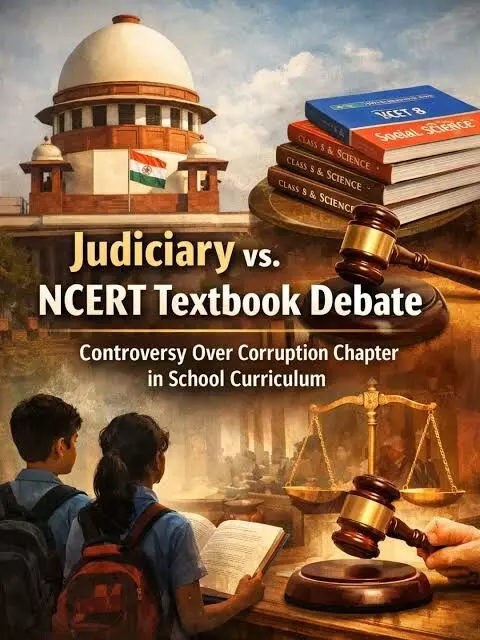
The Supreme Court's intervention over an NCERT textbook raises a harder question than judicial delays or corruption. It raises the question of who gets to decide what children are allowed to know. There is a particular irony in a court moving to suppress a textbook that criticises judicial delay. The case itself will, in all likelihood, take years to resolve. That irony is not lost on anyone who has spent any time waiting in the corridors of Indian justice. But the irony, satisfying as it is to point out, is almost beside the point. The deeper issue is this: should a constitutional court have the power to determine what schoolchildren may read about constitutional institutions, including itself?
The NCERT Class 8 Social Science textbook, now withdrawn following the Supreme Court's intervention, contained two passages that generated controversy. The first addressed pendency in courts, concluding that justice delayed is justice denied, a principle so well-established that it appears in the court's own judgments with some regularity. The second, subtitled Corruption and Judiciary, cited former Chief Justice B.R. Gawai's own words on how judicial corruption erodes public faith in the institution. Both passages, it is worth noting, drew directly from the statements of sitting and former judges. The court, in essence, objected to children reading what judges themselves have said.
The question of whether such content belongs in a textbook for twelve and thirteen year olds is a legitimate one, and it is, as legal observers have rightly noted, fundamentally a question for educationists, not for courts. There is a reasonable debate to be had about the appropriate age at which students should encounter institutional critique, about the difference between teaching constitutional structure and teaching constitutional failure, about whether a child first needs to understand what the judiciary is before being told how it sometimes falls short. These are pedagogical questions. They require pedagogical answers.
But that debate cannot be foreclosed by judicial order. When a court moves against a textbook that criticises courts, it conflates two entirely different things: the power to adjudicate disputes and the power to curate public knowledge. The first is its proper domain. The second belongs to no single institution, least of all one with a direct interest in how it is portrayed.
There is also the matter of completeness. Critics of the textbook have argued, with some justification, that its treatment of judicial delays and corruption was incomplete. And this is fair. India's judiciary, for all its failures, has also been a bulwark against executive overreach, a protector of fundamental rights, a forum of last resort for millions who have nowhere else to turn. A textbook that presents only dysfunction without context does not educate; it indoctrinates, just in a different direction. If the passages gave students the impression that the judiciary is simply corrupt and slow, with no acknowledgment of its role in a democratic republic, that is a genuine flaw.
The remedy for incomplete education, however, is more complete education, not suppression. The appropriate response to a textbook that does not give the full picture is to revise it, to add context, to situate critique within a broader understanding of how institutions function and why they matter. It is not to remove the critique altogether. Children who learn only the idealised version of their institutions are not being educated. They are being managed.
This matters beyond the specific contents of one textbook. India has a long tradition of civic education that is essentially ceremonial, teaching students the names of constitutional articles and the steps of the legislative process without ever suggesting that any of it might fail. The result is generations of citizens who are surprised and then cynical when institutions do not perform as advertised, rather than citizens who understand that institutions require constant scrutiny and pressure to function well. A democracy needs the second kind of citizen, not the first.
The Supreme Court has, in recent years, been more willing than ever to speak candidly about its own limitations. Chief Justices have acknowledged delays. Judges have lamented the gap between constitutional promise and courtroom reality. That candour, when it comes from within the institution, is treated as statesmanship. When it appears in a textbook, apparently, it becomes a threat. The inconsistency is difficult to defend.
Public faith in judicial institutions is not built by controlling what children read about them. It is built, slowly and with difficulty, by the institutions themselves acting in ways that merit faith. A court that withdraws a textbook critical of courts does not inspire confidence. It confirms the very anxieties the textbook sought to describe.
There will be those who argue that the court acted to protect impressionable young minds from unbalanced material, that it was a curatorial intervention rather than a censorious one. But courts do not have the mandate to curate the national curriculum. That mandate belongs to educationists, subject to democratic accountability and public debate. Once courts begin deciding which institutional critiques are fit for classrooms, the question becomes not just what children may read today, but who controls the terms of democratic understanding tomorrow.
That is too high a price to pay for the comfort of any single institution, however important. A judiciary confident in its own legitimacy should be able to withstand the scrutiny of a Class 8 textbook. One that cannot invites a harder set of questions than any textbook could pose.