The Courtroom and the Constitution: What Justice Bhuyan’s Opinion Really Tells Us

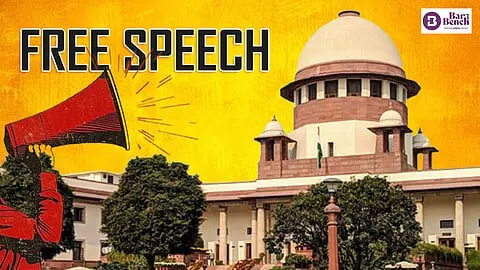
Images Credit - Bench
There is something almost poetic about a case that essentially resolved itself, with producers quietly agreeing to rename their film and petitioners walking away satisfied, yet generating a judicial opinion that will be debated in law schools and newsrooms for years to come. The Supreme Court’s handling of the Ghooskhor Pandat matter is, on the surface, an unremarkable story about a Netflix movie and a hurt community’s bruised sentiments. Beneath that surface, however, lies a profoundly important reckoning with some of the most contested questions in Indian constitutional law: Who gets to define the limits of artistic expression? What standards should courts apply when evaluating offence? And does the right to fraternity impose obligations that can legally constrain free speech?
Justice Ujjal Bhuyan’s concurring opinion deserves to be read in full, because it refuses the comfort of easy answers. It is, in the most honest sense, a document in tension with itself, and that tension mirrors the genuine difficulty of the problem it addresses.
The Problem With Hurt Feelings as Legal Standing
Let us begin with what brought this case to the Supreme Court in the first place. A PIL filed by an individual claiming to represent the Brahman Samaj of India argued that a film title associating bribery with the word “Pandat” would denigrate the Brahmin community and provoke law and order problems. The petition was, by any rigorous legal standard, extraordinarily thin. There was no evidence presented of actual incitement, no demonstrated harm, no causal chain between a film title and communal violence. What existed was the claim that a community felt insulted.
This matters because India’s courts have, over decades, allowed “hurt sentiments” to function as a near-automatic threshold for judicial intervention in artistic expression. The pattern is familiar: a book, a film, a painting; a petition claiming community offence; pressure, legal or extralegal, until the artist capitulates. The Ghooskhor Pandat producers did exactly what artists in India are conditioned to do. They surrendered. The film will release under a different name, the petitioner will claim victory, and the chilling effect on every writer and filmmaker watching this unfold will be immeasurable.
What the Opinion Gets Right
This is precisely why Justice Bhuyan’s choice to write separately, when he could simply have concurred and moved on, is significant. He chose to use a settled, unremarkable case to address something unsettled and deeply important.
His most consequential observation is about the standard of the “ordinary man of common sense and prudence.” This is not a novel legal concept; it has roots in both Indian and British jurisprudence. But its restatement here is pointed and deliberate. By explicitly rejecting the standard of those who “always have a sense of insecurity, or of those who always perceive criticism as a threat to their power or position,” Justice Bhuyan is doing something courts in India rarely do with such clarity: he is telling petitioners that the hypersensitive, perpetually aggrieved complainant is not the legal benchmark for free speech restrictions.
This is enormously important. If courts adopt the standard of the most sensitive possible member of any community, then virtually all artistic expression becomes vulnerable. Satire, which by definition cuts, becomes impossible. Fiction that draws on social realities, including caste hierarchies, religious hypocrisy, and institutional corruption, becomes legally hazardous. The “reasonable person” standard is the minimum floor that a functioning democracy must maintain.
What the Opinion Leaves Unresolved
Yet the opinion is not without its complications, and critics who have flagged them are not wrong to do so. The assertion that it is “constitutionally impermissible” for state or non-state actors to vilify or denigrate any community is stated with a confidence that the constitutional text does not entirely support. Article 19(2), which permits reasonable restrictions on free speech, contains specific enumerated grounds, including public order, decency, morality, defamation, and incitement. “Vilification of a community” is not a standalone ground. Courts have stretched these categories before, and the concern is that embedding “constitutional impermissibility” language into an opinion, even a concurring one, without tethering it carefully to specific provisions gives future courts and petitioners fresh ammunition to restrict expression.
The practical danger is not hypothetical. India already has a deeply problematic ecosystem of speech restrictions. Section 295A of the IPC, which criminalises deliberate acts intended to outrage religious feelings, has been used to silence novelists, scholars, and comedians. Cinematographic certification is routinely weaponised. The courts themselves have not always been defenders of artistic liberty. Inserting broad language about the unconstitutionality of community “vilification” into the judicial record, however well-intentioned, risks being weaponised by the very interests Justice Bhuyan was implicitly pushing back against.
The Deeper Question: What Is Fraternity For?
Justice Bhuyan’s invocation of fraternity, that third and often neglected value of the constitutional preamble alongside liberty and equality, is philosophically rich but legally underspecified. Fraternity, as B.R. Ambedkar understood it, was about annihilating caste, about social solidarity in a fractured society. It was an aspirational concept pointing toward a more equal India, not a mechanism for insulating powerful communities from criticism.
When a member of a historically dominant group invokes fraternity to suppress a film title that mocks bribe-taking priests, something has gone wrong in the translation. Fraternity cannot be the constitutional basis for powerful communities to avoid satirical scrutiny while marginalised communities continue to face structural violence.
The Verdict on the Opinion
Justice Bhuyan’s opinion is best understood as a judicial intervention in an ongoing cultural and legal conversation, rather than a settled pronouncement. It offers tools for defenders of free speech, particularly the rejection of hypersensitivity as a legal standard, while also leaving openings that could be exploited to constrict it further. Courts and commentators will reach for whichever strand serves their purpose.
What is beyond dispute is that a filmmaker should not have to rename their work because someone filed a petition. That the producers capitulated is understandable. That the system made capitulation the path of least resistance is the real indictment, and no judicial opinion, however thoughtful, can fully paper over that failure.