The Double-Engine Fallacy: When Political Rhetoric Obscures Federal Reality
Explore how India’s federal system challenges the “double-engine government” narrative. Opposition-ruled states like Kerala and Tamil Nadu prove development thrives beyond political alignment. Understand the real factors driving state growth and governance.

Imges Credit - Ani
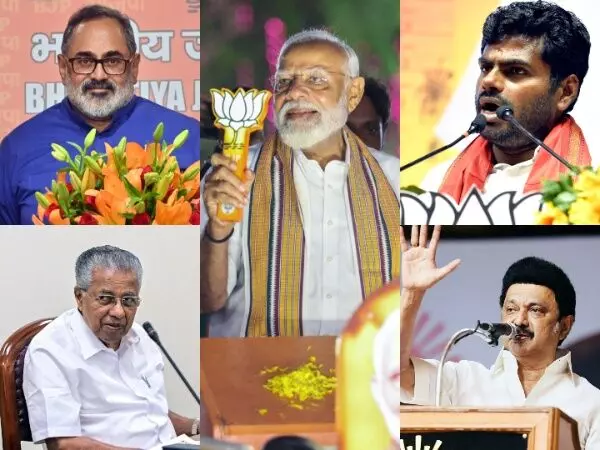
As India’s election season gathers momentum, Prime Minister Narendra Modi’s recent visits to Kerala and Tamil Nadu have reignited a familiar political refrain: the promise of a “double-engine government.” The metaphor, deployed with increasing frequency in states facing assembly elections, suggests that having the Bharatiya Janata Party or its National Democratic Alliance allies governing both at the Centre and in individual states will accelerate development and prosperity. Yet this seductive narrative demands closer scrutiny, particularly when confronted with the empirical reality of India’s federal structure and the performance of opposition-ruled states.
The double-engine concept rests on a simple premise: political alignment between the Centre and states should theoretically facilitate smoother coordination, faster approvals, and preferential resource allocation. Like two engines pulling a train in the same direction, the argument goes, governance becomes more efficient when both levels of government share political objectives and party affiliations. This reasoning has become a cornerstone of the BJP’s electoral strategy in states where it seeks to expand its footprint or consolidate existing power.
However, Tamil Nadu Chief Minister M.K. Stalin has posed a question that cuts to the heart of this narrative: how are opposition-ruled states managing to perform well without this supposed advantage? The query is not merely rhetorical. Several states governed by parties outside the NDA fold have demonstrated robust economic growth, effective welfare delivery, and innovative governance models, often outperforming their BJP-ruled counterparts on multiple development indicators.
The fundamental flaw in the double-engine argument lies in its misunderstanding of how India’s federal system actually functions. Constitutional provisions, statutory frameworks, and institutional mechanisms already exist to ensure cooperation between the Centre and states, regardless of political affiliation. Finance Commission awards, central scheme allocations, and disaster relief funds operate according to established formulas and criteria that transcend party politics. When these systems work as intended, political alignment becomes largely irrelevant to a state’s ability to access its rightful share of resources and support.
Moreover, the double-engine rhetoric implicitly threatens a troubling proposition: that states not governed by the ruling party at the Centre might face discrimination or disadvantage. This suggestion strikes at the foundation of India’s federal democracy, which is predicated on the principle that all states, regardless of their political leadership, deserve equal treatment and opportunity. If the promise of a double-engine government contains any truth, it simultaneously admits that single-engine states face systemic bias. This would be a confession of federalism’s subversion rather than a celebration of cooperative governance.
Evidence from recent years complicates the double-engine narrative considerably. Opposition-ruled states have not merely survived but often thrived, implementing successful welfare programs, attracting investment, and managing crises effectively. Kerala’s health infrastructure and social indicators, Tamil Nadu’s industrial development and social welfare schemes, and West Bengal’s rural development initiatives demonstrate that good governance does not require political alignment with the Centre. These states have leveraged their constitutional powers, mobilized resources creatively, and prioritized citizen welfare, often despite rather than because of their relationship with the central government.
The performance of these states raises uncomfortable questions about what the double-engine promise actually delivers. If political alignment were truly the key determinant of developmental success, one would expect to see consistent outperformance by BJP-ruled states across all metrics. The reality proves more complex. Development outcomes depend on numerous factors: administrative capacity, fiscal discipline, policy innovation, social capital, historical advantages, and leadership quality. Political party affiliation appears far down this list of determinants when rigorous analysis is applied.
Furthermore, the double-engine discourse risks reducing India’s vibrant federal democracy to a transactional spoils system where access to legitimate rights and resources depends on political loyalty.
Such a framework undermines the very institutions that make India’s democracy functional. The Planning Commission’s replacement with NITI Aayog, changes in the distribution of centrally sponsored schemes, and the restructuring of Centre-state financial relations have already raised concerns about increasing centralization. The explicit promotion of political alignment as a prerequisite for state prosperity amplifies these anxieties.
From a governance perspective, diversity in state governments often proves beneficial rather than detrimental to national development. Different parties experiment with varied approaches to common challenges, creating laboratories of democracy where successful innovations can be studied and replicated. Tamil Nadu’s midday meal scheme, Kerala’s decentralized planning model, and Chhattisgarh’s innovations in public distribution were all developed by state governments operating independently of the Centre’s political direction. This policy diversity enriches India’s governance ecosystem and provides alternatives when centralized approaches prove inadequate.
The double-engine argument also ignores the potential benefits of checks and balances that emerge when different parties govern different levels. Opposition-ruled states often scrutinize central policies more rigorously, demand accountability for resource allocations, and advocate for federalism’s strengthening. This dynamic tension, while sometimes creating friction, ultimately contributes to better policymaking and prevents the concentration of unchecked power.
Critics of the double-engine model do not argue that Centre-state cooperation is unimportant. Rather, they contend that such cooperation should flow from constitutional obligation and institutional design, not political convenience. India’s federal structure provides numerous forums (inter-state councils, zonal councils, and various ministerial committees) specifically designed to facilitate collaboration across political lines. Strengthening these institutions would serve the nation better than promoting political uniformity.
As voters in Kerala and Tamil Nadu prepare for their electoral decisions, they would do well to look beyond the double-engine metaphor to examine actual governance records. Questions worth asking include: Has the state government delivered on its promises? Have public services improved? Has development been inclusive? Has the government demonstrated fiscal responsibility and administrative competence? These practical considerations matter far more than abstract claims about political alignment.
The persistence of the double-engine narrative reflects broader trends in Indian politics: the increasing presidentialization of parliamentary democracy, the weakening of federal institutions, and the reduction of complex governance questions to simple partisan slogans. Countering this requires vigilance from voters, robust defense of federalism from state leaders across party lines, and media scrutiny that moves beyond rhetoric to examine actual governance outcomes.
India’s strength has always resided in its ability to accommodate diversity (linguistic, cultural, religious, and political). The double-engine model, by implying that uniform political control represents an ideal, threatens this pluralistic foundation. True progress lies not in political homogenization but in strengthening the institutional frameworks that allow all states, regardless of their political leadership, to access resources fairly and govern effectively. Only then can India’s federal democracy fulfill its promise of delivering prosperity and dignity to all citizens, everywhere.