The Hidden Economic Engine: How Migration Shapes Bihar’s Future
Explore the complex role of migration in Bihar's economy, its impact on local development, and the need for a nuanced approach to leverage its benefits.

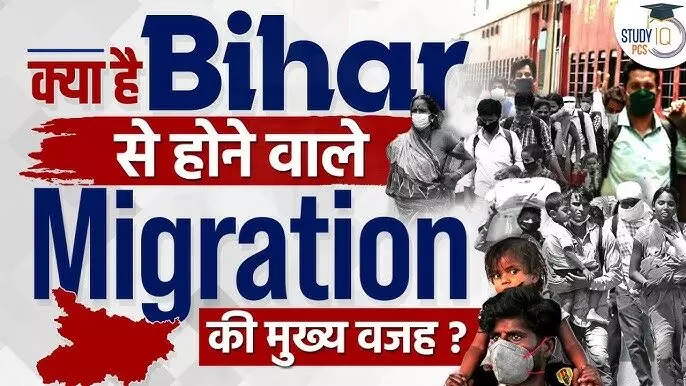
Images Credit -Study iq
Bihar stands at a fascinating economic crossroads. While much of India celebrates rapid urbanization and industrial growth, this eastern state tells a different story—one where migration, not manufacturing, has become the primary driver of economic transformation. Yet this reality is often misunderstood, dismissed as a sign of failure rather than recognized as a complex economic phenomenon with profound implications for Bihar’s workforce, families, and future.
The numbers tell an undeniable story. Bihar sends more migrants to other parts of India than perhaps any other state, with estimates suggesting that between 5 to 8 million Biharis work outside their home state at any given time. From construction sites in Delhi to textile mills in Surat, from agricultural fields in Punjab to service sectors across metropolitan India, Bihari workers form the backbone of the nation’s informal economy. This exodus is not merely a demographic trend; it is an economic lifeline that fundamentally reshapes how we must understand employment and prosperity in Bihar.
Critics often point to out-migration as evidence of Bihar’s economic failure—a state so lacking in opportunities that its youth must seek livelihoods elsewhere. This narrative, while emotionally compelling, misses the economic forest for the trees. The reality is that migration has become Bihar’s most successful export industry, generating more reliable foreign exchange than any manufacturing sector the state currently possesses.
Consider the remittances. Conservative estimates suggest that Bihari migrants send home between ₹50,000 to ₹1,00,000 crores annually. These are not abstract figures in government ledgers; they represent money that flows directly into Bihar’s villages and towns, bypassing inefficient bureaucracies and reaching families with unprecedented directness. This influx of capital has tangible effects: better housing, improved access to education, enhanced healthcare, and increased consumption that stimulates local economies.
In villages across Bihar, the transformative power of remittances is visible everywhere. Brick houses replace mud huts. Children attend private schools. Families can afford medical treatment that would have been unthinkable a generation ago. Local shops stock consumer goods that indicate rising purchasing power. This is not the economic stagnation critics describe; it is growth, albeit of a different character than traditional industrial development.
Yet the migration economy creates its own complexities. The departure of working-age men—and increasingly women—from Bihar creates a demographic imbalance with economic consequences. Agriculture suffers from labor shortages at crucial periods. Local enterprises struggle to find skilled workers. Villages become communities of the very young and the elderly, with the most productive demographic cohort absent for much of the year.
This absence also stunts local job creation in a paradoxical way. When families receive regular remittances, the urgency to develop local employment opportunities diminishes. Why risk capital on a local business when migration provides steady income? Why pressure the government for industrial development when survival is secured through earnings from Mumbai or Bangalore? The remittance economy can create a dependency that inhibits the very local economic development that might make migration unnecessary.
Furthermore, the skills and human capital that migrate out of Bihar represent an opportunity cost. Engineers, technicians, educated professionals, and entrepreneurial individuals who could be building Bihar’s economy instead build other states’ prosperity. The irony is acute: Bihar invests in education and skill development, only to see that investment benefit Maharashtra, Gujarat, or the National Capital Region.
However, dismissing migration as purely extractive ignores the return flows beyond mere money. Migrants bring back new skills, exposure to different work cultures, technological familiarity, and broader perspectives. Many return to Bihar with capital and knowledge to start businesses. The construction boom in Bihari towns owes much to returnee migrants who learned modern building techniques elsewhere. Small manufacturing units often reflect knowledge acquired in industrial centers.
The question Bihar faces is not whether to stop migration—that ship has sailed, and attempting to restrict labor mobility would be both impractical and ethically questionable. Rather, the challenge is how to leverage migration as a catalyst for sustainable local economic development rather than as a substitute for it.
This requires a fundamental reframing of economic policy. Bihar must recognize that its workers are a valuable export commodity and invest accordingly in their skills and protections. Better vocational training aligned with market demands in destination states would increase earning power and remittance flows. Legal support systems could protect migrant workers from exploitation. Financial infrastructure could facilitate cheaper, more efficient remittance transfers.
Simultaneously, the state must work to create what economists call “circular migration” patterns rather than permanent exodus. This means developing economic opportunities compelling enough to draw workers back, at least seasonally or eventually. Agricultural modernization could create higher-value work in rural areas. Small and medium enterprise development could absorb returning migrants. Infrastructure improvements could unleash entrepreneurial potential.
The goal should not be to stop Biharis from seeking opportunities elsewhere—that freedom of movement is both a constitutional right and an economic necessity. Rather, the objective should be ensuring that migration becomes a choice rather than the only option, and that it serves as a stepping stone to broader prosperity rather than a permanent crutch.
Bihar’s migration economy is neither purely beneficial nor entirely detrimental. It is a complex adaptation to economic realities that has lifted millions from poverty while simultaneously creating dependencies and draining local potential. Understanding this nuance is essential for crafting policies that maximize migration’s benefits while minimizing its costs.
The path forward requires acknowledging an uncomfortable truth: Bihar’s economic transformation will not follow the traditional industrial development model that worked for other states. Instead, it must chart a unique course that harnesses migration’s financial flows while gradually building the local economic ecosystem that can offer viable alternatives. This hybrid approach—embracing Bihar’s role in India’s labor markets while investing in homegrown opportunities—may be unconventional, but it reflects the economic reality of millions of Bihari families.
Migration is not Bihar’s problem. Properly managed and leveraged, it could be part of Bihar’s solution.