The State Strikes Back: How the Transgender Persons Amendment Bill 2026 Betrays a Community
"India's Transgender Persons Amendment Bill 2026 sparks outrage, removing self-identification rights and introducing medical certification, undermining Supreme Court judgment and perpetuating marginalization."

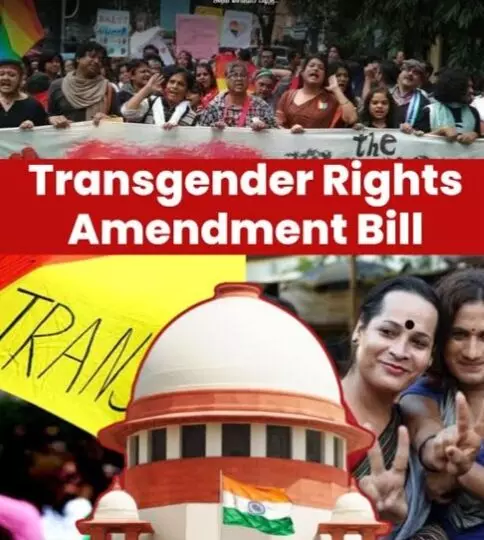
In 2014, the Supreme Court of India handed down one of its most humane judgments. In National Legal Services Authority v. Union of India, a bench of two judges recognized transgender persons as a third gender, affirmed their right to self-identification, and directed the state to treat them as a socially and educationally backward class deserving of affirmative action. It was a moment of rare institutional generosity, a court telling a long-persecuted community that the Constitution of India belonged to them too.
Twelve years later, the Union Government appears determined to claw that promise back.
The Transgender Persons Amendment Bill 2026 is not a reform. It is a regression dressed in the language of administration. And the manner of its drafting is as alarming as its content. Reports have confirmed what many activists long suspected: the government drafted these amendments without consulting the National Council for Transgender Persons, the very statutory body created to advise it on transgender welfare. A national council, constituted by law, was bypassed. That is not an oversight. That is a statement of intent.
The Violence of the Medical Gate
At the heart of the amendment lies a proposal that should outrage every civil libertarian in this country: the removal of self-identification as the basis for legal gender recognition, replaced by mandatory medical examination.
Let us be precise about what this means. Under the current framework, imperfect as it is, a transgender person can approach a district magistrate and assert their identity. The 2026 amendment would interpose a doctor between a person and their own legal existence. A panel of medical professionals, armed with the authority of the state, would determine whether someone is sufficiently, provably, measurably transgender before the law will acknowledge who they are.
This is not medicine. It is gatekeeping. It echoes the discredited pathologisation of transgender identity that the global medical community, including the World Health Organisation, has spent decades dismantling. The WHO removed gender incongruence from its list of mental disorders in 2019. India’s proposed amendment would, in practice, re-medicalise an identity that is fundamentally a matter of self-knowledge.
The practical consequence is stark: these requirements ignore the realities of poverty and healthcare access. The transgender community in India faces some of the most acute economic marginalisation of any group. Unemployment, family rejection, housing insecurity, and the denial of education compound into a cycle that leaves a significant proportion of transgender persons without reliable access to hospitals, specialists, or bureaucratic infrastructure. A mandatory medical examination is not a neutral procedural requirement. For the poor, it is a wall. The law would, in effect, reserve legal gender recognition for those with the resources to navigate a medicalised process. The rest would remain legally invisible.
NALSA’s Promise, Amended Away
The NALSA judgment was not merely symbolic. It created enforceable entitlements. It said that transgender persons had the right to identify their gender without surgery or medical intervention, that they were entitled to reservations in education and public employment, and that the state had an affirmative obligation to address the discrimination they faced.
The 2026 amendment does not engage with this jurisprudence. It circumvents it. By making medical examination mandatory, the bill places administrative diktat above constitutional interpretation. Parliament is, of course, entitled to legislate. But legislation that contradicts a Supreme Court ruling on fundamental rights is not ordinary legislation. It is a constitutional confrontation, and it is one the government has chosen to pick with the most vulnerable community in the country.
The nationwide protests that have greeted this bill are not merely an expression of anger. They are a constitutional argument made in the streets, by people who have learned, correctly, that formal channels do not always protect them.
The Exclusion of Trans Men and the Narrowing of Recognition
Among the bill’s less-discussed failures is the continued exclusion of trans men from its protective provisions. This is not a technical gap. It reflects a deeper conceptual failure in how the state imagines transgender identity, reducing it to a narrow and often caricatured understanding that centres trans women while rendering trans men legally and socially invisible. A rights framework that excludes half the community it claims to protect is not a framework at all. It is a selective concession.
Disproportionate Sentencing and the Signal It Sends
The bill also introduces sentencing provisions for crimes against transgender persons that are conspicuously disproportionate when compared to equivalent offences against cisgender victims. The message embedded in this disparity is ugly and unmistakable: that violence against a transgender person is, in the law’s estimation, a lesser harm. At a time when crimes against transgender individuals remain dramatically underreported and prosecuted, weakening the deterrent framework is not a neutral administrative choice. It is an abdication.
What Parliament Must Do
Activists and council members have signalled clearly that they cannot, in conscience, lend institutional credibility to a government that bypasses its own advisory bodies when crafting policy, and then uses their existence as evidence of inclusive governance. That signal deserves to be taken seriously.
The plea to Members of Parliament is straightforward. This bill, if passed, will face immediate constitutional challenge. More importantly, it will cause immediate human harm to real people whose daily lives are already defined by exclusion, poverty, and violence.
Parliament has before it a choice between two versions of the Indian Constitution: one that reads Article 21 as a living guarantee of dignity to every person on Indian soil, and one that reads it as a conditional offer, extended and retracted at administrative convenience.
The transgender community of India is not asking for charity. It is asserting citizenship. The least Parliament can do is listen.