The Tianjin Triangle: Modi’s China Visit Reshapes Asian Geopolitics
At the Tianjin SCO summit, Modi, Xi, and Putin reshaped Asian geopolitics, signaling a strategic shift in India-China ties and Russia’s pivot to Asia.

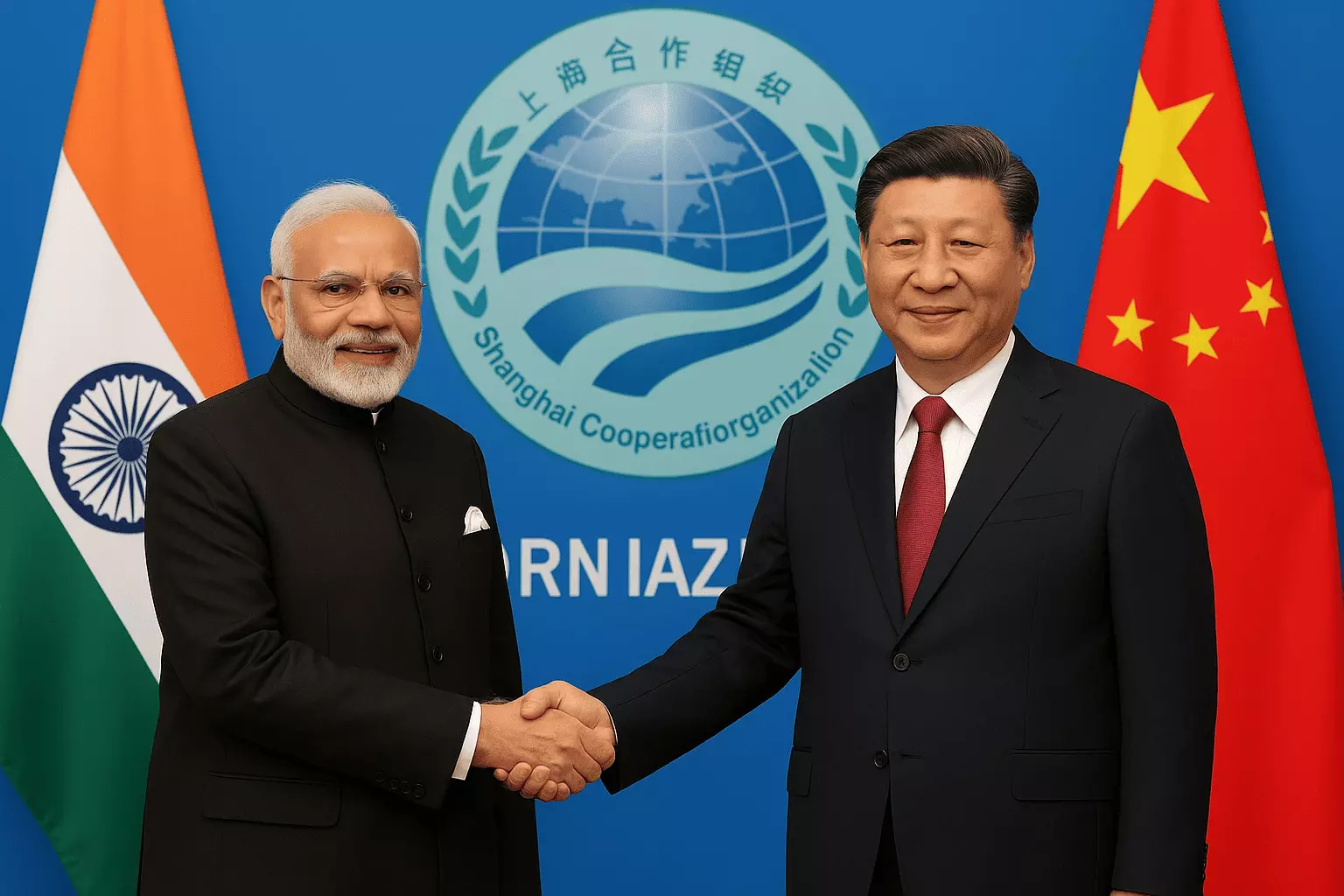
The Shanghai Cooperation Organization (SCO) summit in Tianjin, China, from August 31 to September 1, 2025, marked a watershed moment in Asian geopolitics. For the first time in seven years, Indian Prime Minister Narendra Modi set foot on Chinese soil, engaging in high-stakes diplomacy with Chinese President Xi Jinping and Russian President Vladimir Putin. This trilateral convergence in Tianjin represents far more than routine multilateral diplomacy—it signals a potential recalibration of the Asian balance of power and a pragmatic response to the evolving global order under renewed American protectionism.
*The Diplomatic Thaw: From Galwan to Tianjin*
Modi’s presence in China marks a dramatic shift from the nadir of India-China relations following the deadly Galwan Valley clashes in 2020. The bilateral meeting between Modi and Xi Jinping—their first on Chinese soil since the 2018 Wuhan summit—represents a calculated diplomatic gambit by both leaders to compartmentalize territorial disputes while pursuing broader strategic interests.
This rapprochement is driven by compelling geopolitical realities. Both nations face mounting pressure from renewed American trade wars and strategic containment policies under the Trump administration’s return to office. The shared challenge of navigating an increasingly protectionist United States has created unexpected common ground between the world’s two most populous nations, despite their unresolved border disputes and strategic competition.
The timing is particularly significant. With President Trump launching aggressive trade policies and threatening to weaponize tariffs against major economies, China and India recognize the strategic value of reducing bilateral tensions while strengthening multilateral frameworks that can provide alternative pathways for economic cooperation and political coordination.
*Putin’s Pivot: Russia’s Asian Gambit*
Vladimir Putin’s prominent role at the SCO summit underscores Russia’s strategic pivot toward Asia following its isolation from Western institutions. Putin’s bilateral meetings with both Modi and Xi highlight Moscow’s desire to leverage its relationships with major Asian powers to maintain global relevance and economic viability despite ongoing sanctions related to the Ukraine conflict.
For Russia, the SCO represents a crucial platform for demonstrating that it remains a significant player in global affairs, capable of convening major world leaders and shaping regional security architectures. Putin’s engagement with Modi particularly signals Russia’s intent to maintain its historically strong relationship with India despite New Delhi’s evolving strategic partnerships with Western powers.
The Russia-India energy cooperation discussions at the summit reflect broader geopolitical realignments. As Europe reduces its dependence on Russian energy, Moscow has increasingly looked to Asian markets, with India becoming a major buyer of Russian oil at discounted prices. This economic relationship provides both countries with strategic flexibility—Russia gains crucial revenue streams while India secures energy security at competitive prices.
*The SCO’s Strategic Evolution*
The SCO has transformed from its original focus on regional security cooperation into a broader platform for challenging Western-dominated global governance structures. The organization now encompasses roughly 40% of the world’s population and represents a significant portion of global GDP, making it impossible for Western powers to ignore.
The 2025 Tianjin summit demonstrated the SCO’s evolution into what some observers describe as an “anti-Western bloc,” though this characterization oversimplifies its diverse membership and varying national interests. More accurately, the SCO represents an alternative multilateral framework that allows member states to pursue interests that may diverge from Western priorities without necessarily adopting an adversarial stance.
The inclusion of countries like Turkey as a dialogue partner and the potential expansion to include more Middle Eastern and African nations signals the SCO’s ambition to become a truly global alternative to Western-led institutions. This expansion reflects broader trends in international relations, where middle powers are increasingly seeking platforms that offer greater agency and representation than traditional Western-dominated organizations.
*India’s Strategic Balancing Act*
Modi’s participation in the SCO summit exemplifies India’s sophisticated approach to multi-alignment in an increasingly polarized world. New Delhi’s strategy involves maintaining strategic autonomy while engaging with multiple power centers, refusing to be forced into rigid bloc politics that could compromise its national interests.
India’s relationship with both China and Russia presents unique challenges and opportunities. While border tensions with China remain unresolved, both countries recognize the economic benefits of managed competition rather than open confrontation. Similarly, India’s continued engagement with Russia despite Western pressure demonstrates New Delhi’s commitment to strategic independence and its recognition that global partnerships cannot be dictated by third parties.
The Modi-Xi bilateral meeting produced commitments to resolve border differences through existing mechanisms, suggesting both sides recognize that territorial disputes need not preclude broader cooperation in areas of mutual interest. This pragmatic approach reflects mature statecraft that prioritizes long-term strategic stability over short-term tactical advantages.
*Implications for Global Order*
The Tianjin summit occurs against the backdrop of accelerating changes in the global order. The return of great power competition, the fragmentation of global supply chains, and the weaponization of economic interdependence have created new imperatives for middle powers to diversify their strategic partnerships and reduce dependencies on any single power center.
The convergence of Modi, Xi, and Putin in Tianjin signals the emergence of alternative governance structures that may increasingly compete with Western-led institutions. While these leaders represent different political systems and have varying relationships with Western powers, their willingness to engage in sustained multilateral cooperation reflects a shared interest in maintaining strategic autonomy in an increasingly constrained global environment.
This development has significant implications for American foreign policy. The Biden administration’s emphasis on rally democratic allies against authoritarian competitors may have inadvertently pushed diverse nations toward alternative platforms where they can pursue interests without ideological constraints. The Trump administration’s renewed emphasis on bilateral trade wars and alliance burden-sharing may further accelerate this trend.
*Economic Dimensions and Future Trajectories*
Beyond the political symbolism, the SCO summit addressed substantive economic cooperation initiatives. Discussions on energy cooperation, trade facilitation, and currency arrangements reflect member states’ desires to reduce dependence on Western financial systems and create alternative mechanisms for economic interaction.
The potential development of SCO-based payment systems and trade mechanisms could provide member states with greater insulation from Western sanctions and economic pressure. While these initiatives remain in early stages, they represent serious attempts to create parallel economic architectures that could reshape global trade patterns.
*Pragmatism Over Ideology*
The Tianjin summit demonstrates that in an era of renewed great power competition, pragmatic statecraft often trumps ideological alignment. Modi’s willingness to engage with both Xi and Putin, despite significant policy differences and strategic competition, reflects a mature understanding that sustainable security and prosperity require engagement across the full spectrum of international relationships.
As the global order continues to evolve, the SCO’s ability to facilitate dialogue among diverse powers while managing fundamental disagreements may prove increasingly valuable. The challenge for all participants will be ensuring that this pragmatic cooperation contributes to global stability rather than exacerbating existing divisions.
The success of the Tianjin summit should be measured not by the elimination of strategic competition among its participants, but by their demonstrated ability to manage competition while cooperating on shared interests. In an increasingly complex and multipolar world, such diplomatic sophistication may prove essential for preventing competition from escalating into destructive confrontation.