Trump’s “Dead Economy” Jab at India: A Dangerous Diplomatic Miscalculation
US President Donald Trump's characterization of India's economy as "dead" sparks concern, as India's economy is projected to grow at 6.4% in 2025 and 2026, outpacing the US.

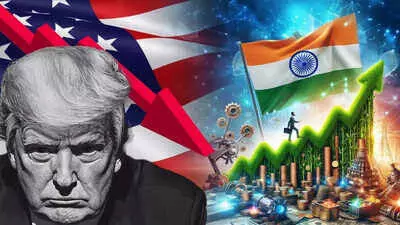
U.S. President Donald Trump’s recent characterization of India as having a “dead economy” represents more than just diplomatic hyperbole—it reveals a profound misunderstanding of global economic realities and threatens to undermine America’s strategic interests in the Indo-Pacific region. “I don’t care what India does with Russia. They can take their dead economies down together, for all I care,” Trump declared on social media, coupling his economic assessment with criticism of India’s relationship with Russia and complaints about high Indian tariffs.
This rhetorical broadside against the world’s most populous nation and one of its fastest-growing major economies demonstrates either a startling ignorance of economic data or a willful disregard for facts in favor of political theater. Either interpretation should concern Americans who value informed foreign policy decision-making.
*The Numbers Don’t Lie*
The assertion that India possesses a “dead economy” flies in the face of virtually every credible economic indicator. India’s economy is projected to grow at 6.4% in both 2025 and 2026, while the US is expected to grow at 1.9% and 2%, respectively, according to the International Monetary Fund’s latest World Economic Outlook. This means India is growing at more than three times the rate of the United States—hardly the performance of a moribund economy.
At $4.19 trillion, India surpassed Japan as the fourth-largest economy in the world in 2025, positioning itself behind only Germany, China, and the United States. More significantly, India is projected to become the world’s third-largest economy by 2030, a trajectory that would place it ahead of Germany and firmly establish it as an economic superpower.
These figures paint a picture of an economy that is not merely alive but vibrantly expanding, driven by a young demographic dividend, increasing digitization, and growing manufacturing capabilities. India’s economic dynamism has made it a preferred destination for global investment and a critical link in international supply chains—hardly characteristics of a “dead” economy.
*Strategic Blindness in the Indo-Pacific*
Trump’s cavalier dismissal of India’s economic significance reveals a dangerous blind spot in America’s approach to the Indo-Pacific region, where China’s growing influence represents the century’s defining geopolitical challenge. India serves as a natural counterweight to Chinese hegemony, sharing democratic values and strategic concerns about Beijing’s expansionist ambitions. The Quad partnership between the United States, India, Japan, and Australia has emerged as a cornerstone of regional stability and economic cooperation.
By alienating India through inflammatory rhetoric and threatened tariffs, Trump risks pushing New Delhi toward greater alignment with alternative power centers, including the very Russia he criticizes India for maintaining ties with. This would represent a colossal strategic mistake, potentially fracturing the democratic coalition needed to maintain balance in the region.
India’s relationship with Russia, while problematic from Washington’s perspective, reflects historical ties and pragmatic energy needs rather than ideological alignment. India has maintained strategic autonomy throughout the Cold War and beyond, refusing to become anyone’s junior partner. This independence, rather than being cause for American condemnation, should be understood as a strength that prevents any single power from dominating South Asia.
*Economic Realities vs. Political Rhetoric*
The irony of Trump’s “dead economy” comment becomes apparent when examining bilateral trade dynamics. While Trump complains about India’s high tariffs, the United States maintains its own complex web of trade barriers and has historically used economic coercion as a diplomatic tool. The solution to trade imbalances lies in negotiation and mutual accommodation, not in inflammatory rhetoric that poisons the well of future cooperation.
Moreover, Trump’s focus on traditional trade metrics ignores the deeper economic integration between the two nations. Indian companies have invested billions in American operations, creating hundreds of thousands of jobs. The Indian diaspora in the United States represents one of the most successful immigrant communities, contributing significantly to American innovation, entrepreneurship, and economic growth. This human capital flow represents a form of economic partnership that transcends simple import-export calculations.
The Cost of Diplomatic Malpractice
Presidential words carry weight on the global stage, and Trump’s careless characterization of India’s economy will have consequences beyond the immediate diplomatic friction. International investors pay attention to such statements, and uncertainty about U.S.-India relations could affect global supply chain decisions and investment flows.
Furthermore, such rhetoric plays directly into the hands of America’s competitors. China has spent decades cultivating relationships across the Global South through patient diplomacy and economic engagement. When the United States appears dismissive or hostile toward major developing economies, it creates opportunities for Beijing to position itself as a more reliable partner.
The timing of Trump’s comments is particularly unfortunate given India’s growing role in global governance. India holds significant influence in forums like the G20, BRICS, and various United Nations bodies. Alienating such a partner at a moment when the international system faces multiple crises—from climate change to technological governance—represents a failure of strategic thinking.
*A Path Forward*
Rather than dismissing India’s economic achievements, American leadership should recognize the tremendous opportunities that India’s growth presents. A thriving Indian economy means a larger market for American goods and services, more opportunities for bilateral investment, and a stronger democratic partner in addressing global challenges.
The United States and India share fundamental interests in maintaining an open, rules-based international order. Both nations benefit from free trade, technological innovation, and peaceful resolution of disputes. These common interests provide a foundation for partnership that transcends temporary political disagreements or trade disputes.
Trump’s “dead economy” comment about India reveals more about American diplomatic shortcomings than Indian economic realities. At a time when the United States needs all the friends it can get in navigating an increasingly complex global landscape, alienating one of the world’s most dynamic economies through ill-informed rhetoric represents a self-inflicted wound.
The U.S. president would serve American interests better by acknowledging India’s economic achievements and working constructively to address legitimate trade concerns through dialogue rather than disparagement. In an interconnected world, dismissing major economies as “dead” when they are clearly very much alive reflects a dangerous detachment from reality that America can ill afford.