Agni Pariksha for Nitish as Ministers Face Corruption Heat
Bihar CM Nitish Kumar faces credibility test as key ministers face graft charges from Prashant Kishor, rocking JD(U) government.

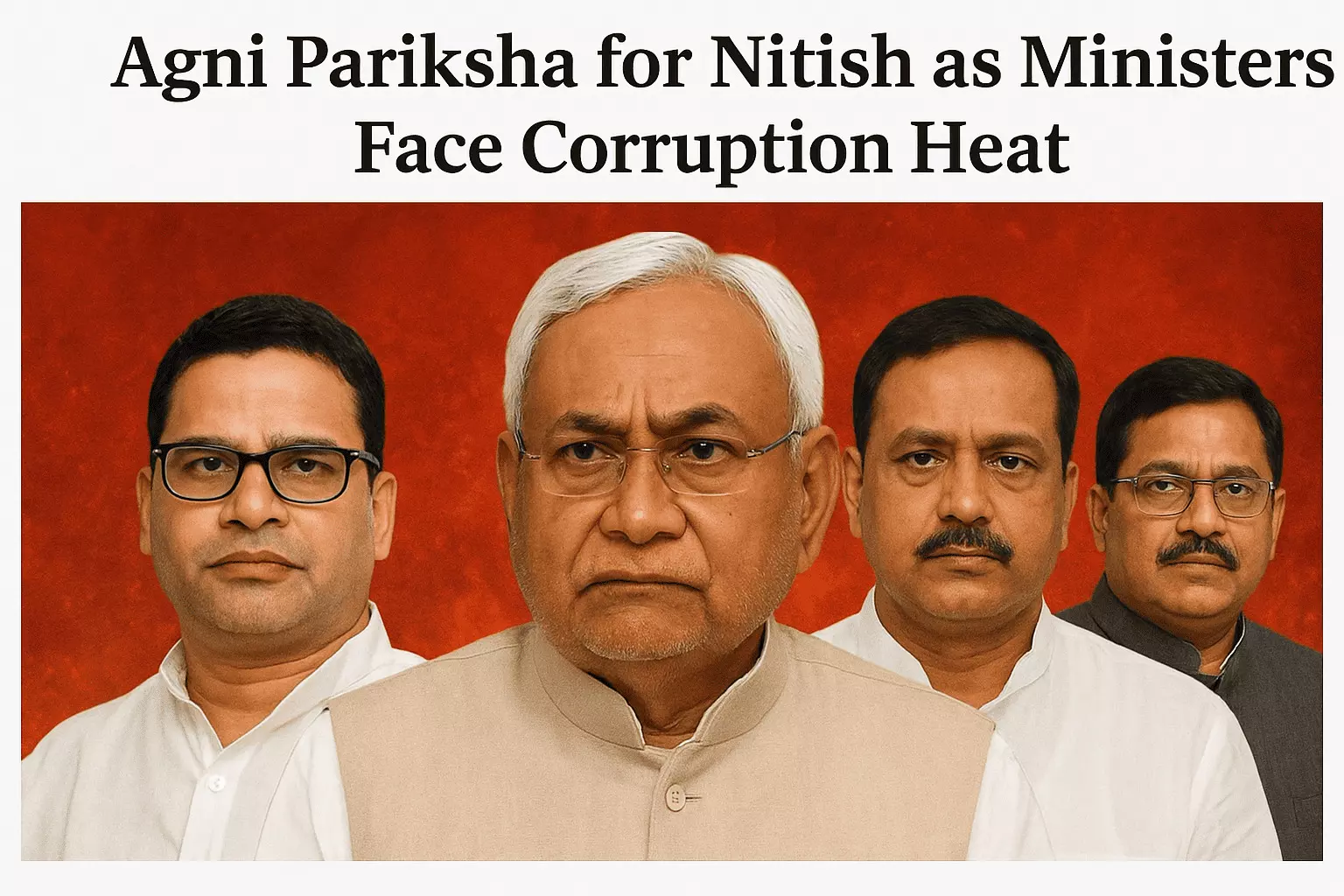
Patna: Bihar Chief Minister Nitish Kumar, long celebrated for his “zero-tolerance” stance on corruption, faces perhaps the toughest credibility test of his two-decade tenure. Three senior members of his cabinet stand accused of serious graft by Jan Suraj Party chief Prashant Kishor, once Nitish’s own trusted strategist and a former JD(U) vice-president with cabinet rank.
Kishor alleged that Deputy Chief Minister Samrat Chaudhary falsified his educational record, producing Bihar School Examination Board papers to claim Chaudhary had failed matriculation despite presenting himself as a “DLitt from California.”
The sharpest charge targets Ashok Kumar Chaudhary, senior JD(U) leader and Rural Development Minister. Kishor called him the “most corrupt (bhrashttam) minister,” accusing him of buying land worth ₹200 crore over two years. He likened the case to RJD chief Lalu Prasad’s land-for-jobs scandal, citing a plot at Vikram on Patna’s outskirts allegedly purchased for ₹35 lakh in the name of Chaudhary’s personal assistant, later transferred to his daughter for ₹10 lakh. After an Income Tax notice, Kishor said, the minister deposited an additional ₹25 lakh in the state treasury on April 25, 2025.
Health Minister Mangal Pandey is also in the line of fire. Kishor alleged that during the height of the Covid-19 pandemic Pandey bought a New Delhi flat for ₹4.5 crore, claiming he had borrowed ₹10 lakh from the then state party president. Kishor released what he said was a bank statement showing ₹2.24 crore in the account of Pandey’s homemaker wife.
For the first time, Nitish’s hallmark anti-corruption plank is openly questioned within his own party. JD(U) principal spokesman Neeraj Kumar described the situation as an “agni pariksha” for the chief minister, urging the accused ministers to explain themselves. He recalled Nitish’s 2017 move to seek answers from then deputy CM Tejashwi Yadav after Enforcement Directorate raids; when no response came, Nitish broke with the RJD.
Nitish’s record shows swift action against tainted colleagues: Jeetan Ram Manjhi was dropped within a day of taking oath in 2005, Ram Narain Singh within two days after a vigilance inquiry, and Kartikeya Singh within a week. Governors in the past have dismissed ministers—Lallan Singh and P.K. Shahi—on Nitish’s recommendation.
Bihar’s political history is dotted with similar scandals. In the 1970s, Governor R.D. Bhandare publicly accused three ministers in Abdul Gafoor’s cabinet of corruption. Judicial inquiries—the Justice Aiyar and Justice Mudholkar commissions—probed charges that felled five Congress ministers under K.B. Sahay and later seven in Mahamaya Prasad Sinha’s ministry.
Today, with Prashant Kishor’s allegations reverberating and the opposition sharpening its attack, Nitish Kumar’s famed reputation for probity faces its sternest trial yet.