Bihar 2025: The Election Where Manifestos Lost Their Voice
The 2025 Bihar Assembly elections mark a shift from manifestos to personal rivalries and alliance politics. With Nitish Kumar, Tejashwi Yadav, and Chirag Paswan battling survival, Bihar’s democracy faces a test of endurance and trust.

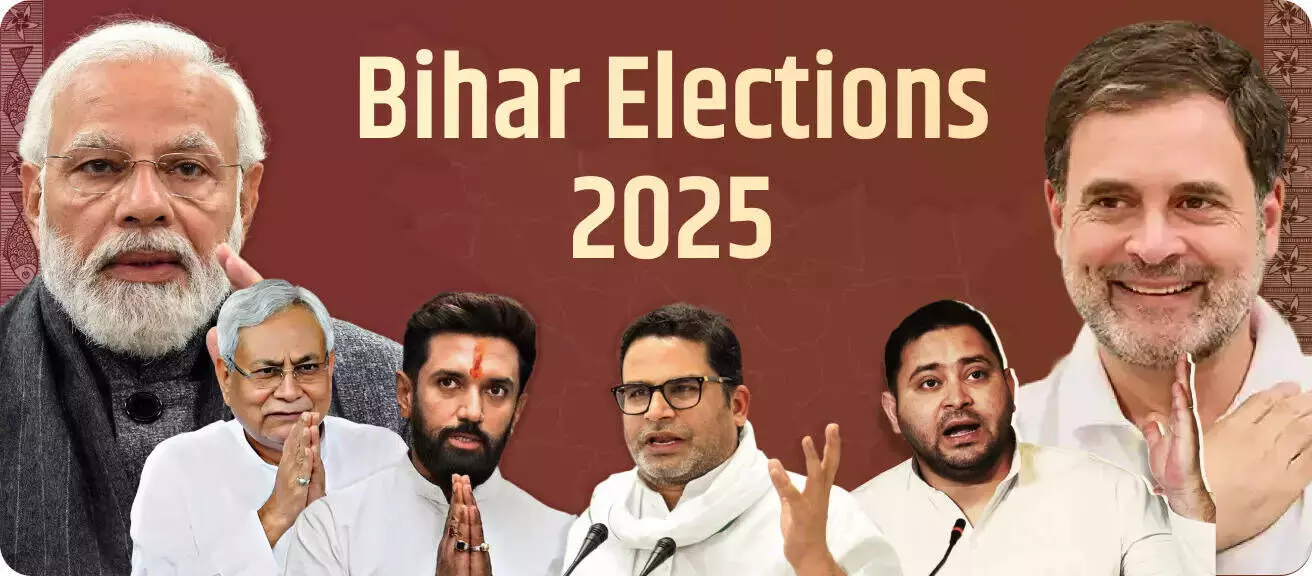
Images Credit - TOI
Politics in Bihar has never been simple—but this election has redefined the complexity of democratic contests. The 2025 Bihar Assembly polls have emerged as a battlefield where manifestos have lost their voice and personal vendettas, alliances, and survival instincts have taken over the discourse. It is perhaps the only election where leaders are speaking more about their rivals than about their own vision for the state. Neither the NDA nor the INDIA alliance has projected a coherent ideological roadmap. Instead, the election narrative revolves around blame, betrayal, and the uncertain arithmetic of caste and coalition.
The irony is deep-rooted. Once hailed as the architect of Bihar’s modern development, Nitish Kumar now finds himself cornered by the very forces he once empowered. The slogan that once electrified the NDA—“Abkwoi baare Nitishe Kumare”—has evaporated into political amnesia. The BJP, once his strongest partner, appears intent on scripting his political obituary. But Nitish is not a man to surrender easily. The shrewd strategist in him has started moving the pieces with precision, countering his detractors by quietly disarming their allies.
Chirag Paswan, the self-proclaimed torchbearer of his father’s legacy, is Nitish’s first target. Though Paswan remains in the NDA, his relations with Nitish have been frosty since the 2020 elections. Nitish, reading the political map carefully, began fielding JD(U) candidates in seats allocated to Chirag’s faction—essentially challenging his relevance within the alliance. Political observers recall how Chirag tried a similar experiment in 2020 when he fielded candidates against JD(U) nominees while pretending to support the BJP. That move had weakened Nitish’s position but failed to give Chirag any substantial gain. This time, Nitish seems determined to return the favor.
Experts believe that if Chirag fails to secure more than 20 seats, his bargaining power will shrink drastically, possibly limiting his influence even in the Lok Sabha. In contrast, smaller allies like Upendra Kushwaha and Jitan Ram Manjhi, once Nitish’s critics, have surprisingly turned loyal, sensing the changing wind in Patna’s corridors of power.
On the other side, Tejashwi Yadav’s RJD is struggling to manage the INDIA alliance’s seat-sharing turbulence. The Congress, though a minor player in Bihar’s electoral chessboard, refused to succumb to RJD’s bargaining pressure, leading to multiple friendly contests in key constituencies. Within the Congress, discontent brews quietly—many leaders are frustrated with the party’s weak position and the leadership’s indecision.
For Tejashwi, however, this election is a battle for political survival. After years of positioning himself as the face of Bihar’s youth and development, he now faces an existential test. Failure to reclaim power would not only shake the RJD’s credibility but also trigger a severe funding and leadership crisis within the party. Interestingly, the RJD’s own house shows cracks. Tej Pratap Yadav, the elder son of Lalu Prasad, has been sidelined—his political eccentricity proving too costly for the party’s serious campaign narrative. In a dramatic twist, RJD even fielded a candidate from Mahua, the very seat Tej Pratap had claimed as his stronghold, signaling the leadership’s desperation to assert control and discipline. The Congress, too, has found itself marginalized within the INDIA bloc, with limited seats and limited relevance.
What makes this election truly unique is the absence of any constructive political agenda. No major party has presented a clear manifesto that addresses Bihar’s pressing issues—employment, education, migration, or healthcare. Instead, campaign speeches are dominated by accusations, counter-accusations, and alliance politics. Every rally echoes the names of rivals rather than policies or promises. The rhetoric of “Jan Suraj” (Good Governance) floated by Prashant Kishor has also entered the fray, further fragmenting the political landscape. Kishor’s movement, though yet to transform into a full-fledged political force, has forced traditional players to rethink their strategies.
Political commentators argue that this election marks the end of ideological politics in Bihar and the beginning of pure political pragmatism. National parties like the BJP and Congress seem detached from Bihar’s local realities, their central leaderships more focused on power arithmetic than people’s aspirations. Regional players, meanwhile, are locked in battles of ego and survival. The voters, who once decided elections on slogans and visions, are now left to choose between fractured promises and fading trust.
As the campaign accelerates, one truth becomes evident: Bihar’s 2025 election is not about who will win—it is about who will survive. The battle has moved beyond manifestos and development; it is now a contest of endurance, betrayal, and political resurrection. In this theatre of shifting loyalties and broken slogans, Bihar’s democracy stands at a crossroads—searching for a voice that speaks not of alliances, but of the people.