BTR 2025 Elections: From Jhumjhum Legacy to Inclusion Politics
Bodoland’s 2025 vote weighs peace, parity, and political power after decades of ethnic tension.

When the Bodoland Territorial Region (BTR) goes to the polls in 2025, it will do so under the lingering shadow of Operation Jhumjhum. Conceived in the mid-1980s as a covert manoeuvre to fracture pan-Assamese unity after the Assam Movement, the operation altered the ethnic balance of Lower Assam. The Bodo-dominated forest belts became the epicentre of militancy, spawning armed movements like the BLT and NDFB.
What began as a strategy of political containment left an enduring paradox: autonomy for one group, inequity for many others.
The creation of the Bodoland Territorial Council (BTC) in 2003, under the Sixth Schedule, was intended as the full stop to the insurgent phase. It brought peace but not parity. In several BTC constituencies, Bodos became demographic minorities yet retained overwhelming political control. Non-Bodos—Assamese-speaking Hindus, Adivasis, Nepali Gorkhas, Bengali Hindus, and Muslims—remained excluded from crucial decisions on land, employment, and governance.
It is on this unresolved terrain that the 2025 battle will be fought.
The Players and the Stakes
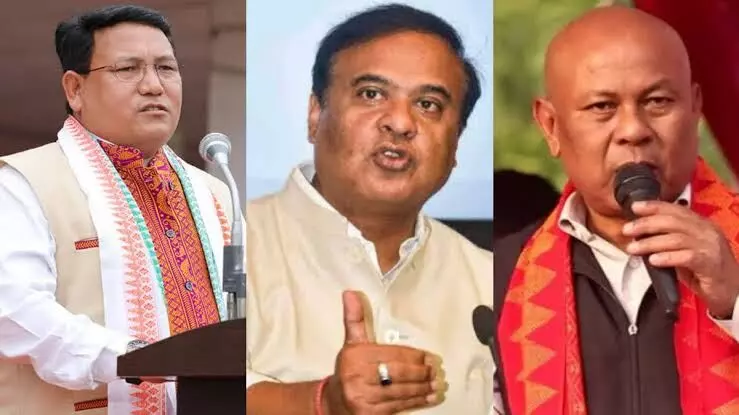
On one side stands Promod Boro’s United People’s Party Liberal (UPPL), buoyed by the 2020 Bodo Accord and presenting itself as the pragmatic custodian of peace and development. Facing them is Hagrama Mohilary’s Bodoland People’s Front (BPF), appealing to Bodo pride and nostalgia for a time when ethnic dominance was uncontested.
Hovering above the contest is Chief Minister Himanta Biswa Sarma, balancing roles—partnering with the UPPL to preserve the peace compact, while boldly promising “no second-class citizens” in the BTC. For non-Bodo voters, this is a rare glimmer of hope for political parity; for some Bodo hardliners, it signals a shift in the delicate balance of power.
The Congress–AIUDF combine waits at the fringes, eyeing minority votes and disaffected non-Bodo communities, though hampered by a weak ground network.
---
RSS Coalition Politics – An Inversion of Jhumjhum
If Operation Jhumjhum sought fragmentation in the 1980s, the RSS strategy in 2025 aims for consolidation—specifically, a four-cornered Hindu coalition across Assam’s diversity:
Nepali Gorkhas, assured they are not “foreigners” and shielded from NRC stigma.
Bengali Hindus, safeguarded by the Citizenship Amendment Act from D-voter uncertainty.
Adivasis and tea-tribe communities, courted with promises of ST status and targeted welfare.
Assamese-speaking Hindus, anchored with rhetoric on law, order, and cultural heritage.
This approach is carefully mapped onto BTR’s political geography. In alliance with the UPPL for the core Bodo vote, the BJP seeks to draw in the non-Bodo Hindu swing—reversing the old Jhumjhum logic by knitting communities into a single saffron umbrella.
---
Bhutan, China, and the Frontier Calm
BTR’s stability is linked in part to the Bhutan frontier. Bhutan’s Operation All Clear in 2003–04 uprooted NDFB and ULFA camps, paving the way for peace in western Assam. But Bhutan–China boundary talks remain a geopolitical wildcard. Any compromise near Doklam could unsettle India’s security calculus, revive border anxieties, and indirectly reignite ethnic mobilisation in BTR—a region where insurgency once fed on perceptions of neglect and vulnerability.
---
The Phoenix in the Ashes
The NDFB stands disbanded, its factions neutralised, its most prominent leader Ranjan Daimary serving a life sentence. The jungle camps are gone; the guns largely silent. Yet the metaphorical “phoenix” of Bodo militancy still exists—not as a call to arms, but as latent political alienation awaiting a trigger.
If HBS’s inclusion promises translate into tangible change—secure land titles, fair representation, and visible opportunities—the phoenix may settle into the normal give-and-take of electoral politics. But if these pledges remain hollow, resentment could find its outlet at the ballot box.
---
From Jhumjhum to Inclusion—or Back Again?
The 2025 BTR polls are more than a contest for council seats—they are a referendum on Assam’s federal imagination. From the divisive legacy of Operation Jhumjhum to the RSS’s integrative gambit, the trajectory bends towards inclusion, but only if rhetoric is matched by results.
If the BJP–UPPL alliance delivers, it could cement a new equilibrium—peace anchored in Bodo pride, stability underpinned by non-Bodo parity. If it falters, the embers of grievance could glow again. In that case, the phoenix may not roar with the war cries of the past, but with the quiet, decisive rebellion of the ballot.