CAA Camps in Bengal, Silence in Bihar: Commission’s Betrayal of Neutrality
The Election Commission's silence on BJP's CAA campaign in Bengal raises concerns of neutrality and electoral integrity.

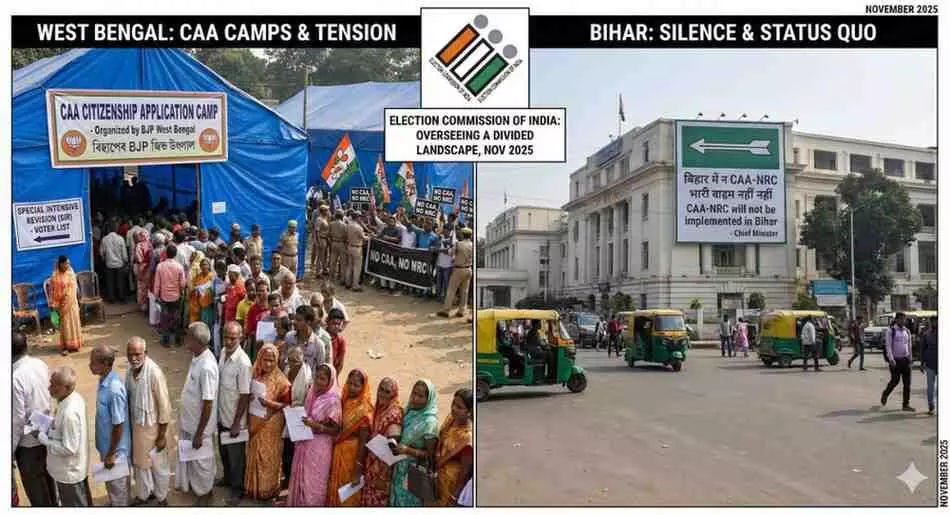
The BJP’s Citizenship Amendment Act (CAA) campaign in Bengal, launched in the midst of election season, is not simply a matter of political messaging—it is a calculated attempt to dominate the narrative. By opening camps and employing saffron and velour symbolism, the party deliberately polarizes voters. Yet the Election Commission, whose constitutional duty is to safeguard neutrality, remains conspicuously silent. This silence is not neutrality; it is negligence.
In Bengal, where migration and identity are politically charged, the BJP has chosen to foreground CAA as urgent. The symbolism is designed to evoke fear and consolidate votes. But in Bihar, the same issue vanishes. There, money power and caste equations dominate, and CAA is not projected as a central concern. This selective emphasis reveals the truth: CAA is not being treated as a consistent national policy but as a tactical weapon deployed where it can yield maximum electoral dividends. If the Act were genuinely essential, it would have been campaigned uniformly across states. Its absence in Bihar exposes its opportunistic use as propaganda rather than governance.
The Election Commission’s role in this scenario is deeply troubling. Constitutionally mandated to ensure free and fair elections, the Commission is expected to prevent undue influence, curb divisive propaganda, and safeguard democratic discourse. Yet in Bengal, it appears passive, allowing the BJP’s CAA campaign to unfold unchecked. This silence undermines its credibility and erodes public trust. By failing to act, the Commission risks becoming an accessory to the manipulation of electoral narratives.
The contradiction becomes sharper when one considers the Commission’s own voter awareness campaign. While it invests resources in educating citizens about their rights and responsibilities, it simultaneously allows partisan campaigns to dominate the public sphere. Voters are left confused, bombarded with conflicting signals—neutral institutional guidance drowned out by polarizing rhetoric. This gap between institutional responsibility and political reality is corrosive. Democracy thrives on trust, and when the Commission fails to safeguard fairness, cynicism and disengagement take root among the electorate.
The implications extend beyond electoral integrity. If policies like CAA are allowed to be selectively weaponized during elections, governance itself becomes hostage to electoral calculations. Policy is reduced to a tactical maneuver rather than principled decision-making. The Commission, by failing to check such practices, indirectly legitimizes the erosion of governance standards. This is not merely about one election or one campaign; it is about the long-term credibility of democratic institutions.
The allegations against the Commission, therefore, are grave. Its silence in Bengal, contrasted with the absence of CAA discourse in Bihar, reflects a failure to uphold uniformity in electoral fairness. The Commission’s inaction amounts to negligence, if not complicity, in the manipulation of public sentiment. By allowing fear-based narratives to dominate in one state while ignoring them in another, it has betrayed its constitutional duty.
The danger of such silence is that it normalizes selective campaigning. Once institutions fail to act, political parties are emboldened to exploit divisive issues wherever they yield maximum benefit. This creates a fragmented democracy, where voters in different states are subjected to different rules of engagement, and where national policies are reduced to regional weapons. The Commission’s failure to enforce uniform standards of fairness risks institutionalizing this fragmentation.
Moreover, the Commission’s silence has symbolic consequences. It signals to voters that partisan campaigns can overshadow institutional authority without consequence. This erodes the moral authority of the Commission, reducing it from a guardian of democracy to a passive observer. In a country where electoral integrity is the bedrock of legitimacy, such erosion is catastrophic.
The question is no longer whether the BJP is exploiting CAA—it clearly is. The real question is why the Election Commission is allowing it. Inaction at such a critical moment is not oversight; it is complicity. And complicity at the heart of democracy is the gravest betrayal of all.
In conclusion, the simultaneous unfolding of BJP’s CAA campaign and the Election Commission’s voter awareness drive in Bengal exposes a dangerous gap in democratic practice. The selective deployment of CAA reveals its use as a tool of polarization rather than genuine governance. The Commission’s silence is not a neutral stance but a betrayal of its mandate, eroding trust and weakening the foundations of democracy. If electoral integrity is to be preserved, the Commission must act decisively against such manipulations. Its failure to do so is not merely an oversight—it is a profound threat to the credibility of India’s democratic institutions.