Chirag Paswan Demands 40 Seats as BJP Offers 25 in Bihar NDA Talks
Chirag Paswan seeks 40 seats from BJP for 2025 Bihar polls; BJP offers 25. Prashant Kishor’s Jan Suraaj outreach adds pressure to NDA strategy.
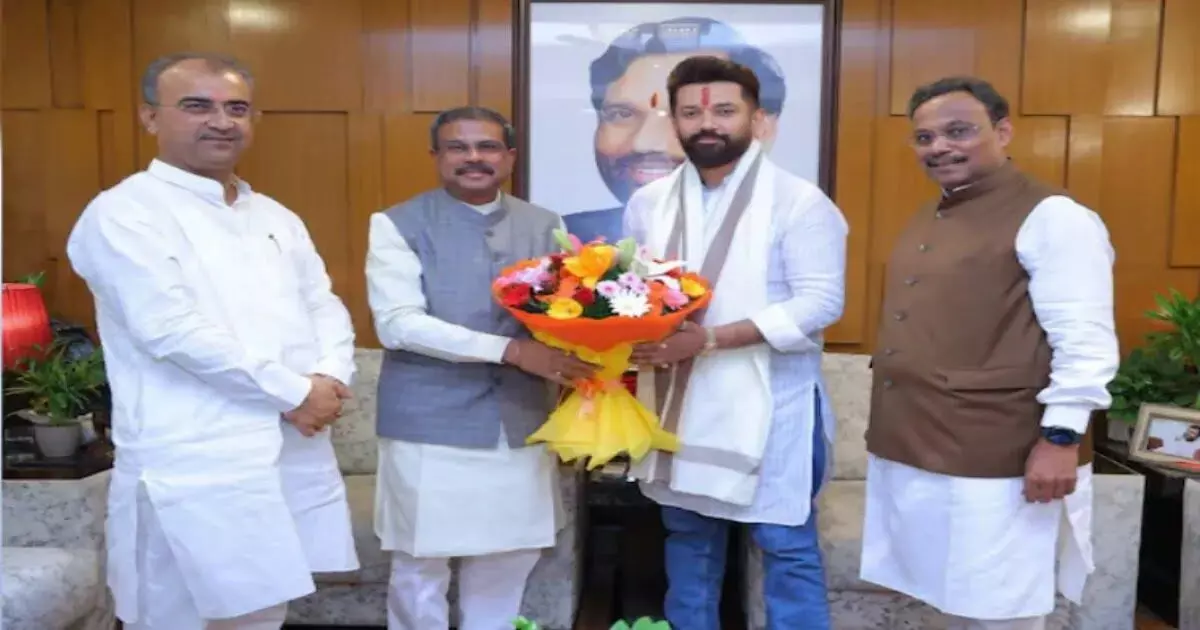
As Bihar gears up for the 2025 Assembly elections, the National Democratic Alliance (NDA) finds itself grappling with internal strain over seat-sharing arrangements. Chirag Paswan, leader of the Lok Janshakti Party (Ram Vilas), has sought 40 seats from the Bharatiya Janata Party (BJP), which has countered with an offer of 25. The divergence has triggered unease within the alliance, particularly as political strategist Prashant Kishor intensifies his outreach across the state.
Chirag Paswan’s pitch rests on his party’s perceived strength in Dalit-majority constituencies. In the 2020 Bihar Assembly elections, the LJP managed just one seat but secured 5.66 per cent of the vote share. While the outcome was modest in numbers, the party dented JD(U)’s performance in several key segments. Earlier, in the 2019 Lok Sabha elections, the LJP had won six seats with an 8.02 per cent vote share — a record that bolsters Chirag’s claim for greater representation in the upcoming polls.
The BJP, which bagged 74 seats in the 2020 Assembly polls with a 19.46 per cent vote share, remains wary of overcommitting. The party’s leadership is attempting to strike a balance between its electoral prospects and the demands of its partners. With JD(U) now part of the Opposition, the BJP faces the challenge of reconfiguring its social coalition. In 2020, JD(U) had secured 43 seats with 15.39 per cent of the vote, and its departure from the NDA has left a vacuum the BJP is keen to fill.
Adding to the churn is Prashant Kishor’s growing presence. Through his Jan Suraaj campaign, Kishor has traversed hundreds of constituencies and is believed to be in touch with regional leaders, including Chirag Paswan. Though he has stopped short of announcing a formal political outfit or alliance, his persistent groundwork has stirred speculation about a possible third front or tactical collaborations that could influence the electoral arithmetic.
Sources indicate the BJP may revise its offer to around 30 seats for Chirag Paswan, targeting constituencies where the LJP enjoys local traction. The final decision, however, will hinge on internal feedback and ground-level assessments. BJP strategists are also closely tracking Kishor’s movements, wary of a split in the NDA’s traditional vote base should Chirag explore alternatives.
Meanwhile, the Opposition camp — led by the Rashtriya Janata Dal (RJD) — is observing the developments with interest. In the 2020 Assembly elections, the RJD had emerged as the single largest party, winning 75 seats with a 23.11 per cent vote share. Tejashwi Yadav has since renewed his outreach in constituencies with LJP influence, seeking to woo voters disenchanted with the NDA’s performance.
The Congress and Left parties, too, are in the process of refining their strategies. The CPI(ML) had secured 12 seats in 2020, while the Congress won 19. Both are expected to remain part of the Mahagathbandhan, and could stand to gain if the NDA’s core vote fragments further.
For the BJP, the central challenge is to preserve alliance unity without compromising its own expansion plans. Chirag Paswan’s demand for 40 seats may appear ambitious, but his vote share and regional clout lend him bargaining power. The BJP must decide whether to accommodate him or risk alienating a potential ally who might tilt toward other formations.
Prashant Kishor’s campaign, with its focus on governance and grassroots engagement, has gained traction among younger voters. Should he choose to contest or back a new front, it could unsettle the NDA’s urban and semi-urban voter base — a segment crucial to the BJP’s performance.
For now, Bihar’s political landscape remains in flux. Seat-sharing negotiations are ongoing, and alliance equations could shift in the coming weeks. The BJP is expected to finalise its strategy after internal consultations with its state unit.
The NDA’s fortunes in Bihar will hinge on two fronts — how it reconciles Chirag Paswan’s seat demand and whether it can counter the potential vote fragmentation driven by Prashant Kishor’s expanding footprint. The 2025 Assembly elections are shaping up to be a test of both endurance and adaptability for all major players.