Congress seals alliance with DMK in Tamil Nadu after internal debate within party leadership
Congress has decided to continue its alliance with the DMK in Tamil Nadu after internal discussions and negotiations between the two parties over seat sharing and political strategy ahead of the next electoral contest.
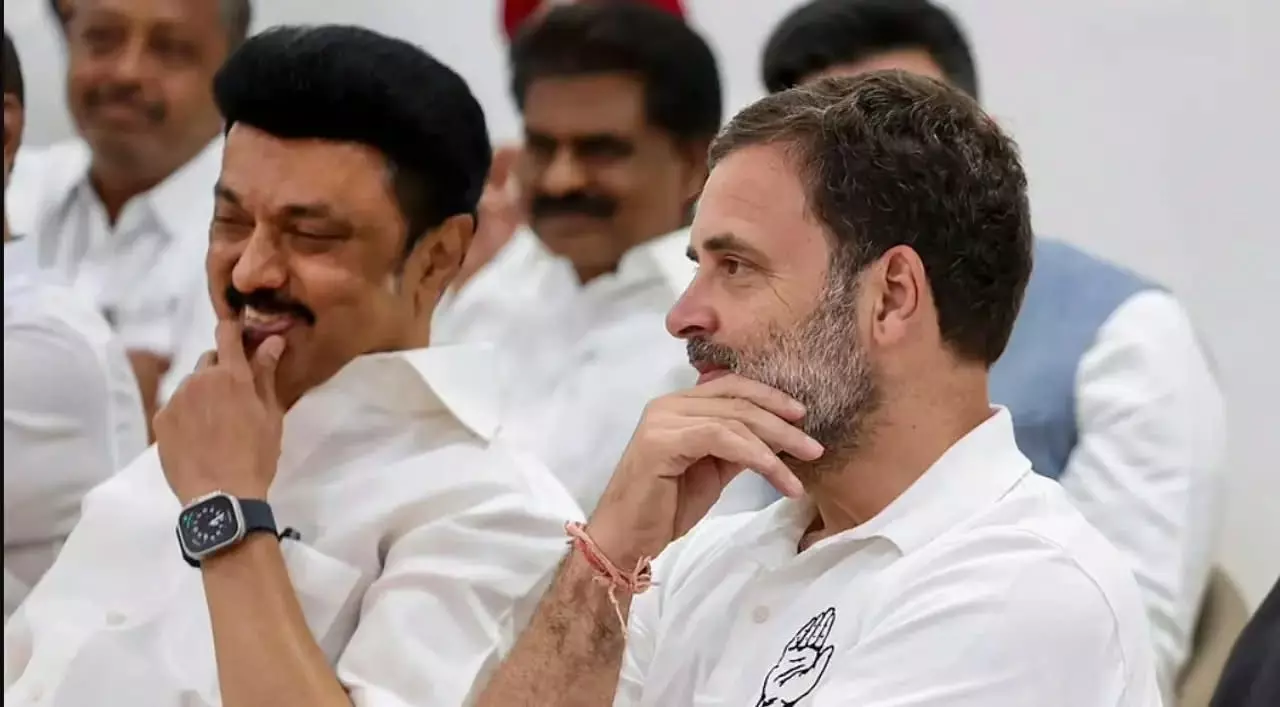
Chennai/New Delhi: The Congress leadership has finally agreed to continue its alliance with the DMK in Tamil Nadu, but the decision has come after days of fraught negotiations, internal disagreement and a round of quiet conversations that reached the very top of the party.
Sources in both parties say the final understanding emerged only after DMK MP Kanimozhi Karunanidhi opened a direct line with Congress parliamentary chairperson Sonia Gandhi, laying out the political arithmetic in the state and the risks of a fractured Opposition space ahead of the 2026 Assembly election.
For weeks, Congress leader Rahul Gandhi had conveyed strong reservations about renewing the arrangement without a clearer share in power. According to party insiders, Gandhi’s argument within the Congress was blunt: an alliance without meaningful political space for the party would leave it reduced to a junior partner with little organisational gain.
The position had slowed negotiations on the seat-sharing agreement. Until the final hours of talks, the Congress’s Tamil Nadu in-charge, Girish Chodankar, was said to be holding back on signing the pact, reflecting the unease in sections of the party leadership in Delhi.
The delay irritated the DMK leadership, which saw the move as unnecessary brinkmanship when the broader Opposition space in the state is under pressure from the rising presence of the Bharatiya Janata Party and new political entrants.
At this stage, Kanimozhi is learnt to have stepped in, briefing Sonia Gandhi directly on the ground situation in Tamil Nadu. According to those familiar with the conversation, she pointed to three factors — the DMK’s entrenched electoral base, the BJP’s attempt to expand its footprint in the state, and the emergence of actor Vijay as a possible political force capable of fragmenting anti-incumbent votes.
The message, sources say, was straightforward: without the DMK alliance, the Congress risks slipping further into political irrelevance in the state.
That assessment appears to have weighed with Sonia Gandhi. Senior Congress functionaries indicate that she signalled the party should not allow the alliance to collapse over tactical disagreements. Soon after, the Congress leadership softened its position and the seat-sharing pact was cleared.
Yet the negotiations did not end there.
Another round of friction surfaced over a Rajya Sabha nomination sought by the Congress as part of the broader understanding. The party’s central leadership initially explored fielding a leader from north India, but the proposal ran into resistance from the DMK.
According to DMK sources, the party insisted that a Rajya Sabha member elected from Tamil Nadu must reflect the state’s political and social profile. The DMK conveyed that the candidate should be a Tamil representative and preferably from the Christian community — a demand it argued would strengthen the coalition’s social outreach.
Faced with the impasse, the Congress eventually named a candidate from within its national organisation who fits that profile.
Despite the alliance being stitched together, insiders say Rahul Gandhi remains dissatisfied with the manner in which the negotiations unfolded. The perception in parts of the Congress leadership is that the party had limited room to manoeuvre once the electoral realities of Tamil Nadu were placed on the table.
That discomfort may show up in the campaign calendar.
Congress leaders in the state privately concede that Rahul Gandhi’s participation in the Tamil Nadu campaign remains uncertain. If he does travel to the state, it is likely to be for a single joint rally featuring the leadership of all alliance partners rather than an extended tour.
For the moment, the alliance between the Dravida Munnetra Kazhagam and the Indian National Congress stands intact. But the uneasy negotiations that preceded it have once again underlined the asymmetry between the two partners in Tamil Nadu.
Whether the arrangement holds comfortably through the 2026 Assembly contest — or becomes a source of continuing strain — is a question that both camps are already weighing quietly behind closed doors.