Democracy on Trial: The Battle Over Power, Justice, and the Constitution
Indian government's introduction of the Constitution (130th Amendment) Bill has ignited a fierce debate over democracy, federalism, and judicial independence.

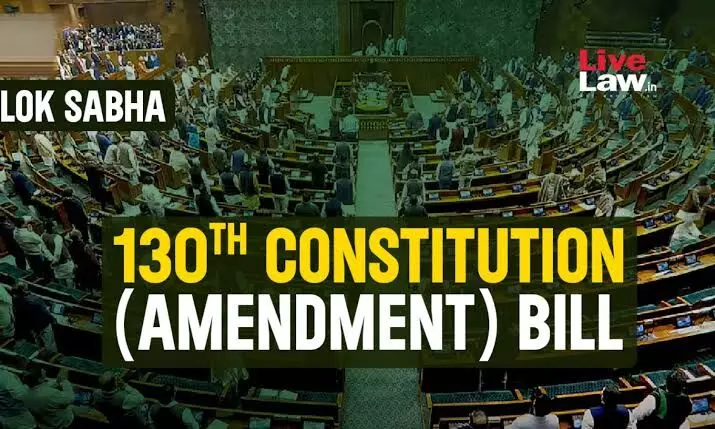
News Credit to Live Law
The Lok Sabha turned into a battleground on August 20, 2025, as the introduction of the Constitution (130th Amendment) Bill, along with two others, sparked unprecedented chaos. Torn papers, raised voices, and near-scuffles between MPs marked the day Union Home Minister Amit Shah tabled legislation that could remove a Prime Minister, Chief Minister, or Minister if detained for 30 consecutive days on serious criminal charges. The bills—also amending the Government of Union Territories Act and the Jammu and Kashmir Reorganisation Act—have ignited a fierce debate over the future of Indian democracy, federalism, and judicial independence.
At the heart of the storm lies a fundamental question: can a democracy allow its elected leaders to remain in office while facing serious criminal allegations? The government argues no. Shah defended the move as a moral imperative, stating, “We cannot be so shameless that we continue to occupy constitutional positions while facing serious charges.” The bills, he assured, would be sent to a Joint Committee of Parliament for review, allowing both Houses—including the Opposition—to suggest changes.
But the Opposition sees something far more sinister. Congress leader Priyanka Gandhi Vadra called the bills “draconian” and “undemocratic,” warning that they allow the government to remove elected leaders without conviction. “You can put any case on a chief minister and have him arrested for 30 days without even him being convicted, and then he ceases to be chief minister,” she said. Her concern echoes a broader fear: that the bills weaponize investigative agencies to target political opponents, bypassing courts and due process.
Manish Tewari, another Congress MP, argued that the legislation undermines the rule of law and the Constitution’s basic structure. “This Bill makes an Investigating Office the boss of the Prime Minister of India,” he said, highlighting how it reverses the principle of “innocent until proven guilty.” AIMIM’s Asaduddin Owaisi warned that the bills give executive agencies unchecked power, turning India into a “police state.”
The uproar in Parliament was more than symbolic. Congress MP K.C. Venugopal and Samajwadi Party’s Dharmendra Yadav tore up copies of the bills, while BJP and TMC MPs nearly came to blows. The spectacle underscored the depth of opposition to what many see as an authoritarian overreach. Trinamool Congress chief Mamata Banerjee called the move a “Hitlerian assault” on democracy, warning that it dismantles judicial independence and constitutional safeguards.
Critics argue that the bills violate Article 21 of the Constitution, which guarantees protection of life and personal liberty. By allowing removal based on detention—not conviction—they shift power from courts to agencies under executive control. This, they say, is a recipe for political vendetta. TMC MP Mahua Moitra pointed out that the bills bypass both federal structure and judiciary, enabling the Union government to arrest opposition leaders on “fake charges” and remove them from office without trial.
The timing and context of the bills raise further concerns. With several opposition leaders already under investigation or arrested, including former Delhi CM Arvind Kejriwal and Tamil Nadu’s V Senthil Balaji, the legislation appears tailored to consolidate power. CPI(M)’s John Brittas called it a tool for “ulterior motives,” while TMC’s Abhishek Banerjee accused the government of using central agencies like the ED and CBI to crush dissent and manipulate mandates.
Yet not all voices in the Opposition are aligned. Congress MP Shashi Tharoor took a nuanced stance, saying the idea of removing tainted leaders “seems reasonable” on the face of it. He emphasized the need for accountability but cautioned against misuse. This divergence within the Opposition reflects the complexity of balancing ethics in public office with the principles of justice and federalism.
Outside Parliament, political strategist Prashant Kishor offered a stark endorsement. He argued that the Constitution’s framers never anticipated leaders so corrupt they’d refuse to resign even from jail. “If a leader is accused and sent to jail, they cannot continue running the government from jail,” he said, supporting the bill’s intent.
But intent is not enough. Experts warn that the Centre’s monopoly over investigative agencies creates a dangerous imbalance. In a federal democracy, states must have autonomy, and leaders must be judged by courts—not by political rivals wielding police powers. The bills, they argue, threaten to erode this balance, allowing the Centre to destabilize opposition-led states under the guise of anti-corruption.
The Joint Committee may offer a platform for dialogue, but the damage to trust is already done. The spectacle in Parliament, the fiery rhetoric, and the deep divisions reveal a democracy at a crossroads. Is India moving toward a cleaner political system, or is it sliding into authoritarianism masked as reform?
The answer may lie not in the text of the bills, but in how they are implemented. If used to genuinely uphold integrity, they could mark a turning point. But if wielded as tools of suppression, they risk becoming the very instruments that dismantle the democratic edifice they claim to protect.
In the end, the battle over these bills is not just about law—it’s about the soul of Indian democracy. And that battle, it seems, has only just begun.