Democracy Over Drama: Nobel Committee Sends a Global Signal
The 2025 Nobel Peace Prize awarded to María Corina Machado signals a global stand for democracy, challenging political pressure and authoritarian influence.
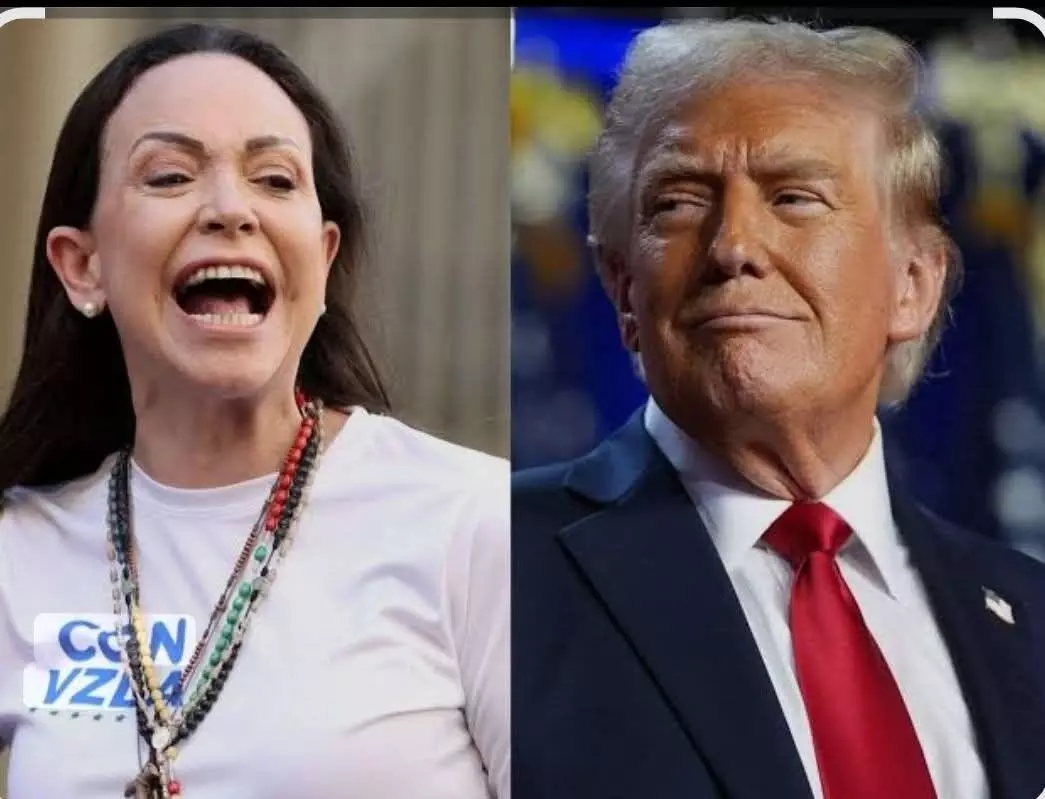
The decision to award the 2025 Nobel Peace Prize to Venezuelan opposition leader María Corina Machado is more than a recognition of individual courage—it is a global statement. In choosing Machado, the Nobel Committee has not only honoured her defiant stand against Nicolás Maduro’s authoritarian regime but also rebuffed the increasingly politicised campaign by U.S. President Donald Trump to claim the prize for himself. The contrast between the two figures—one in hiding for over a year, the other commanding the world’s most powerful office—could not be starker.
Machado, often referred to as Venezuela’s “Iron Lady,” has endured disqualification, threats and repression for her refusal to legitimise a disputed election. Her continued advocacy for free elections and human rights in a country where political freedoms are severely curtailed reflects the very spirit Alfred Nobel envisioned when he wrote that the prize should go to those who “shall have done the most or the best work for fraternity between nations.” Her selection comes at a time when democracy is under siege—not just in Venezuela, but globally.
Trump’s reaction, via White House spokesperson Steven Cheung, was swift and bitter: “Once again, the Nobel Committee has proved they place politics over peace.” The statement, while predictable, underscores the frustration of a leader who has long sought validation through accolades. Trump’s campaign for the Nobel Peace Prize has been marked by exaggerated claims—some bordering on falsehoods—about ending wars and brokering peace. His supporters point to the Abraham Accords of 2020, which normalised relations between Israel and several Arab states, as justification. Yet, many of his nominations came after the February 1 deadline for the 2025 award, and his recent involvement in mediating between Israel and Hamas, while notable, remains incomplete and fraught.
The Nobel Committee’s decision is not without precedent. Three sitting U.S. Presidents—Theodore Roosevelt (1906), Woodrow Wilson (1919) and Barack Obama (2009)—have received the prize. Jimmy Carter and Al Gore were honoured post-tenure. Obama’s award, given early in his presidency, was controversial and has remained a sore point for Trump, who remarked just days ago, “They gave it to Obama for doing absolutely nothing but destroying our country.” Such rhetoric, while politically charged, fails to acknowledge the committee’s broader criteria, which prioritise sustained peace efforts over transactional diplomacy.
Observers note that the Nobel jury faced immense pressure to consider Trump, especially from Republican circles. Representative Claudia Tenney of New York formally nominated him in December, citing his role in the Abraham Accords. Yet, the committee chose to spotlight Venezuela—a country where democracy is not just debated but endangered. Machado’s selection is a reminder that peace is not merely the absence of war but the presence of justice, accountability and democratic resilience.
The timing is symbolic. The prize, worth 11 million Swedish crowns (approximately $1.2 million), will be presented in Oslo on December 10, the anniversary of Alfred Nobel’s death. Four other prizes—in medicine, physics, chemistry and literature—have already been awarded this week. The economics prize will follow on Monday. In this context, the Peace Prize stands apart—not just for its prestige but for its political weight.
Machado’s recognition also resonates beyond Venezuela. In recent years, right-wing populism has surged globally, often through democratic means, only to erode constitutional safeguards once in power. The pattern is visible in both the world’s oldest democracy and its largest. Leaders elected through popular mandate have increasingly undermined institutions—judiciaries, legislatures and media—raising alarms about democratic backsliding. The Nobel Committee’s choice, therefore, is not just about Venezuela; it is a warning to all nations flirting with authoritarian tendencies.
Trump’s disappointment is palpable, but the Nobel Peace Prize was never meant to be a trophy for transactional politics. It is a moral compass, pointing toward those who risk everything to uphold democratic values. Machado’s courage, forged in the crucible of repression, stands in stark contrast to the self-congratulatory campaigns of powerful leaders seeking validation.
In the end, the Nobel Committee has reaffirmed its commitment to principle over pressure. By honouring María Corina Machado, it has reminded the world that peace is not a performance—it is a pursuit. And in that pursuit, it is often the quiet, unyielding voices from the margins that deserve the loudest applause.