DMDK Joins DMK Alliance: Historic Political Shift in Tamil Nadu After Vijayakanth’s Legacy
In a turn heavy with memory and meaning, the Desiya Murpokku Dravida Kazhagam (DMDK), founded by the late actor-politician Vijayakanth, has, for the first time in its 21-year political journey, aligned with the Dravida Munnetra Kazhagam (DMK) led by M. K. Stalin. The alliance comes ahead of the first Assembly election after the passing of the man his cadres simply called “Captain”.
The political significance cannot be missed. In 2016, the then DMK patriarch M. Karunanidhi had openly hoped that Vijayakanth would join the DMK-led front. In his inimitable style, Karunanidhi had remarked that the fruit was about to fall into the lap. But at the last minute, DMDK chose to float the People’s Welfare Alliance instead, altering the arithmetic of that election.
Now, years later and after Vijayakanth’s demise, DMDK has entered the DMK fold. Talks had been ongoing with both the AIADMK and the BJP. Yet, it was Premalatha Vijayakanth who took a firm stand, deciding in favour of the DMK alliance—an insistence that has reshaped the political conversation in Tamil Nadu.
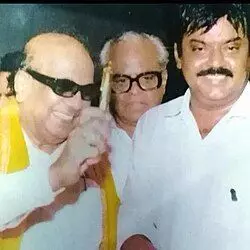
The BJP in Tamil Nadu has criticised the move, saying the Captain’s soul would not forgive such a decision. But those who tracked Vijayakanth’s journey—on screen and in public life—know that his affection and regard for Karunanidhi ran deep, often transcending political lines. More than Prime Minister Narendra Modi or former Chief Minister Jayalalithaa, it was Karunanidhi for whom Vijayakanth held an abiding personal warmth.
Their association dates back decades. In films such as Veeran Veluthambi (1987) and earlier projects where Karunanidhi contributed to story and dialogue, Vijayakanth publicly acknowledged the senior leader’s creative and intellectual influence. From the early 1980s, he maintained visible respect for Karunanidhi, addressing him with reverence.
When Vijayakanth married Premalatha, it was Karunanidhi who presided over the ceremony. Family milestones in the Vijayakanth household often saw Karunanidhi at the helm. At a grand felicitation marking Vijayakanth’s golden jubilee in cinema, a massive function was organised by the film fraternity, where Karunanidhi presented him with a specially crafted gold pen—an emblem of their bond. Even in political disagreement, Vijayakanth never once addressed him without respect.
The emotional depth of that relationship became starkly visible in 2018. When Karunanidhi passed away, Vijayakanth was in the United States undergoing medical treatment. Unable to immediately return, he released a video message from abroad. Visibly shaken, he said he could not bear Kalaignar’s death—and then broke down mid-sentence. The video moved cadres across party lines; even hardened political observers remember that moment.
Upon returning to Chennai, Vijayakanth drove straight from the airport to the Marina Beach memorial to pay homage. Even at midnight, he stood in silent tribute. DMK cadres still recount that gesture.
Years later, when Vijayakanth himself passed away, it was the DMK government that accorded him full state honours without hesitation. Arrangements for public homage were facilitated proactively. There were no demands, no negotiations—only recognition of stature.
Seen in this light, the DMDK’s present alliance with the DMK is not merely a tactical move. It is layered with history—of cinema and politics, of rivalry and regard, of public postures and private loyalties. For many within the party and beyond, it affirms what was visible all along: that Vijayakanth’s respect and affection for Karunanidhi endured through triumph, turbulence and time.