DMK and Congress Seat-Sharing Talks in Tamil Nadu Enter Crucial Phase
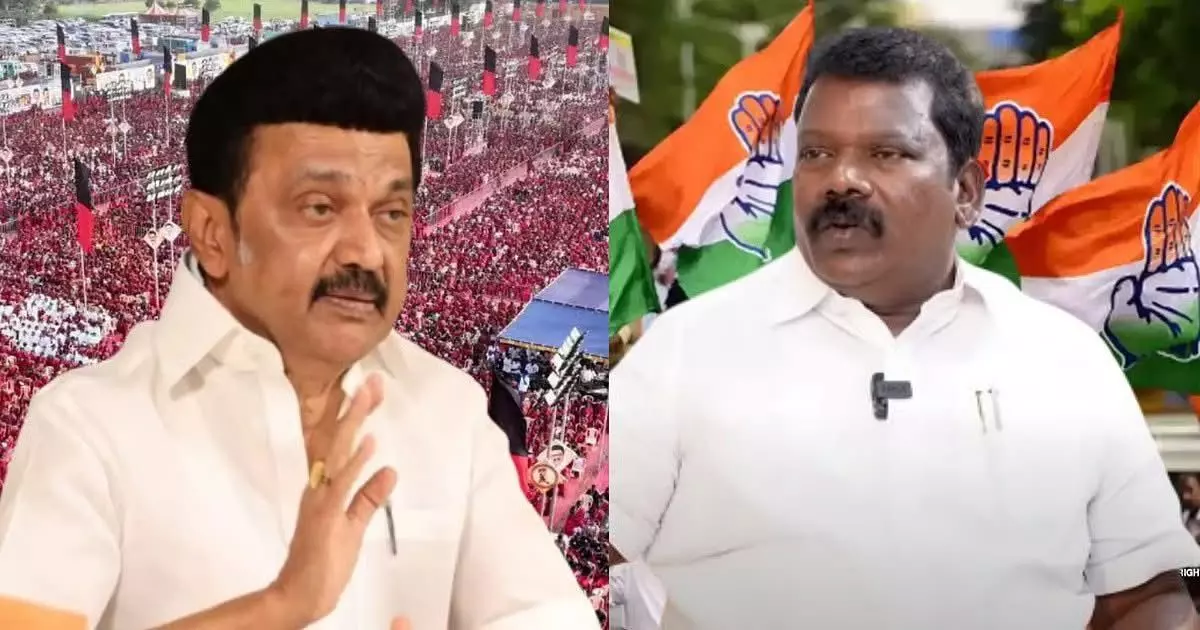
Seat-sharing talks between the Dravida Munnetra Kazhagam (DMK) and the Indian National Congress in Tamil Nadu have entered a crucial phase, with both sides hardening their respective positions even as they publicly maintain that discussions are “cordial”.
At the heart of the negotiations lies a familiar question: how much is too much?
The Congress, party sources indicate, has pitched for a larger share of Assembly constituencies, arguing that it must bargain from a position of strength. However, the DMK is said to have drawn a firm line. With new allies entering the coalition fold, the ruling party maintains there is little room to stretch beyond a point.
A day after Congress general secretary K. C. Venugopal met Tamil Nadu Chief Minister M. K. Stalin, formal seat-sharing talks commenced. On Monday, DMK MP Kanimozhi Karunanidhi held discussions at her residence with Congress’ state in-charge Girish Chodankar on the contours of the arrangement.
The Congress has also sought a Rajya Sabha berth. On this, the DMK is believed to be more amenable. But the sticking point remains the Assembly tally.
Congress negotiators have reportedly asked for 41 seats, similar to the number they contested in 2016. The DMK, however, is said to have made it clear that even in the most generous scenario, it may not go far beyond 22 — roughly in line with previous allocations. Some sources suggest that, under pressure, the party could consider adding two or three more seats. Yet, the broader indication is unmistakable: anything beyond the 20–28 range is unlikely.
The DMK’s reasoning, insiders say, is rooted in arithmetic as well as assessment. With a crowded alliance and the need to field winnable candidates, it is wary of conceding space in constituencies where it believes organisational strength is decisive. There is also a quiet undercurrent within sections of the DMK that in the 2021 Assembly election, the party machinery did much of the heavy lifting in several seats won by Congress nominees.
The Congress, for its part, counters with data. It points to its strike rate in the last election and argues that in constituencies where the DMK faltered, it could serve as a corrective force. The party has suggested that it be accommodated in seats the DMK previously lost. That proposal, however, has reportedly been turned down.
Complicating matters further is the entry of new alliance partners this time, which, the DMK insists, limits its flexibility. Party functionaries privately concede that 28 seats would be a ceiling, not a starting point.
Meanwhile, the political churn has not gone unnoticed outside the alliance. Actor Vijay’s outfit, the Tamilaga Vettri Kazhagam, is said to be making overtures to the Congress, with reports suggesting it could offer as many as 70 seats in a potential arrangement — though this remains speculative.
There is also divergence over the idea of a coalition government. While some voices within Congress are said to be open to a power-sharing formula, the DMK has shown little appetite for such an experiment. A coalition government, it believes, could create perceptions of instability — something it argues would not be in Tamil Nadu’s interest.
For now, all these accounts stem from party circles. Neither the DMK nor the Congress has issued an official statement detailing the precise contours of the negotiations. Despite the evident friction, there is a broad expectation that seat-sharing will be finalised within a fortnight.
In Tamil Nadu’s alliance politics, brinkmanship is often part of the script. The denouement, as always, will depend not just on numbers, but on who blinks first.