From Adani to Epstein: Rahul Gandhi’s Claim of Modi’s Compromise Sparks National Debate
Explore the heated debate over the India-US trade deal, farmer interests, and political claims involving Modi, Rahul Gandhi, Adani, and national security concerns.
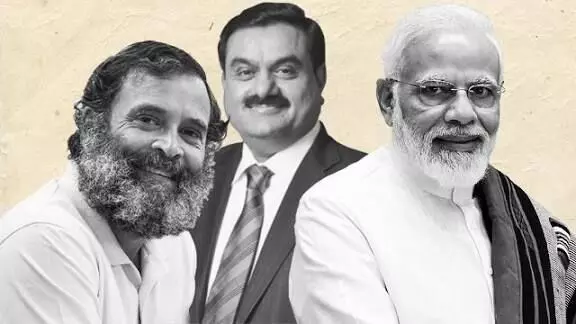
Rahul Gandhi’s latest attack on Prime Minister Narendra Modi over the India–US trade deal has opened a stormy debate that cuts across economics, politics, and national security. His claim that Modi “sold out” Indian farmers under US pressure, allegedly linked to cases involving Gautam Adani and the Epstein files, is not just a political jab but a serious allegation of compromise at the highest level. The government, on its part, has categorically denied any dilution of farmers’ interests, insisting that agriculture and dairy remain protected. Yet the clash of narratives raises fundamental questions: is this deal a betrayal of India’s agrarian backbone, or is it a pragmatic step in global trade diplomacy?
On one side, Rahul Gandhi frames the issue as a moral and national betrayal. His rhetoric is sharp: Indian farmers’ “blood and sweat” has been traded away, the country “sold out,” and the Prime Minister “scared” into submission. He ties the sudden finalisation of the deal to external pressure, hinting at sensitive cases abroad that allegedly compromise Modi’s position. By invoking Adani’s troubles in the US and the Epstein files, Gandhi attempts to paint a picture of a Prime Minister cornered by international forces, forced to barter away domestic interests to protect personal or corporate vulnerabilities. This is a classic opposition strategy—linking global scandals to domestic policy decisions, thereby questioning the integrity of governance.
On the other side, the government’s defence is equally firm. Officials assert “zero compromise” on farmers’ interests, stressing that India’s agriculture and dairy sectors remain shielded. They argue that trade deals are complex negotiations where concessions are balanced by gains, and that India continues to exercise autonomy in critical areas such as crude oil imports, even from Russia despite Western sanctions. This narrative positions Modi not as a compromised leader but as a pragmatic negotiator who balances global pressures with national priorities. The government’s promise of a suo motu statement in Parliament further seeks to project transparency and accountability, countering the opposition’s charge of secrecy and betrayal.
The clash in Parliament reflects the deeper tension between procedure and politics. Rahul Gandhi insists on quoting from an article based on former Army chief M. M. Naravane’s unpublished memoir, linking national security concerns with the trade deal debate. The Speaker’s refusal to allow such references, and Gandhi’s insistence on authenticating the document, turned the House into a theatre of disruption. BJP MPs accused him of misleading the House, while Gandhi claimed he was being silenced as Leader of the Opposition. This procedural tussle is not trivial—it highlights how parliamentary rules can become battlegrounds for larger political narratives. Gandhi’s framing of himself as a silenced voice of truth versus the BJP’s portrayal of him as a disruptive, rule-breaking leader encapsulates the broader struggle for legitimacy.
At the heart of the debate lies the question of farmers. India’s agrarian community has long been sensitive to trade deals that open markets to subsidised foreign imports. The fear is that cheap US agricultural products could undercut Indian farmers, eroding livelihoods built on fragile margins. Gandhi’s charge resonates with this anxiety, tapping into the memory of past farmer protests against perceived threats from liberalisation. For the opposition, this is fertile ground to mobilise sentiment, portraying Modi as betraying the very backbone of India’s economy. For the government, the challenge is to reassure farmers that protections remain intact, while also convincing the broader public that trade deals are necessary for India’s global rise.
The debate also touches on national security and geopolitics. Gandhi’s attempt to link the trade deal to India’s stance on China and Pakistan, and to the larger US–China conflict, situates the issue in a global strategic frame. He argues that the President’s address itself highlighted international conflict as central, and that India’s choices must be scrutinised in this context. The government, however, resists this conflation, insisting that trade negotiations are distinct from military and strategic concerns. Yet in reality, the two are intertwined: trade deals often reflect broader alignments, and India’s balancing act between the US, China, and Russia is a delicate one. Gandhi’s charge, therefore, may be politically exaggerated but is not entirely devoid of strategic logic.
The BJP’s counterattack is sharp and personal. Spokespersons accuse Gandhi of being “clueless,” “directionless,” and disrespectful of parliamentary traditions. They frame him as a “Leader of Pandemonium and Propaganda” rather than a serious Leader of Opposition. This rhetorical strategy seeks to delegitimise Gandhi’s critique by portraying him as incompetent and disruptive. Yet such attacks also risk trivialising genuine concerns about transparency and accountability in trade negotiations. If Gandhi’s allegations are dismissed merely as antics, the government may miss the opportunity to engage substantively with farmer anxieties and opposition scrutiny.
Ultimately, the debate is not just about one trade deal. It is about the larger question of how India negotiates its place in the global order while protecting domestic interests. Gandhi’s charge of “selling out” is a powerful political weapon, but it requires evidence to move beyond rhetoric. The government’s defence of “zero compromise” is reassuring, but it must be backed by clear details of the deal’s terms. Farmers, caught between these competing narratives, deserve clarity rather than slogans.
In a democracy, such clashes are inevitable. The opposition’s role is to question, provoke, and hold the government accountable. The government’s role is to defend, explain, and reassure. When these roles collide in Parliament, disruption is almost guaranteed. But beneath the noise lies a serious debate about sovereignty, integrity, and the future of India’s agrarian economy. Whether Modi has indeed “sold out” farmers or whether Gandhi is indulging in political theatre will depend on the transparency of the trade deal’s details and the government’s ability to convince the public that national dignity remains intact.
In the end, the India–US trade deal controversy is a mirror of India’s democratic tensions: opposition suspicion versus government assurance, farmer anxiety versus global ambition, parliamentary rules versus political theatre. Rahul Gandhi’s charge may or may not stand the test of evidence, but it has succeeded in igniting a debate that goes to the heart of India’s economic and political identity. And that, perhaps, is the real significance of this storm—forcing the nation to ask whether global deals are being struck at the cost of those who till its soil.