Impeaching the Referee: Democracy’s Test in the Battle Over the Election Commission
Opposition parties move to impeach Chief Election Commissioner Gyanesh Kumar, alleging partisan conduct and electoral unfairness, sparking debate on India's democratic institutions.

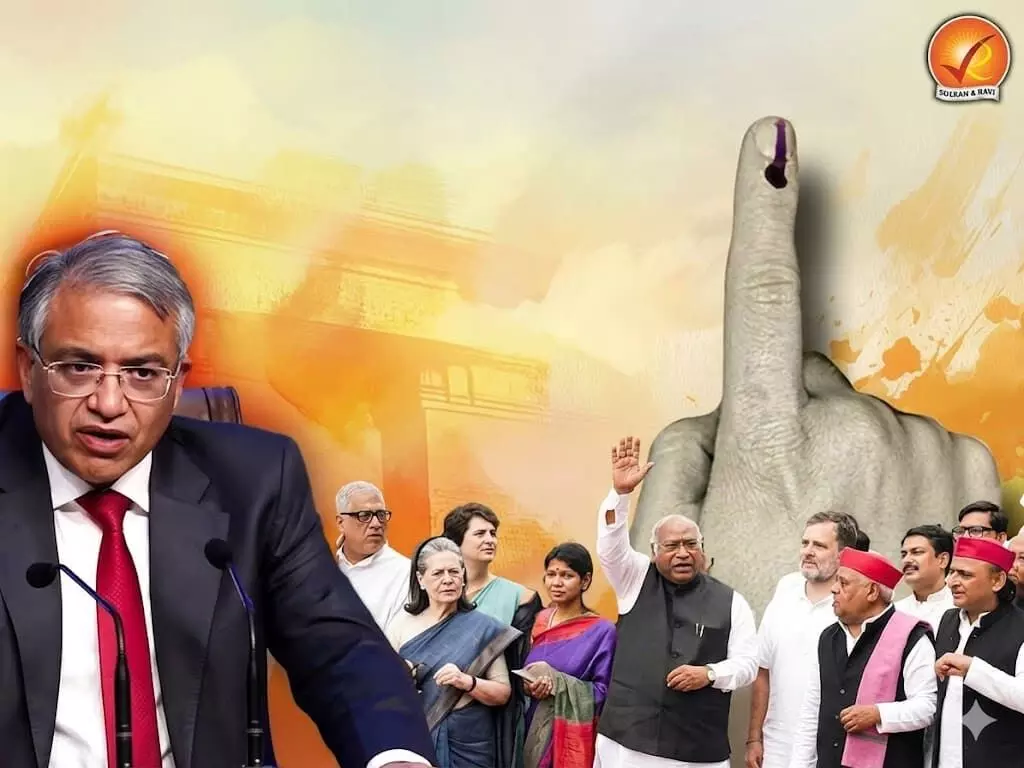
In every democracy, the credibility of elections depends not merely on ballots and polling booths but on the trust citizens place in the institution that conducts them. When that trust is questioned, the crisis is not only administrative but profoundly political. The recent move by opposition parties to submit a notice for the impeachment of Chief Election Commissioner Gyanesh Kumar has therefore triggered a debate that goes far beyond parliamentary procedure. With 193 Members of Parliament—130 from the Lok Sabha and 63 from the Rajya Sabha—signing the motion, the episode represents one of the most significant confrontations between the opposition and the Election Commission of India in recent years. Although the ruling National Democratic Alliance enjoys a numerical advantage that makes the motion unlikely to succeed, the political symbolism of attempting to remove the country’s top election authority is immense.
The impeachment notice alleges “proven misbehaviour,” “partisan and discriminatory conduct,” and the possibility of mass disenfranchisement through the controversial Special Intensive Revision (SIR) of electoral rolls. Opposition leaders also claim that the appointment process of the CEC was compromised and that the Commission failed to maintain its constitutional independence. The initiative has largely been driven by the All India Trinamool Congress, led by Mamata Banerjee, whose party has been particularly vocal about alleged irregularities in voter roll revisions in West Bengal. According to opposition leaders, the SIR exercise risks excluding legitimate voters and undermining electoral fairness in states preparing for Assembly elections, including West Bengal, Assam, Kerala, Tamil Nadu, and the Union Territory of Puducherry.
The constitutional framework surrounding the removal of the Chief Election Commissioner is deliberately stringent. Article 324(5) of the Constitution ensures that the CEC cannot be removed except in a manner similar to the impeachment of a judge of the Supreme Court of India. This provision was designed by the framers of the Constitution to protect the autonomy of the Election Commission from political pressure. The process itself is demanding: a motion must first be signed by at least 100 members of the Lok Sabha or 50 members of the Rajya Sabha, after which the presiding officer may admit the motion and constitute a three-member investigative committee under the provisions of the Judges (Inquiry) Act, 1968. If the committee finds evidence of misbehaviour or incapacity, both Houses must pass the motion with a special majority—two-thirds of members present and voting and more than half of the total membership. Only then can the motion be forwarded to the President for final approval.
The framers’ intention was clear: institutions overseeing elections must be insulated from political turbulence. Yet the present controversy raises a critical question—how should a democracy balance institutional independence with accountability? If the Election Commission is entirely shielded from scrutiny, public confidence may erode when allegations arise. Conversely, if removal proceedings become tools of political contestation, the neutrality of the institution could be undermined.
India’s political history provides important precedents illustrating the delicate nature of such institutional conflicts. In 1993, the government led by P. V. Narasimha Rao expanded the Election Commission from a single-member body to a three-member commission, a move widely interpreted as an attempt to dilute the authority of the then Chief Election Commissioner T. N. Seshan, whose aggressive anti-corruption reforms had unsettled political parties. Although Seshan challenged the decision legally, the Supreme Court of India upheld the government’s move, establishing the principle that institutional design could be altered but not in a manner that compromised constitutional independence.
Another relevant episode emerged during the tenure of Navin Chawla, when opposition parties demanded his removal, alleging bias in favour of the ruling party. The controversy ultimately subsided without formal impeachment proceedings, but it demonstrated how the Election Commission can become the focal point of political confrontation when electoral stakes are high.
The present situation must also be understood within the broader transformation of Indian democracy. Electoral competition has intensified dramatically, and allegations regarding electronic voting machines, voter roll revisions, and administrative bias have become routine features of political discourse. As the authority responsible for conducting elections in a country of more than 900 million voters, the Election Commission inevitably becomes the arena where these tensions converge.
However, the impeachment motion also reveals a deeper paradox of democratic politics. While opposition parties emphasize institutional accountability, the practical chances of removal remain negligible because of the ruling coalition’s parliamentary strength. Thus, the motion functions less as a realistic attempt to remove the CEC and more as a political signal—a declaration that the opposition no longer accepts the neutrality of the electoral referee.
For citizens and constitutional observers, the larger issue is not the fate of one individual but the credibility of the electoral system itself. The Election Commission was once described by constitutional scholar Granville Austin as the “keystone of India’s democratic arch.” If political actors begin to question the impartiality of this keystone, the entire structure of electoral legitimacy risks becoming fragile.
Ultimately, the controversy surrounding the impeachment attempt against Gyanesh Kumar represents a defining moment for Indian democracy. Whether the motion succeeds or fails in Parliament may be less important than the institutional introspection it demands. Democracies survive not merely by conducting elections but by ensuring that the institutions overseeing them command universal trust. When the referee itself becomes a subject of political contestation, the real challenge lies not in winning the parliamentary vote but in restoring public confidence in the rules of the democratic game.