Justice as Power, Power as Justice: When Bail Becomes a Theatre of Political Geopolitics
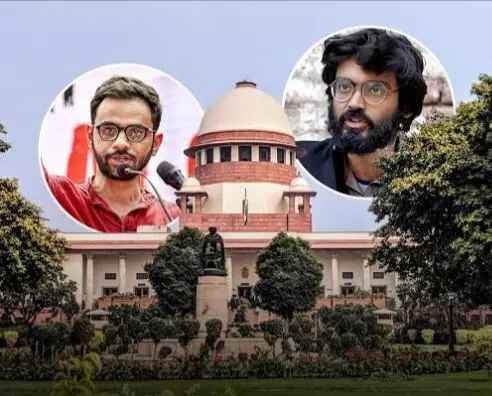
In any functioning democracy, the judiciary is expected to operate above the churn of politics, insulated from ideological winds and partisan convenience. Yet, moments arise when judicial outcomes—irrespective of intent—are inevitably read through a wider political and even geopolitical lens. The Supreme Court’s refusal to grant bail to Umar Khalid and Sharjeel Imam in the 2020 Delhi riots conspiracy case, juxtaposed against the repeated paroles granted to convicted rapist and Dera Sacha Sauda chief Gurmeet Ram Rahim Singh, has become one such moment. It is no longer merely a legal debate; it has evolved into a symbolic contest over power, dissent, state authority, and the moral credibility of democratic institutions in a politically polarised world.
At the heart of the controversy lies not only the principle of “bail is the rule, jail the exception,” but also the question of proportionality in state power. Khalid and Imam have spent over five years in prison under the Unlawful Activities (Prevention) Act, a law globally recognised for its stringent bail provisions and expansive definition of “terrorist activity.” Their trial has not yet begun in earnest, and yet the highest court has held that the duration of incarceration has not crossed the threshold of constitutional alarm. In contrast, Ram Rahim Singh—a man convicted of rape and murder and serving a 20-year sentence—has been granted parole for the fifteenth time since 2017, often coinciding with electoral cycles. This contrast has created a narrative that travels far beyond India’s borders, feeding into global conversations on selective justice, democratic backsliding, and the instrumentalisation of law.
Domestically, opposition leaders have framed this as a crisis of natural justice, arguing that prolonged pre-trial incarceration amounts to punishment without conviction. Their language is not accidental. Across the world, from Turkey to Egypt to parts of Eastern Europe, the extended detention of political dissidents without speedy trials has become a hallmark of what political scientists term “electoral authoritarianism”—systems that retain democratic forms but hollow out democratic substance. India, long projected as the world’s largest democracy and a counterweight to authoritarian models, now finds itself increasingly scrutinised through the same analytical prism.
The Supreme Court’s reasoning—that accused persons in the same case do not stand on the same footing and that bail must reflect a “hierarchy of participation”—may be legally defensible within the four corners of jurisprudence. But geopolitics does not operate on legal nuance alone; it thrives on optics, symbolism, and narrative power. When activists accused of conspiracy remain incarcerated for half a decade without trial, while a politically influential convict repeatedly walks out of prison on parole, the image that travels outward is not one of legal sophistication, but of asymmetrical accountability.
This asymmetry acquires sharper edges in a global context where India positions itself as a normative power—championing the rule of law, democratic values, and constitutionalism in international forums. At a time when New Delhi seeks moral authority in debates on Ukraine, Gaza, or the Indo-Pacific order, its domestic legal contradictions become strategic vulnerabilities. Western democracies, civil liberties organisations, and global media increasingly read such cases not as isolated judicial decisions, but as indicators of structural trends. In geopolitics, perception often precedes reality.
The ruling party’s response, celebrating the denial of bail as a “slap” to the opposition and framing it as a victory over an alleged “anti-national ecosystem,” further politicises the issue. When judicial outcomes are claimed as ideological triumphs, the boundary between constitutional adjudication and political theatre becomes dangerously blurred. This is not merely a matter of rhetoric; it has institutional consequences. Courts derive their legitimacy not from coercive power, but from public trust. That trust erodes when legal processes appear aligned—rightly or wrongly—with political narratives.
The comparison with Ram Rahim Singh is particularly damaging because it exposes a deeper contradiction in the governance model. The state argues for zero tolerance against dissent framed as a security threat, while simultaneously displaying indulgence towards a convicted criminal with demonstrated electoral influence. This selective severity reflects a broader global pattern where states distinguish between “useful” and “disruptive” actors, applying the law with variable intensity. Such patterns are not unique to India, but India’s democratic self-image makes the contradiction more stark.
From a geopolitical standpoint, the issue also touches upon India’s internal cohesion and social stability. The 2020 Delhi riots were a traumatic episode, leaving deep scars across communities. Justice in such cases must not only be done, but must be seen to be done—swiftly, transparently, and without ideological bias. Prolonged incarceration without trial risks transforming accused individuals into enduring symbols of victimhood, further polarising society and internationalising domestic fault lines.
The Supreme Court has sought to mitigate this by directing that the trial be expedited and allowing the possibility of renewed bail pleas if protected witnesses are not examined within a year. However, in the global arena, conditional assurances rarely neutralise immediate perceptions. The dominant image remains that of activists ageing behind bars while a powerful godman enjoys repeated “jail vacations.”
Ultimately, this episode underscores a central paradox of contemporary democracies: the tension between security and liberty, between state power and individual rights. In a world increasingly divided between authoritarian efficiency and democratic messiness, India’s choices are watched closely. Each legal decision, especially in high-profile political cases, becomes a data point in a larger geopolitical assessment of the country’s democratic trajectory.
The question, therefore, is not whether the Supreme Court acted within its legal mandate. The deeper question is whether India, as a constitutional republic with global aspirations, can afford the cumulative symbolism of such contrasts. When bail becomes a marker of political hierarchy rather than legal parity, justice ceases to be a neutral arbiter and begins to resemble an extension of power. And in today’s interconnected world, that transformation does not remain confined within national borders—it becomes part of India’s geopolitical story.