Modi’s Missed Calls: Diplomacy, Drama, and the Himalayan Salt of Skepticism
Did Modi ignore Trump’s calls? A German daily’s claim sparks debate on India-US trade war, diplomacy, tariffs, and shifting global alliances.
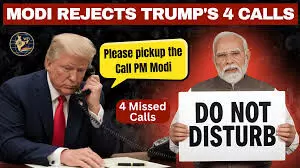
In the high-stakes theatre of global diplomacy, silence can speak louder than words. A recent report by the German daily Frankfurter Allgemeine Zeitung (FAZ) has stirred a storm by claiming that Indian Prime Minister Narendra Modi refused to take four phone calls from US President Donald Trump amid escalating trade tensions and geopolitical friction. The allegation, though unconfirmed by either Washington or New Delhi, has ignited a flurry of speculation, satire, and strategic analysis across media and diplomatic circles.
The FAZ report suggests that Modi’s refusal to engage directly with Trump stems from a mix of irritation and caution. The backdrop is a deteriorating India-US relationship, punctuated by the imposition of a 50% tariff on Indian exports to the US—reportedly in retaliation for India’s continued purchase of Russian crude oil. Trump’s repeated public claims that he single-handedly prevented a nuclear war between India and Pakistan have further strained ties, casting a shadow over the once-celebrated Modi-Trump camaraderie.
Former Foreign Secretary Nirupama Rao’s reaction to the FAZ report was both pointed and poetic. In a post on X, she advised readers to take the story “with a good dollop of Himalayan salt,” highlighting the lack of corroboration from Indian sources and the dangers of relying on single-source international reporting for complex diplomatic narratives. Her skepticism reflects a broader unease among seasoned diplomats and analysts who question the motives and methods behind such leaks.
Yet, the absence of an official denial from either side adds intrigue. If the report were entirely baseless, one might expect swift rebuttals. Instead, what has emerged is a chorus of source-based stories in Indian media subtly suggesting that the narrative doesn’t align with Modi’s diplomatic style. Modi, known for his proactive outreach and strategic optics, rarely shies away from high-profile engagements. His silence, if deliberate, could be a calculated signal rather than a snub.
The idea that the Indian government may be using foreign media to shape perceptions is not new. A veteran diplomatic observer noted that the Modi administration has previously leveraged international outlets—such as Bloomberg’s interview with the Chief of Defence Staff—to release sensitive information while avoiding domestic scrutiny. In this context, the FAZ report could be seen as a strategic leak, designed to convey displeasure without direct confrontation.
Data lends weight to the theory of a deliberate distancing. According to trade figures, the US remains India’s largest export destination, accounting for nearly 20% of total exports. The new tariffs, which raise duties to 50%, could slow India’s GDP growth from an expected 6.5% to 5.5%. Such economic headwinds, coupled with Trump’s unpredictable diplomacy—exemplified by his unilateral announcement of a trade deal with Vietnam—may have prompted Modi to tread carefully. As FAZ noted, Modi “doesn’t want to fall into the same trap.”
Geopolitically, India’s posture is shifting. Modi’s recent engagements with Chinese President Xi Jinping and participation in the Shanghai Cooperation Organisation summit suggest a recalibration of alliances. Analyst Mark Frazier argues that the American vision of an Indo-Pacific alignment, with India as a bulwark against China, is unraveling. India’s strategic interests increasingly align with China in global institutions and industrial growth, making Trump’s pressure tactics less effective.
Public sentiment, too, plays a role. Trump’s “dead economy” remark about India and his claims of brokering peace with Pakistan have not gone down well domestically. Modi’s image, once buoyed by his global stature, has taken a hit. In this climate, a refusal to engage with Trump could be seen as a move to reclaim narrative control. As one former diplomat put it, media manipulation to bolster or tarnish political images is as old as politics itself—and if the Modi establishment planted the FAZ story, it’s simply playing the game.
Social media, ever the mirror of public mood, has responded with characteristic wit. Comedian Ramesh Srivats quipped that Modi should set an auto-reply: “Hi, this is Narendra Modi. I can't take your call right now as I'm on a road trip with Xi Jinping and Putin.” The joke, while lighthearted, underscores the shifting allegiances and the theatrical nature of modern diplomacy.
Ultimately, whether Modi dodged Trump’s calls or not may be less important than what the episode reveals about India’s evolving foreign policy. The skepticism voiced by Rao and others is a reminder to scrutinize narratives, especially those emerging from single sources. But the silence from official channels, the economic data, and the geopolitical context suggest that something deeper is at play.
In diplomacy, missed calls can be messages. And in this case, the message may be that India is no longer willing to play second fiddle in Trump’s transactional world order. Whether that’s a strategic masterstroke or a risky gamble remains to be seen. But one thing is clear: the Himalayan salt of skepticism is now a staple in decoding global headlines.