The Contradictions of Praise: Tharoor, Modi, and the Fragile Idea of India
Images Credit - Sential Asam
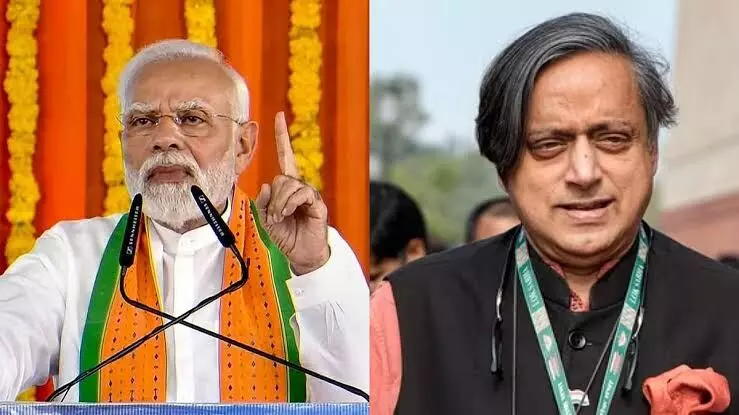
The recent controversy surrounding Shashi Tharoor’s praise for Prime Minister Narendra Modi’s Ramnath Goenka Lecture and his earlier reflections on the Trump–Mamdani dynamic has reignited a debate that cuts to the core of India’s political philosophy: the tension between admiration for rhetorical flourish and the deeper responsibility of safeguarding democratic institutions. When Tharoor described Modi’s speech as both an economic outline and a “cultural call to action,” he was not merely commenting on a lecture; he was, knowingly or not, entering into the contested terrain of political legitimacy, where words carry the weight of history and philosophy.
Congress leader Sandeep Dikshit’s sharp rebuke, calling Tharoor a “hypocrite,” and Supriya Shrinate’s dismissal of the speech as devoid of anything praiseworthy, reflect not just intra-party dissent but a larger anxiety about the erosion of the “Idea of India.” This phrase, famously articulated by Nehru and later defended by thinkers like Sunil Khilnani, represents a pluralist, secular, and democratic vision. To commend a speech that many see as part of a cultural majoritarian project is, in the eyes of critics, to risk legitimizing the dismantling of that vision.
Political philosophy offers a lens to understand this tension. Hannah Arendt, in her reflections on totalitarianism, warned of the dangers when political rhetoric becomes a substitute for institutional accountability. The “cultural call to action” that Tharoor praised can be read as an attempt to mobilize identity over deliberation, echoing Arendt’s concern that politics grounded in myth rather than reason risks sliding into authoritarianism. Similarly, Antonio Gramsci’s notion of cultural hegemony reminds us that power is not only exercised through coercion but through the shaping of cultural narratives. Modi’s speech, framed as both economic and cultural, can be seen as an effort to consolidate such hegemony, where economic policy is inseparable from cultural identity.
Tharoor’s admiration for the Trump–Mamdani dynamic adds another layer. Mahmood Mamdani’s critique of colonial legacies and Trump’s populist rhetoric represent two very different traditions, yet Tharoor’s juxtaposition of them suggests a fascination with the interplay of cultural identity and political power. But here lies the contradiction: Mamdani’s work emphasizes the dangers of identity politics when it ossifies into exclusion, while Trump’s politics exemplify precisely that exclusionary populism. To praise this dynamic without acknowledging its destructive potential risks undermining the very democratic pluralism Tharoor has long defended.
History offers sobering parallels. In the Western world, intellectuals who once admired the rhetorical brilliance of leaders later regretted their silence on the erosion of institutions. Martin Heidegger’s early support for Hitler, couched in philosophical admiration, remains a cautionary tale of how intellectual endorsement can lend legitimacy to authoritarian projects. In the United States, the initial fascination with Trump’s populist energy among some commentators gave way to alarm as democratic norms were tested. In India, the stakes are no less grave. The “Idea of India” is not an abstract slogan but a lived reality of linguistic, religious, and cultural diversity. To commend speeches that blur economic vision with cultural mobilization is to risk normalizing a politics that privileges one identity over others.
Prof. Dikshit’s charge that Tharoor is undermining democratic institutions and dismantling the Idea of India he once cherished is therefore not merely rhetorical. It reflects a philosophical concern: can intellectual admiration for political rhetoric coexist with the responsibility to defend institutions? John Stuart Mill, in his defense of liberty, argued that the health of democracy depends not only on free speech but on the vigilance of citizens and leaders against the encroachment of power. When leaders within the opposition appear to legitimize the ruling dispensation’s cultural project, they risk weakening that vigilance.
The Congress party’s internal criticism of Tharoor also reveals a deeper struggle within Indian politics: the balance between intellectual independence and collective responsibility. Tharoor, known for his eloquence and cosmopolitan outlook, often draws on global references to frame Indian debates. Yet, as critics point out, his praise for Modi’s lecture and his reflections on Trump risk appearing as intellectual indulgence at a time when the opposition is tasked with defending democratic institutions against what they see as systematic erosion. In political theory, this tension is captured by the debate between individual conscience and collective solidarity. Rousseau’s concept of the “general will” emphasizes the need for individuals to subordinate personal admiration to the collective good of preserving democracy.
The controversy also recalls the historical debates within the Indian National Congress itself. During the Emergency in the 1970s, intellectuals and leaders faced the dilemma of whether to praise Indira Gandhi’s rhetoric of discipline and efficiency or to resist the authoritarian drift. Those who chose admiration were later judged harshly by history. Today, the parallel is striking: to commend Modi’s cultural call to action without acknowledging its potential to marginalize dissent risks repeating that error.
Western political history further underscores the danger. In Italy, Mussolini’s early speeches were praised for their energy and vision, even by intellectuals who later regretted their complicity. In Germany, the Weimar Republic’s collapse was hastened by the failure of elites to challenge the cultural mobilization of the Nazis. These examples remind us that intellectual praise, even when couched in nuance, can contribute to the legitimization of projects that undermine democracy.
Tharoor’s defenders might argue that acknowledging rhetorical skill does not equate to endorsing policy. Yet political theory teaches us that rhetoric is never neutral. As Aristotle noted, rhetoric shapes perception, and perception shapes reality. To praise a speech that blends economic outline with cultural mobilization is to risk reinforcing the narrative that cultural identity is central to economic progress. In a country as diverse as India, that narrative can be exclusionary.
The larger question, then, is not about Tharoor’s personal admiration but about the role of intellectuals in times of democratic stress. Should they praise rhetorical brilliance even when it comes from those they oppose, or should they withhold praise to avoid legitimizing projects they believe undermine democracy? The answer, history suggests, lies in caution. Admiration must be tempered by responsibility. Intellectual independence must be balanced with solidarity in defense of institutions.
The controversy over Tharoor’s remarks is therefore more than an intra-party squabble. It is a philosophical debate about the responsibilities of intellectuals in politics. To praise without qualification is to risk complicity. To criticize without nuance is to risk dogmatism. The challenge is to find a balance