The Long Shadow of Suppression in Nepali Politics
Cycles of control have repeatedly unraveled, but Nepal’s fragile democracy still struggles to move from performance to participation
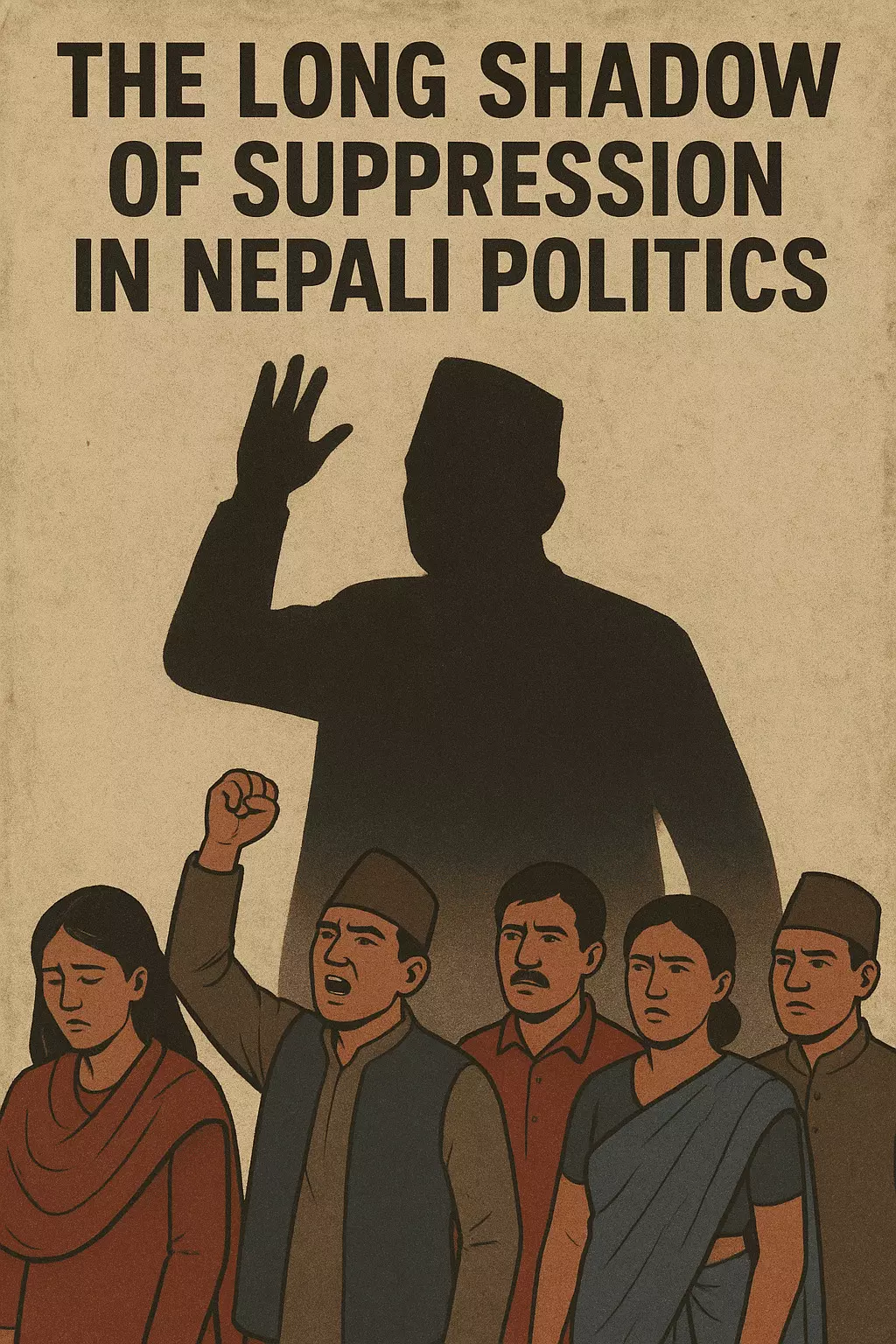
No country, however powerful or insulated, can suppress its people forever without inviting deep and lasting consequences. Nepal’s political journey stands as a stark reminder of this truth, where every attempt at repression has eventually collided with the people’s irrepressible demand for dignity, representation, and justice. From the autocratic Rana regime to the partyless Panchayat system and the monarchy’s efforts to stifle dissent, Nepal has endured decades of political suppression. Each phase ultimately unraveled—not because of external forces, but because Nepalis themselves refused to be silenced. The consequences of these cycles are not relics of history; they continue to haunt the country’s fragile democracy, fractured political culture, and uncertain future.
Suppression in Nepal has rarely taken the form of brute violence seen elsewhere. Instead, its subtler expressions—censorship, elite capture, exclusionary governance, and institutional decay—have proved equally corrosive. When dissent is treated as a threat rather than a right, trust in institutions evaporates. Legitimacy, once lost, is not easily restored. Citizens come to see the state less as a guarantor of rights and more as a gatekeeper of privilege. The gulf between rulers and ruled widens. Governance loses its moral anchor, policies become performative, and instability becomes the norm. In Nepal, this has manifested in fragile governments collapsing under factionalism, opportunism, and public disillusionment. The federalism promised by the 2006 People’s Movement and peace process remains unfulfilled, as local bodies struggle against the weight of entrenched central authority.
The generational costs are equally stark. Young Nepalis, disillusioned by repeated betrayals of democratic ideals, increasingly disengage from politics. This is dangerous—not because it breeds apathy, but because it leaves space for radicalism. The Maoist insurgency, born of decades of exclusion and repression, was not an anomaly but a symptom of systemic failure. Even today, unresolved transitional justice, lingering grievances, and a self-serving political class underscore how suppression doesn’t silence—it drives dissent underground until it explodes. Nepal’s past is littered with such eruptions, each more costly than the last.
If these patterns persist, Nepal risks permanent volatility. Coalition reshuffles, personality-driven politics, and the absence of ideological clarity all point to a democracy struggling to mature. Without accountability, even good policies collapse under suspicion. Development falters not from lack of resources, but from lack of trust. Investors hesitate, aid partners grow cautious, and citizens turn cynical. In such an environment, progressive reforms are easily derailed. Worse still, Nepal’s geopolitical vulnerability grows—a distracted state becomes a pawn in the strategic games of India, China, and the West, all eager to assert influence in a region that is symbolically and strategically vital.
The path forward lies in shifting from performative democracy to participatory democracy. This requires more than institutional tinkering; it demands cultural transformation. Dissent must be protected, not punished. Local governance must be empowered, not sidelined. Transitional justice must be pursued sincerely, not delayed endlessly. Media freedom and civic education must be prioritized so citizens can engage meaningfully in public life. These are not lofty ideals but urgent necessities for a democracy that seeks to endure. Nepalis have shown, time and again, that they will not be silenced. The real question is whether the political class will listen—before the next rupture.
Failure to do so will keep distorting Nepal’s democratic journey. The costs may not be immediate, but they will be profound. A society that cannot speak freely cannot think freely. And a society that cannot think freely cannot govern itself with wisdom or compassion. Nepal stands at a crossroads—politically and morally. The choice is clear: deepen democracy or hollow it out; listen to the people or silence them; build a future rooted in justice or repeat the mistakes of the past. The stakes could not be higher, and the time to act is now.