The UGC Equity Regulations: A Gamble That Turned Into a Political Firestorm
UGC Equity Regulations spark protests & political controversy, raising questions on equity, merit & politics in Indian education.
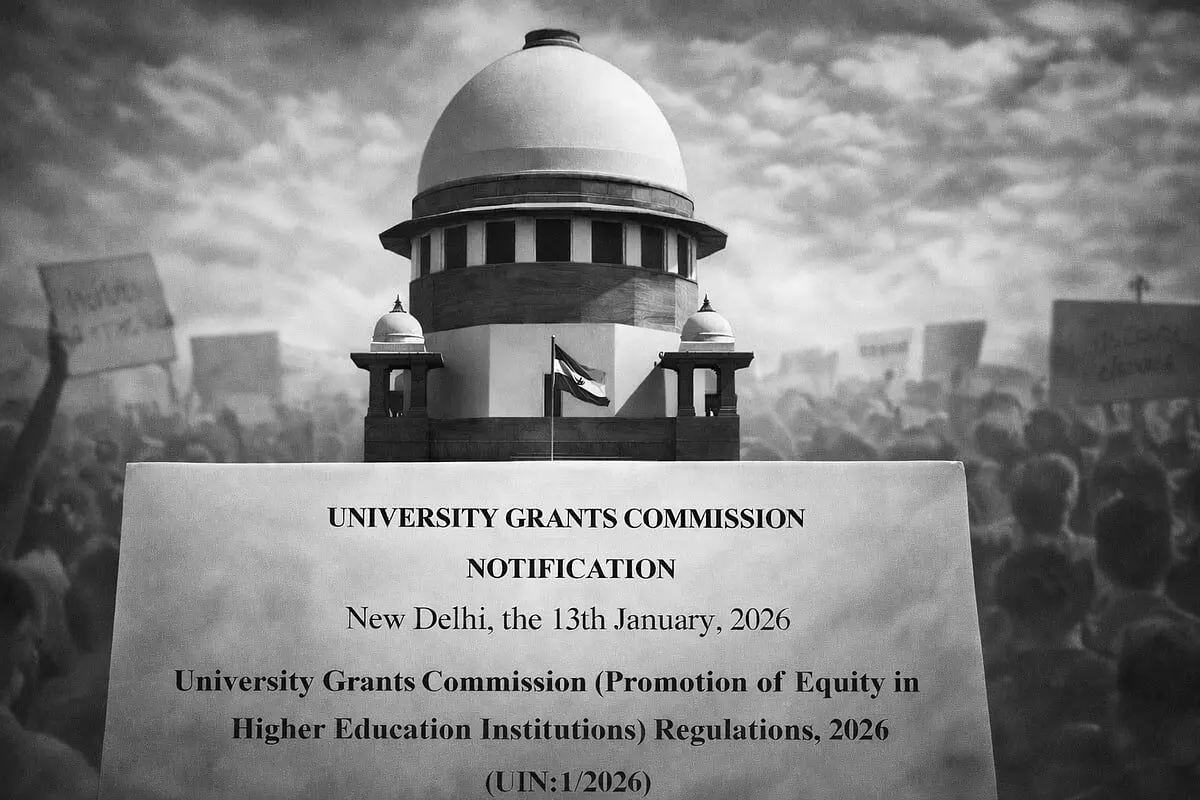
The University Grants Commission’s (UGC) Promotion of Equity in Higher Education Institutions Regulations, 2026 were introduced with the stated aim of curbing caste-based discrimination and ensuring inclusivity across campuses. Yet, within days of their notification, the rules triggered a wave of protests from Delhi University’s North Campus to Lucknow University, exposing the deep fissures in India’s social and political landscape. What was meant to be a progressive step toward equity has instead become a lightning rod for discontent, particularly among upper-caste students who see the regulations as divisive and unfair. The Supreme Court’s decision to stay the regulations, citing vagueness and potential misuse, has only intensified the debate, pushing the controversy into the heart of India’s political discourse.
At the core of the protests lies a perception problem. Students opposing the regulations argue that while the intent may be noble, the execution is fraught with ambiguity. The requirement for institutions to set up Equal Opportunity Cells and grievance mechanisms is seen by critics as a bureaucratic imposition that could be weaponized. The Union Education Minister Dharmendra Pradhan’s assurances that “no one can misuse the law” have done little to quell the unrest, as students remain unconvinced about the safeguards. The protests are not isolated incidents but part of a broader backlash against what many perceive as the politicization of education policy.
The political fallout has been swift. Shyam Sundar Tripathi, vice-president of the BJP Kisan Morcha in Rae Bareli, resigned in protest, calling the regulations divisive. His resignation underscores the growing discomfort within sections of the BJP’s own support base. Analysts point out that the regulations were introduced with an eye on consolidating SC, ST, and OBC votes ahead of upcoming elections. However, the backlash from upper-caste groups—traditionally a stronghold for the BJP—suggests that the move may have backfired. The party now finds itself caught between appeasing marginalized communities and managing resentment among its core supporters.
Experts have long warned about the dangers of using education policy as a tool for electoral gain. Historian Ramachandra Guha once noted that “when politics enters the classroom, pedagogy suffers.” The current controversy seems to validate that concern. By framing equity regulations in a way that appears politically motivated, the government has inadvertently undermined their legitimacy. Constitutional scholars have also raised alarms, pointing out that the regulations, as drafted, risk violating Articles 14 and 15 by creating new forms of exclusion under the guise of inclusion.
The Supreme Court’s intervention has added another layer of complexity. Chief Justice Surya Kant described the regulations as “completely vague” and prone to misuse, ordering the government to redraft them. Until then, the 2012 UGC regulations will remain in force. This judicial pause reflects a broader skepticism about the government’s approach. Legal experts argue that while equity in education is a constitutional imperative, the framework must be precise, transparent, and free from political overtones. The court’s stance has emboldened protestors, who now see their grievances validated at the highest level.
The controversy also highlights a recurring tension in Indian higher education: the balance between social justice and meritocracy. Proponents of the regulations argue that marginalized students continue to face systemic discrimination, and institutional mechanisms are necessary to level the playing field. Critics counter that such rules risk deepening divisions, fostering resentment, and eroding academic standards. This debate is not new. In 2006, when the government expanded reservations in higher education, similar protests erupted, with medical students staging hunger strikes. Then, as now, the issue was not merely about policy but about identity, fairness, and the future of India’s youth.
Political analysts suggest that the government underestimated the symbolic power of education. Unlike economic policies, which can be debated in abstract terms, education touches the aspirations of millions of families. Any perception of unfairness in this domain quickly translates into anger on the streets. The protests at Delhi and Lucknow are emblematic of this dynamic, where students see themselves not just as stakeholders but as defenders of a merit-based system under threat.
The resignation of Tripathi is particularly telling. It signals that the discontent is not limited to students but extends into the political class. For the BJP, this is a precarious moment. The party has built its electoral strategy on a delicate coalition of caste groups. By introducing regulations perceived as favoring one set of communities, it risks alienating another. The optics of protests in university campuses—often seen as incubators of political consciousness—could have long-term consequences for the party’s image among youth voters.
Looking ahead, the Supreme Court’s March 19 hearing will be pivotal. If the government fails to present a clearer, constitutionally sound framework, the regulations may be struck down entirely. That would not only be a setback for the BJP’s political calculus but also a missed opportunity to advance genuine equity in higher education. Experts like sociologist André Béteille have argued that “equity must be pursued with sensitivity to context, lest it become a source of new inequalities.” The current controversy illustrates precisely that danger.
In the end, the UGC equity regulations have become more than a policy dispute; they are a mirror reflecting India’s unresolved tensions around caste, merit, and politics. What began as an attempt to institutionalize fairness has spiraled into a confrontation that threatens to destabilize campuses and erode trust in governance. The government’s challenge now is not merely to redraft the regulations but to rebuild confidence—among students, educators, and the broader public—that equity can be pursued without sacrificing merit or being hijacked by political agendas. Whether it succeeds will depend on its ability to listen, adapt, and rise above the temptation to use education as a tool for electoral arithmetic.