Vijay’s Political Entry Sparks Student Interest in Tamil Nadu Politics
Chennai: Tamil Nadu has a long and layered history of cinema intersecting with politics. From C. N. Annadurai and M. Karunanidhi to M. G. Ramachandran, J. Jayalalithaa and Vijayakanth, the state has repeatedly witnessed film personalities transform mass appeal into political capital. But the political arrival of actor Vijay appears to be unfolding along a different trajectory — one that extends beyond rally grounds and into classrooms.
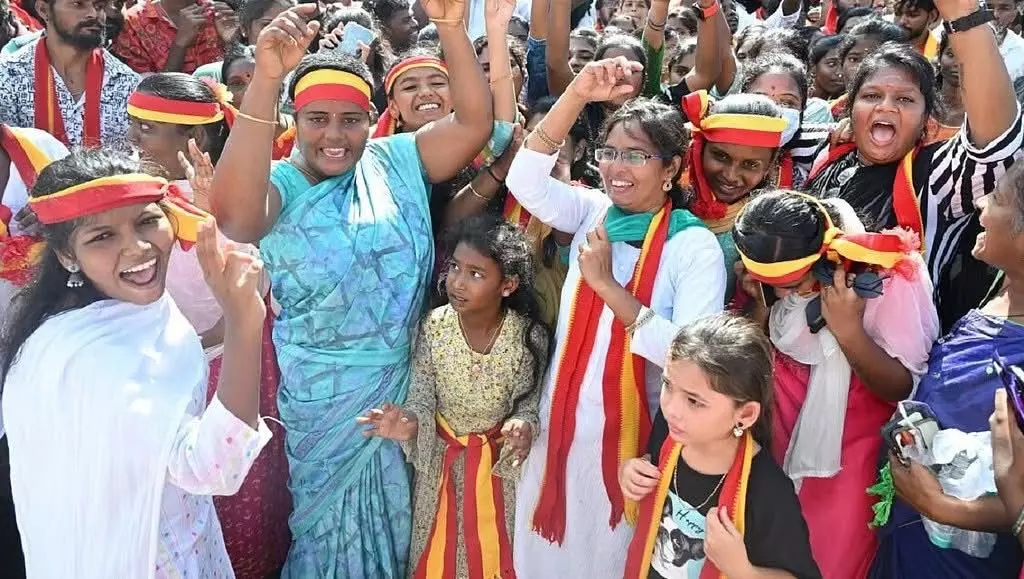
Over the past two years, particularly following his high-profile public meetings, there has been a noticeable spike in political conversations among school and college students. In several households, parents privately acknowledge that children — some not yet eligible to vote — are urging them to support Vijay. The phenomenon raises a larger question: is this the flowering of early democratic awareness, or the by-product of celebrity-driven politics?
Cinema to Citizenship
Vijay’s screen persona has long projected him as a corrective force — a lone figure challenging injustice, confronting authority and delivering swift solutions. That image, political observers say, is now being extended into public life. Unlike conventional political leaders who build ideological narratives over decades, Vijay’s appeal rests heavily on emotional identification.
At public gatherings, he speaks in a conversational tone, often invoking sacrifice — suggesting he is stepping away from superstardom to serve the people. For adolescents who have grown up watching him dominate the screen, the shift from cinematic hero to political aspirant appears natural, even inevitable.
A senior political analyst notes that Gen Z — broadly those born after the late 1990s — forms a significant segment of this support base. “Political awareness at a young age is not inherently negative,” he says. “But politics is about governance, economy, institutions and long-term policy. If the engagement is personality-centric rather than issue-based, it risks becoming superficial.”
Emotional Connect vs Ideological Clarity
Observers point out that Vijay’s political journey so far has prioritised symbolic outreach over structured party-building. His appearances generate fervour; social media amplifies the sentiment. However, critics argue that policy articulation remains limited.
A Chennai-based social activist working with children says the trend must be viewed in context. “For decades, political discussions at home were dominated by adult men. Now, women and even schoolchildren are participating. That signals democratic expansion. But schools do not systematically teach political literacy. Without that grounding, emotional mobilisation can outpace informed judgement.”
Inside the Classroom
Sridharan, a government school teacher, recounts a recurring classroom exercise. During a lesson on leadership, he asks students to define a “hero.” The names that surface include film stars — with Vijay frequently topping the list.
“When asked why, students say heroes solve problems and protect people,” he explains. “But when I ask who actually resolves their daily difficulties, they mention parents, teachers and neighbours. There is a disconnect between cinematic imagination and civic reality.”
He adds that children often equate visibility and authority with leadership. “Our curriculum discusses political structures, but rarely the lived meaning of democracy. In that vacuum, cinema becomes a reference point.”
A Divided Assessment
Professor Manjula, a political science academic, expresses caution. “Every new political entrant deserves scrutiny. The concern arises when young minds advocate passionately without understanding ideology or governance models. Politics is not a duel between personalities; it is about social and economic direction.”
At the same time, some analysts observe that Vijay’s emergence has subtly altered the political climate. Established parties — including the Dravida Munnetra Kazhagam and the All India Anna Dravida Munnetra Kazhagam — are recalibrating strategies in response to his growing visibility. Whether this translates into electoral impact remains to be seen.
The Road Ahead
Tamil Nadu’s political culture has always embraced strong personalities. But durable leadership in the state has historically been anchored in ideology, organisational depth and welfare frameworks. Vijay’s challenge lies in transitioning from emotive appeal to structured political articulation.
For students and young followers, the moment presents both opportunity and risk. Early political curiosity can mature into informed citizenship — provided it is nurtured with critical thinking. Without that, enthusiasm may remain tethered to fandom.
As the state approaches another electoral cycle, the larger test will not simply be Vijay’s vote share. It will be whether this surge of youthful interest evolves into democratic literacy — or remains a reflection of the enduring power of the silver screen.