Vijay’s Solo Political Gamble Shakes Tamil Nadu: Internal Surveys Hint at 80-Seat Upset in 2026 Elections
Actor-turned-politician Vijay’s anti-corruption plank and independent strategy unsettle DMK, AIADMK and BJP as internal assessments संकेत major electoral disruption
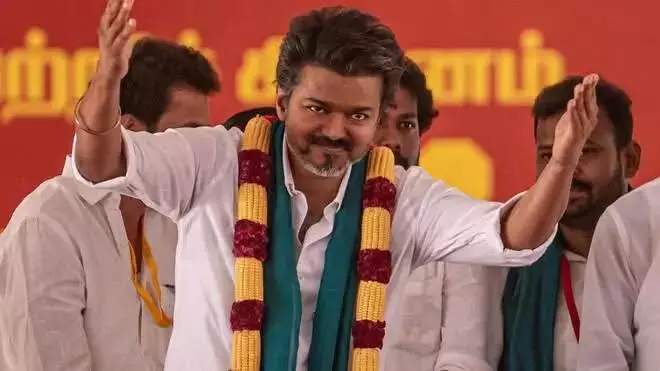
In a development that is sending ripples across Tamil Nadu’s political landscape, actor-turned-politician Vijay is emerging as a formidable independent force ahead of the 2026 Assembly elections. His calibrated political moves, backed by internal assessments and a strong anti-corruption plank, are beginning to unsettle entrenched players across the spectrum.
The growing traction around Vijay’s possible solo electoral debut has reportedly triggered unease not just within the ruling Dravida Munnetra Kazhagam (DMK) and the principal opposition All India Anna Dravida Munnetra Kazhagam (AIADMK), but also within the Bharatiya Janata Party (BJP). Political observers note that his refusal to pursue coalition arithmetic in favour of a “policy-first” approach marks a departure from Tamil Nadu’s alliance-driven electoral tradition.
Sources indicate that Vijay has been invoking past electoral setbacks of major parties—even when backed by expansive alliances—to underline his argument that ideological clarity outweighs coalition strength. “Policy over permutations” appears to be the central message being relayed to his cadre.
Leaked inputs from what are described as internal assessments—conducted by both rival party networks and Vijay’s own organisational outreach—suggest that a standalone contest could yield significant returns. Projections indicate that Vijay may be competitive in no fewer than 80 constituencies, with a realistic pathway to majority victories in a substantial segment of them.
These findings, though unverified independently, have intensified discussions within political circles about the possibility of a credible third axis in a state long dominated by Dravidian majors. Vijay is said to have conveyed confidence to close aides that he has tapped into the aspirations of grassroots workers seeking an alternative political narrative.
Beyond electoral arithmetic, there are indications that Vijay’s political assertiveness is also shaped by personal experiences. Individuals familiar with his thinking suggest that past attempts to obstruct his film releases, public threats, and the amplification of private family matters in the public domain have contributed to his decision to assert his identity more forcefully in the political arena.
However, those close to the development emphasise that the larger framing remains political rather than personal—anchored in governance and institutional credibility.
“Corruption-Free Governance, No Compromise”
Vijay’s messaging is being built around a twin commitment: corruption-free governance and an uncompromising policy framework. Party insiders say he is preparing to enter the fray without yielding to pressure from established power blocs, positioning himself as a candidate of clean administration and decisiveness.
By choosing a solitary path instead of coalition politics, Vijay is attempting to disrupt a deeply embedded electoral model. Analysts point out that while star power may provide initial momentum, the durability of his challenge will depend on booth-level organisation and voter conversion.
Even so, early indicators—from cadre mobilisation to internal polling—suggest that his entry could redraw electoral equations in 2026. Supporters argue that his emphasis on integrity and consistency may resonate with an electorate increasingly disillusioned with traditional alignments.
Whether this momentum translates into electoral gains remains to be seen, but for now, Vijay’s rise has clearly injected a new layer of unpredictability into Tamil Nadu’s political contest.