Vijay’s Tamilaga Vettri Kazhagam: New Political Force in Tamil Nadu 2026
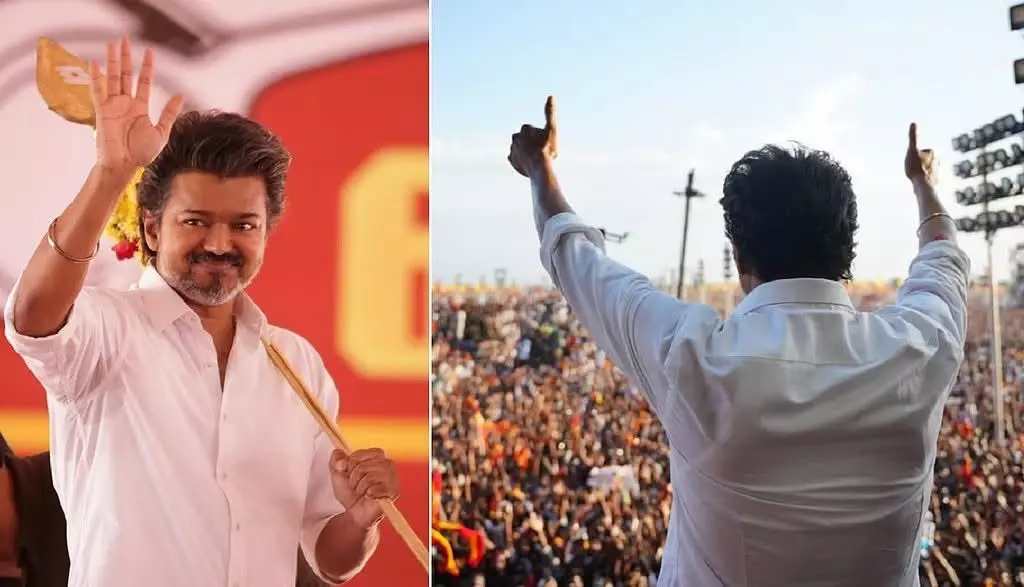
When actor-turned-politician Vijay launched his party Tamilaga Vettri Kazhagam, it was projected as the newest disruptor in Tamil Nadu’s bipolar political arena. In a State long dominated by the DMK and the AIADMK, the emergence of TVK ahead of the 2026 Assembly elections generated uncommon curiosity. But as alliance arithmetic hardens and political conversations move from optics to organisation, a more uncomfortable question is surfacing: is Vijay relying on confidence — or overconfidence?
For months, TVK functionaries waited in anticipation. The expectation was that smaller parties, eager to improve their bargaining power with the two Dravidian majors, would use Vijay’s entry as leverage. In private conversations, the talk was of a “third space” that could redraw the board. Instead, what unfolded was classic Tamil Nadu coalition politics. Regional players negotiated hard with the principal alliances, extracted favourable seat-sharing arrangements, and quietly moved on. TVK, despite the noise around it, remained largely untouched.
There was an early belief among sections of Vijay’s supporters that politics could mirror cinema — that dramatic entry, a couple of large conferences in 2024 and 2025, curated public interactions, and a sharp anti-incumbency pitch could compress the timeline to Fort St. George by May 2026. Cinema permits swift transformation; politics does not. It is an unforgiving terrain where organisation, booth committees, caste equations and financial stamina determine outcomes more than applause. The emotional speech delivered by Vijay at Vellore recently was read by observers as a recognition of this harsh reality.
The 2026 election is not merely another contest between DMK and AIADMK. For TVK, it is an existential test. The initial calculation, party insiders admit, was that the promise of a share in governance would draw parties such as the Viduthalai Chiruthaigal Katchi, Desiya Murpokku Dravida Kazhagam, the Amma Makkal Munnetra Kazhagam, and Left formations into its fold. The assumption was that a broad coalition could, at least theoretically, threaten the established blocs. Instead, these parties appear to have used the possibility of a Vijay alignment as negotiating capital before settling where their interests were better served.
The Karur episode — politically and organisationally bruising for the fledgling party — forced a recalibration. There were exploratory feelers to the Indian National Congress, including suggestions of reciprocal understandings beyond Tamil Nadu. Those conversations, however, did not mature into anything concrete. The message from established players was clear: enthusiasm around a personality does not automatically translate into negotiable strength.
More troubling for TVK is the emergence of internal fissures even before electoral baptism. In most parties, factionalism follows success. Here, district-level rivalries and gatekeeping by emerging second-rung leaders are already being spoken of. Access to Vijay, cadres say privately, is increasingly mediated. For potential allies watching from the outside, this does not inspire confidence about cohesion.
Ideologically too, the messaging appears uneven. Vijay has been consistent in his attacks on the ruling DMK, framing it as his principal political adversary. At the time of launching TVK, he was equally sharp in describing the Bharatiya Janata Party as a policy-level opponent. Yet, critics point out that his recent speeches have focused overwhelmingly on the DMK, with far less emphasis on the BJP. In a State where ideological positioning often determines alliance comfort, such shifts do not go unnoticed.
The gap between spectacle and structure is visible in numbers as well. When applications for party posts and electoral aspirations were invited, nearly 50,000 forms were reportedly issued, both online and offline. The number of completed submissions that returned was a fraction of that. Crowds at roadshows and viral metrics on social media create momentum; they do not, by themselves, build polling-day machinery.
Plans for sustained weekly public outreach, announced with flourish, tapered off within weeks. With the Election Commission expected to announce the poll schedule in the coming months, Vijay is yet to comprehensively tour large parts of the State. For a new party seeking booth-level penetration, time is not an elastic resource.
TVK supporters insist that the swelling crowds wherever Vijay travels are proof of an undercurrent waiting to crystallise. Tamil Nadu’s electoral history, however, offers cautionary tales. Visibility is not viability. Applause is not arithmetic.
Whether Vijay’s resolve is steady confidence or a case of reading the moment too generously will be determined not on social media feeds but inside ballot boxes. The 2026 Assembly election will tell him — and Tamil Nadu — whether TVK is a passing surge or a structural shift in the State’s political narrative.