When Telegrams Delivered Election Funds: Congress Tales from 1993
Before online transfers and EC limits, party funds once travelled by telegrams and taxis. A reporter recalls Congress’s cash distribution during 1993 polls.
Now that the Election Commission of India has announced the Bihar Assembly election schedule, some old stories about how political parties once funded their campaigns have begun to resurface.
When I was posted in Jaipur, I came across one such story that has stayed with me. Prabodh Rawal, a former Home Minister of Gujarat and once the president of the Gujarat Congress Committee, was in charge of the Rajasthan Assembly elections in 1993. He was camping at Khasa Kothi, the VIP guest house, along with AICC secretary Rajubhai Parmar.
I knew both of them from my earlier posting in Ahmedabad. For news gathering, I met them almost every morning over breakfast. One morning, I found two tall policemen from Haryana posted outside Prabodhbhai’s room. I was told Bhajan Lal had sent two large steel trunks packed with currency notes meant for distribution among the Congress candidates.
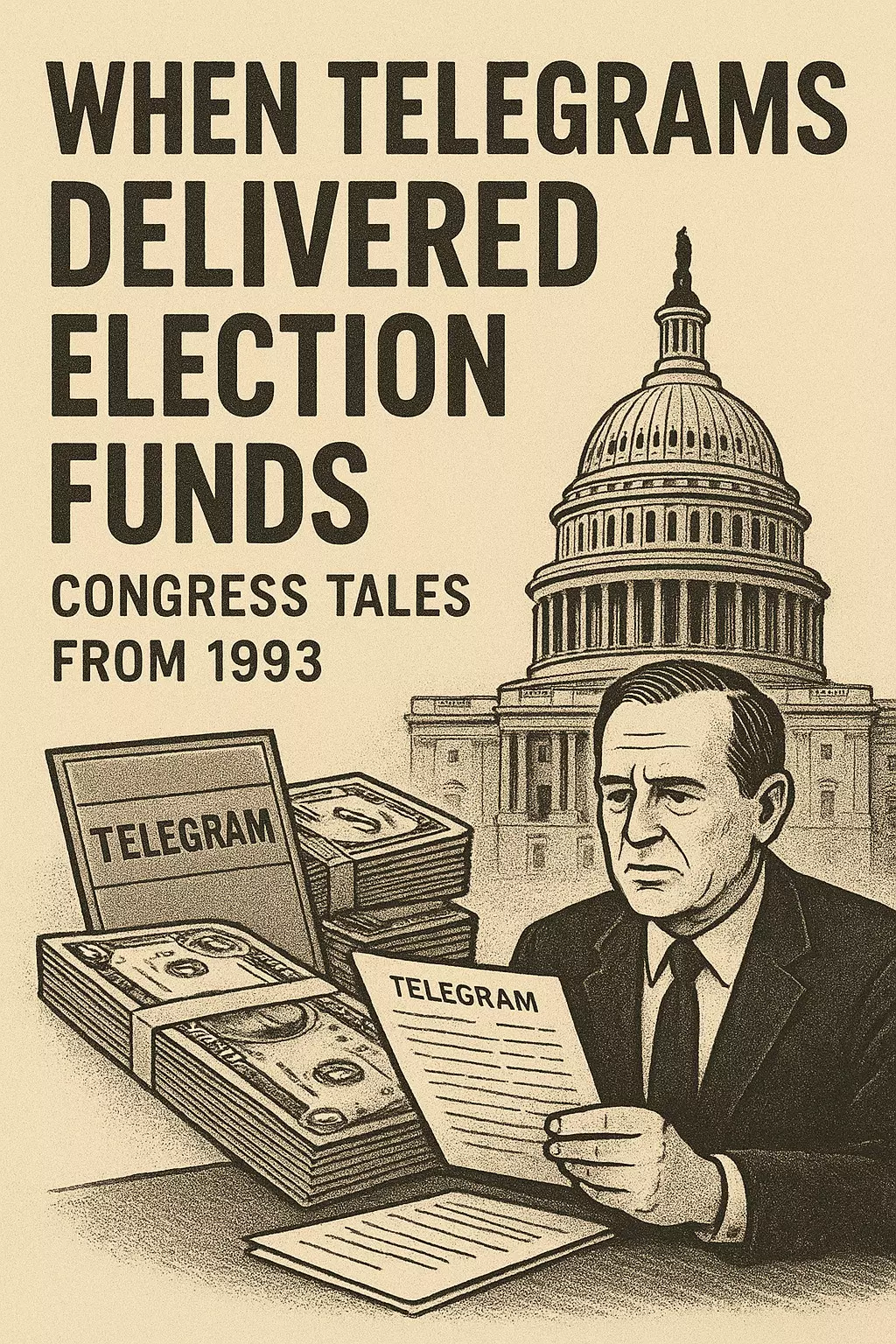
After 10 a.m., candidates or their nominees began arriving at Khasa Kothi. It was Rajubhai Parmar’s duty to hand over the bundles of cash after collecting telegrams sent to them by the party office. The amounts varied from constituency to constituency.
Senior party leaders like Pranab Mukherjee, Priyaranjan Das Munshi and Sudhakar Reddy were also in Jaipur at the time. They stayed in five-star hotels across the Pink City, holding strategy meetings at the farmhouse of Harideo Joshi on Ajmer Road.
Candidates or their representatives travelled from distant corners — Sri Ganganagar, Suratgarh, Sawai Madhopur. The telegrams served as their only proof of identity for receiving funds.
A similar system worked elsewhere. In Bhubaneswar, the residence of Ms. Nandini Satpathy in Unit VI served as the treasury for Congress candidates. A favourite of Mrs. Indira Gandhi, Satpathy once showed me two large steel almirahs, explaining that during election time, both would be stuffed with currency notes. S. Nijalingappa had collected funds from top industrialists and authorised her to disburse them among party candidates contesting the Odisha Assembly polls. Each candidate signed a register before receiving their share, and Satpathy ensured not a single rupee was taken off a bundle.
In Bihar, however, the operation was more decentralised. Packets of cash were sent overnight through taxis to different destinations. Complaints would often surface — some candidates claimed the funds they received had “cuts” in them.
Over the years, of course, the system has become more formal — at least on paper. Since 2010, the official spending limit for Lok Sabha candidates has more than doubled. In 2011, the ceiling was ₹40 lakh for large states and ₹22 lakh for smaller ones. Ahead of the 2014 general elections, it rose to ₹70 lakh (₹54 lakh for smaller states), with another 10% hike in 2020. The Election Commission revised it again in 2022 — ₹95 lakh for most states and ₹75 lakh for smaller ones — the limit that applied during the 2024 polls.
That’s an increase of ₹55 lakh in big states and ₹53 lakh in smaller ones since 2011 — roughly two and a half to three and a half times higher.