India’s Gamble with Pax Silica: Breaking Chains or Building Illusions?
Explore India’s entry into the US-led Pax Silica coalition—its bold tech ambitions, industrial challenges, and the test of true self-reliance in semiconductors.

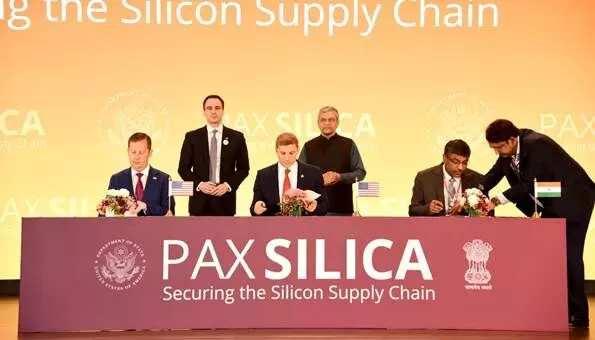
India’s formal entry into the US-led Pax Silica coalition is being celebrated as a historic moment—a bold declaration that New Delhi will no longer remain hostage to China’s stranglehold over semiconductors and rare earths. Yet beneath the grandeur of speeches and declarations lies a paradox that demands deeper scrutiny. For decades, India has struggled to build even the most basic engines and generators indigenously, while simultaneously boasting of satellites to Mars at the cost of a bus ticket. The contradiction is glaring: a nation that cannot master everyday industrial hardware now promises to secure the commanding heights of frontier technology.
The rhetoric at the AI Impact Summit 2026 was thunderous. US officials warned of coercion and cyber threats, invoking the spectre of Mumbai’s 2020 blackout as evidence of vulnerabilities. Indian ministers spoke of resilience, of 2-nanometer chip designs, of ten semiconductor plants nearing production. But the question remains: is this ambition grounded in reality or inflated by political theatre? The coalition’s language—“securing the silicon stack”—is compelling, yet India’s track record in industrial self-reliance is sobering. Even drones at weddings are imported, yet the nation now claims to be a trusted hub for global semiconductor supply chains.
Critics will argue that Pax Silica is less about India’s current capacity and more about geopolitics. With China controlling 61% of rare earth production and 92% of processing, the coalition is designed to dilute Beijing’s leverage. India’s inclusion is symbolic: a vast market, a strategic partner, a democracy positioned against authoritarian supply chains. But symbolism cannot substitute for substance. Without massive investment, transparent governance, and genuine research ecosystems, India risks becoming a junior partner in a coalition that demands industrial muscle it does not yet possess.
The danger is clear: great rhetoric often leads to great failure. When universities parade borrowed inventions as indigenous breakthroughs, when ministers announce quantum computing before labs are funded, when alliances are signed without domestic capacity, the bargain struck is not with truth but with the future itself. Pax Silica may indeed offer India an opportunity, but opportunity without preparation is an illusion. The coalition is designed to secure the entire silicon stack—from mines to fabs to AI deployment—but India’s domestic ecosystem remains fragile. Announcements of 2-nanometer chip designs sound impressive, yet without fabrication plants, supply chains, and skilled manpower, they risk becoming slogans rather than achievements.
India’s entry into Pax Silica should be remembered not as a triumph but as a test. It is a chance to prove that slogans can be matched with substance, that declarations can be grounded in delivery. Otherwise, the coalition will expose India’s fragility rather than its strength. The irony is unavoidable: a nation that dreams of leading the world in AI and semiconductors allocates less than 2% of its budget to education and research, while global giants pour tens of billions into innovation. The gap between ambition and resources is not just wide—it is dangerous.
The coalition itself is not without merit. By joining Pax Silica, India signals to the world that it seeks trusted partnerships, resilient supply chains, and strategic autonomy. It is a geopolitical move designed to counterbalance China’s dominance, and in that sense, it is necessary. But necessity alone does not guarantee success. India must now confront the hard questions: can it build the industrial base required to sustain this partnership? Can it reform its universities, research institutions, and grading systems to prioritise authenticity over spectacle? Can it invest at a scale that matches its rhetoric? Without such steps, Pax Silica risks becoming another chapter in India’s long tradition of speeches that soar higher than satellites but land with the weight of imported generators.
The lesson is timeless. Betrayal never comes from strangers—it comes from within, when nations deceive themselves with borrowed glory and mistake theatre for leadership. Pax Silica offers India opportunity, but opportunity without preparation is illusion. The incident, though unfortunate, reiterates that great rhetoric often leads to great failure—when a university begins to deceive, know that a bargain has been struck not with truth, but with the future itself. And in that exposure lies the warning that binds this entire story: betrayal never comes from strangers; it comes from within.