America’s Reckoning and the World’s Reminder When power forgets people, the streets remember
Over seven million Americans join the “No Kings” protests, warning that democracy is not a crown but a contract amid Trump’s second-term controversies.

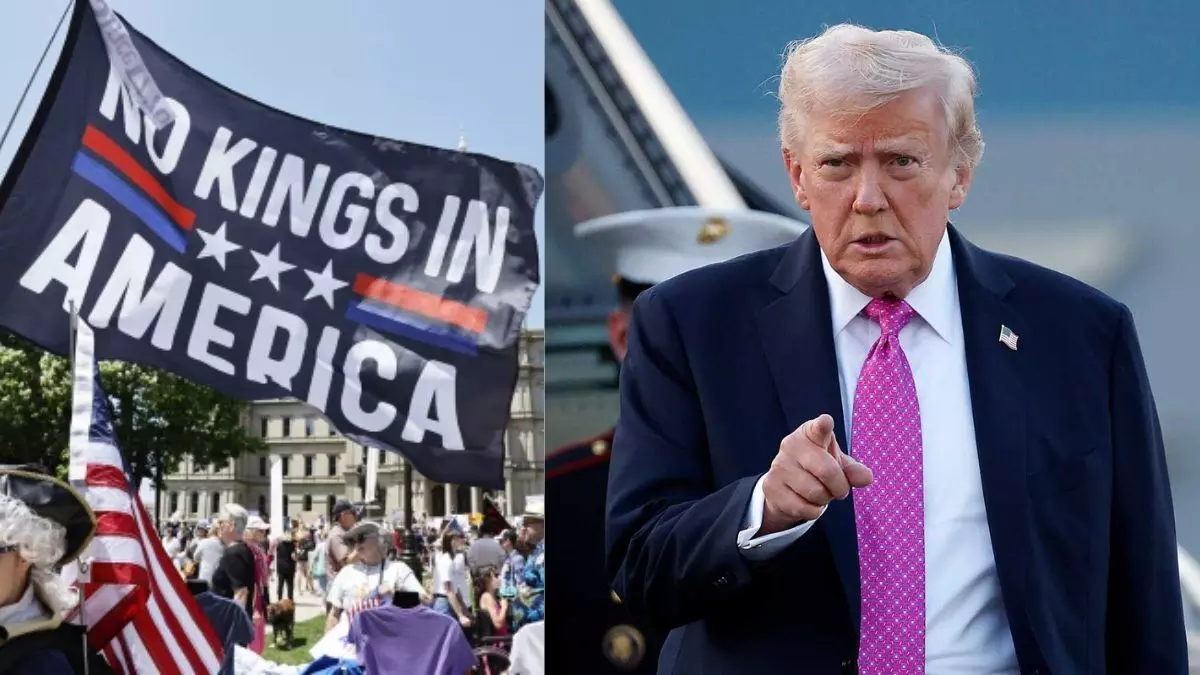
Images Credit - Financial Express
On October 18, 2025, the United States witnessed a civic upheaval unlike anything seen in its modern history. Over seven million citizens across 2,700 cities poured into the streets under the banner of the “No Kings” protest—a massive mobilisation against what demonstrators called President Donald Trump’s authoritarian drift. From Anchorage to Miami, from the heart of Washington, D.C., to the smallest town squares of the Midwest, the message thundered in unison: democracy is not a crown—it is a contract.
The spark that ignited this wave of defiance was not a single policy but an accumulation of actions that many saw as the death knell of constitutional restraint. Operation Patriot 2.0, a federal immigration sweep, had led to mass arrests and deportations, targeting thousands of undocumented residents and even some legal immigrants. Trump’s controversial threat to relocate the 2026 FIFA World Cup games from Boston after political disagreements with local authorities deepened the outrage. Matters escalated further when an AI-generated propaganda video circulated online, depicting Trump as a crowned emperor bombing protesters—a grotesque image that CNN and MSN both condemned as “fascistic and obscene.” The talk of invoking the Insurrection Act to deploy the U.S. military against domestic demonstrators only heightened fears that America’s democracy was edging dangerously close to autocracy.
Political commentators swiftly drew parallels between this moment and the Vietnam War protests, the 2020 George Floyd uprisings, and the 2017 Women’s March. Yet most agreed that “No Kings” was unprecedented—not just in scale, but in spirit. The demonstrations were not merely anti-Trump; they were anti-tyranny. Protesters carried placards declaring, “We the People Are the Boss,” “Democracy Dies in Obedience,” and “No More Crowns.” The symbolism was striking—a republic revolting against the very idea of monarchy it had once defeated nearly 250 years ago.
But the deeper fracture within America was not political alone—it was philosophical. A 2025 Pew Research Center survey revealed that only 38% of Americans now believe their democracy is functioning well, while trust in Congress, the Supreme Court, and federal agencies has plummeted to historic lows. Citizens are no longer merely disillusioned with policies; they are disenchanted with the very structure of governance. As political theorist Francis Fukuyama once warned, “When democratic institutions cease to perform, people cease to believe.” That prophecy seems to echo across America today.
The global reverberations were immediate. From London to Berlin, from Toronto to Sydney, solidarity marches erupted under the same slogan—No Kings. Activists warned that if the world’s oldest constitutional republic could stumble, then no democracy was immune. European newspapers described it as “America’s democratic reckoning,” while commentators in Asia saw it as “the empire confronting its conscience.” The symbolism could not be missed: the crisis of democracy had turned transnational.
Indeed, the malaise afflicting the United States mirrors a larger global trend. Across continents, democracy is under siege—not by coups or tanks, but by the quieter weapons of capital, control, and complacency. In Hungary and Poland, populist regimes have eroded judicial independence. In Turkey, dissent is criminalized in the name of national security. In India, critics warn of majoritarian impulses overshadowing pluralism. In China, surveillance capitalism has replaced citizen participation, creating what one scholar called “the digital dictatorship of consent.” The 2024 V-Dem Institute report delivered a sobering statistic: since 1994, only 42% of democracies that began sliding into autocracy have successfully reversed the trend. The rest remain trapped in hybrid regimes—neither fully democratic nor fully dictatorial.
That is why the “No Kings” protest carries significance far beyond American borders. It is not just a domestic revolt; it is a global metaphor for reclaiming democracy as a living principle, not a ceremonial word. History shows that when people rise en masse, they can alter the course of nations. The 1986 People Power Revolution in the Philippines toppled Ferdinand Marcos. The 1989 Velvet Revolution in Czechoslovakia dismantled communist rule. The 2011 Tahrir Square uprising in Egypt forced Hosni Mubarak’s resignation. Yet, as history also reminds us, protest without reform risks repetition. Revolutions succeed not when streets erupt, but when institutions evolve.
In America’s case, the way forward demands more than outrage—it requires reconstruction. Trump’s second term has polarised the nation to its core. His base remains fiercely loyal, convinced that his defiance of the establishment represents patriotism. His opponents, now more galvanised than ever, see his actions as the ultimate betrayal of the republic’s spirit. The No Kings movement—backed by organisations like the ACLU, Indivisible, and Third Act—has transformed into a policy-driven coalition. Its demands include stricter congressional oversight of executive powers, legislation to regulate AI propaganda and protect digital integrity, comprehensive immigration reform rooted in human dignity, and nationwide civic education initiatives to restore democratic trust.
Yet even these measures may only address the symptoms, not the cause. The heart of the crisis is cultural. America must decide whether it still values human dignity over executive spectacle, truth over tribalism, and participation over passivity. For decades, political discourse in the U.S. has been replaced by performative outrage—governance turned into theatre, and accountability into applause. When politics becomes entertainment, democracy becomes entertainment’s casualty.
At its core, the 2025 protest was not an act of rebellion—it was an act of remembrance. It reminded the world that democracy, like faith, must be practiced to survive. It cannot be inherited through constitutions alone; it must be renewed through conviction. Philosopher Hannah Arendt once wrote, “The most radical revolutionary will become a conservative the day after the revolution.” That insight underscores the current dilemma: protest is the spark, but reform is the fuel.
As America confronts its reckoning, the rest of the world watches—and reflects. Are we building democracies with human faces, or regimes with corporate masks? Are we empowering citizens, or entertaining rulers? Are we educating minds, or engineering obedience? The questions transcend geography; they reach into the conscience of every modern state struggling between liberty and order.
From Boston to Berlin, the “No Kings” movement has become a rallying cry for a generation that refuses to accept democracy as a museum artifact. It asserts that democracy is not a brand to be marketed, but a bond to be maintained. It is not a stage for power to perform, but a space for people to participate. And when that bond is betrayed—when leaders mistake loyalty for submission and authority for ownership—the streets will always speak.
In the end, this moment will be remembered not just as a protest against a president, but as a declaration of humanity against hubris. It reminds the world that democracy is not a crown to be worn but a chorus to be heard. And if those in power forget that truth, the echo of the streets—from Washington to Warsaw—will remind them that sovereignty, in its truest form, still belongs to the people.