G20 Summit Adopts Declaration Despite U.S. Boycott as Ramaphosa Asserts Multilateral Unity
South African President announces overwhelming support for outcome document amid spat with Washington, as global leaders push forward on climate, inequality and development priorities in first African G20 presidency.

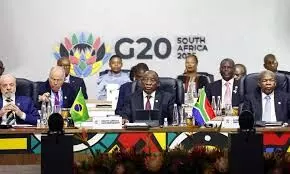
The G20 Summit adopted the Declaration with an overwhelming majority, despite US boycott, sending an important signal to the world that multilateralism can and does deliver.
The announcement was made by South African President Cyril Ramaphosa at the Summit which began early on Saturday with a war of words between Ramaphosa and US over President Dobnald Trump’s boycott of the Summit.
‘’President Cyril Ramaphosa announced that the Declaration from South Africa’s G20 Leaders’ Summit has been adopted by an overwhelming majority of the Group of 20 Member States. The adoption of the Declaration sends an important signal to the world that multilateralism can and does deliver,’’it was posted on the X handle of the Summit
Presidential Spokesperson Vincent Magwenya highlighted the unanimous adoption of the G20 Summit Declaration by all attending countries as a significant achievement for South Africa.
In an interview with SABC he emphasised the importance of this milestone for the country.
Magwenya defined the Summit Declaration as a milestone, positioning it as a practical framework that Member States must implement.
He stressed that translating the agreed statement into concrete actions is more important than diplomatic formality or rhetoric.
As world leaders gathered in Johannesburg, the G20 theme of Solidarity, Equality, Sustainability came alive—reminding that true progress is rooted in unity and shared humanity.
‘’This Summit is a celebration of those who paved the way, those who lead today, and the dreams of tomorrow, as South Africa inspires the world with resilience, dignity, and hope for generations to come.’’
Earlier the G-20 Summit began here on Saturday amid war of words between South African President Cyril Ramaphosa and the US over President Donald Trump’s boycott of the Summit.
The two-day Summit of the world’s 20 most powerful economies, being organized for the first time in South Africa, is being attended by Prime Minister Narendra Modi, French President Emmanuel Macron, Turkish President Recep Erdogan, European Commission President Ursula von der Leyen, Canadian Prime Minister Mark Carney, Australian Prime Minister Anthony Albanese, China’s Premier Li Qiang, French President Emmanuel Macron, Germany’s Chancellor Friedrich Merz, UK Prime Minister Keir Starmer, Brazil’s President Luiz Inacio Lula da Silva, Italian Prime Minister Giorgia Meloni and Japanese Prime Minister Sanae Takaichi among others.
The US President boycotted the Summit in protest against the allegations that South Africa's Black majority government ‘’persecutes its white minority.’’ South Africa vehemently denies the allegations. The US also objected to any mention of climate or renewable energy in the discussions at the Summit.
Ramaphosa had said on Thursday that the US had reached out to South Africa at the last minute to discuss the possible participation. He did not elaborate.
However, US spokesperson Karoline Leavitt said there was no change in the US position and Ramaphosa was “running his mouth.” She said the South African leader’s comments were “not appreciated by the US President or his team.
Significantly, US which is a founder member of G20, will Chair the G20 Summit in 2026. Leavitt said the US will be sending an official for the handover ceremony.
President Ramaphosa hit back saying South Africa will hand over the Chairmanship to an ‘empty chair’’ rather than giving it to an official. The Chairmanship is normally handed over to the Head of State. He said the US is a member of G20. They are an original member of G20 and have every right to attend the Summit.
He, however, said ‘’We will not be bullied.’’
In his inaugural address the South African President emphasised the importance of the Summit which is focused on issues including climate change, debt burdens for developing countries and global wealth inequality.
He said there has been ‘’overwhelming consensus and agreement that one of the other tasks we should undertake right at the beginning is to ... adopt our declaration."
He thanked all delegations who had worked together with South Africa "in good faith to produce a worthy G20 outcome document".
"We should not allow anything to diminish the value, the stature and the impact of the first African G20 presidency," he said.
Ramaphosa expressed confidence that the Summit would proceed successfully despite the US boycott, stating, "Their absence is their loss."
European Commission President Ursula von der Leyen while reacting to the US boycott of the Summit, emphasized the importance of the G20 partnership, announcing a new critical minerals agreement with South Africa ahead of the summit. This move underscores the EU's commitment to strengthening ties with Africa.
Chinese Premier Li Qiang led China's delegation at the Summit in the absence of President Xi Jinping.
World leaders, including German Chancellor Friedrich Merz and Australian Prime Minister Anthony Albanese highlighted their commitment to global cooperation. Albanese emphasized the importance of the G20, citing Australia's trade dependence on G20 partners.
Prime Minister Modi and the Australian Prime Minister held a bilateral meeting on Friday on the sidelines of the Summit. The talks focused on three key sectors--Defence and security, nuclear energy and trade.
After the talks, PM Modi said in a post on X he had a very good meeting with PM Albanese of Australia. "This year, the strategic partnership between our nations completes 5 years and these years have witnessed transformative outcomes that have deepened our cooperation. During our talks today, emphasised three key sectors, defence and security, nuclear energy and trade, where there is immense potential for ties to grow further. The other sectors discussed included education, cultural exchanges and more."
The Australian PM said in a post on X that Australia and India are great friends and partners.
"From trade, defence and security to education and clean energy our relationship is fundamentally important.
The two Prime Ministers also exchanged views on regional and global issues of mutual interest and acknowledged that the frequency of high-level contacts has imparted a strong momentum to bilateral relations. They renewed their commitment to take the India-Australia Comprehensive Strategic Partnership to even greater heights.