Handshake Diplomacy and the Tightrope of Strategic Autonomy
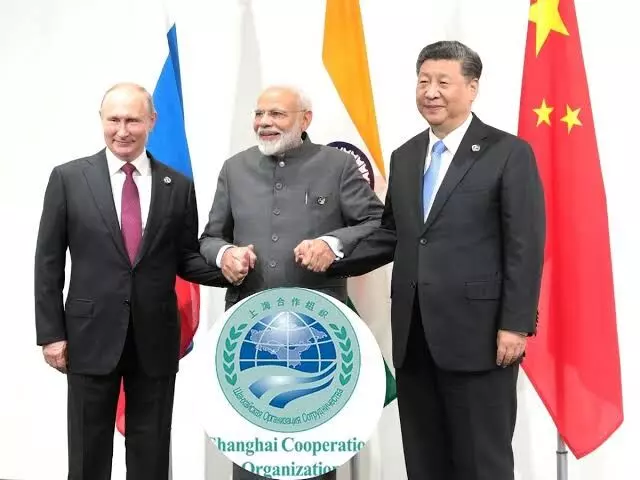
At the SCO Summit in Tianjin, Modi’s camaraderie with Xi & Putin amid Trump’s tariffs signals India’s tightrope of strategic autonomy in geopolitics
Photos/X
Prime Minister Narendra Modi’s visible camaraderie with Chinese President Xi Jinping and Russian President Vladimir Putin at the SCO Summit in Tianjin has sparked a flurry of diplomatic interpretations, especially as visuals of warm handshakes and candid exchanges went viral. In a world increasingly defined by strategic binaries, India’s overtures to Beijing and Moscow—both adversarial to Washington in different theatres—are not just symbolic gestures but calculated moves within a complex matrix of global realignments. At the same time, the United States, through its Embassy and Secretary of State Marco Rubio, has chosen to reaffirm its “enduring friendship” with India, underscoring the resilience of bilateral ties even amid rising tensions over trade and energy.
The juxtaposition of Modi’s outreach to Xi and Putin with Washington’s public messaging reveals the delicate balancing act India is performing. On one hand, the optics of bonhomie with leaders who are increasingly isolated by the West could be read as a signal of defiance or strategic hedging. On the other, the US response—couched in language of partnership and shared progress—suggests a willingness to compartmentalize disagreements and preserve the broader arc of cooperation. This duality is not new to Indian foreign policy, which has long championed “strategic autonomy” as a guiding principle. But the stakes are higher now, as global fault lines harden and economic interdependence becomes a battleground.
The immediate backdrop to this diplomatic choreography is the imposition of steep tariffs by the Trump administration—50% on Indian goods, effective August 27. Ostensibly, these penalties are a response to India’s continued purchase of Russian oil, which Washington claims indirectly funds Moscow’s military operations in Ukraine. But the underlying tensions run deeper. Trump’s repeated characterization of India as a “tariff king” and his frustration with stalled trade negotiations point to a broader dissatisfaction with India’s protectionist stance, particularly in agriculture and dairy—sectors that are politically sensitive and economically vital for millions of Indians.
India’s refusal to open these sectors to US companies is not merely a negotiating tactic; it reflects domestic compulsions and developmental priorities. Modi’s assurance to protect small entrepreneurs, farmers, and livestock rearers is not just rhetoric—it is a political necessity. The livelihoods of vast rural populations hinge on these sectors, and any perceived compromise could trigger backlash. Commerce Minister Piyush Goyal’s statement in Parliament that the government is assessing the impact of tariffs and will take necessary steps to safeguard national interests signals a defensive posture, but also a recognition that the trade dispute cannot be allowed to derail the broader relationship.
Indeed, the launch of discussions for a Bilateral Trade Agreement (BTA) in March, with a target to complete the first stage by October–November 2025, suggests that both sides are still committed to finding common ground. The US messaging around innovation, entrepreneurship, and defence cooperation reinforces this intent. Secretary Rubio’s framing of the friendship as the “bedrock of cooperation” and a driver of economic potential is a strategic counter-narrative to the punitive tariffs—a way of keeping the door open while signaling displeasure.
What complicates matters is the timing and optics of Modi’s engagement with Xi and Putin. China remains a strategic rival, with unresolved border tensions and a history of economic coercion. Russia, while a longstanding defence partner, is increasingly seen in the West as a pariah state due to its actions in Ukraine. Modi’s gestures of warmth toward both leaders could be interpreted as a recalibration, or at least a refusal to be boxed into Western expectations. But they also risk alienating constituencies in Washington that view such moves as undermining collective pressure on authoritarian regimes.
India’s challenge, therefore, is to maintain its strategic autonomy without appearing opportunistic or evasive. The SCO Summit handshake may be a moment of diplomatic theatre, but it also reflects deeper currents—India’s desire to assert its agency, diversify its partnerships, and resist being cast as a junior partner in any bloc. The US, for its part, seems to understand this, choosing to emphasize shared values and long-term potential rather than escalate rhetoric.
Ultimately, the durability of India-US ties will depend on their ability to navigate disagreements without losing sight of common interests. Trade, defence, technology, and people-to-people ties offer ample room for cooperation. But this requires maturity on both sides—a recognition that strategic partnerships are not built on conformity, but on mutual respect and pragmatic engagement. Modi’s handshake diplomacy may raise eyebrows, but it also reaffirms India’s centrality in a multipolar world. The US response, measured and forward-looking, suggests that the relationship is resilient enough to withstand the tremors of tactical divergence.