India, EU Seal Landmark Free Trade Agreement, Creating One of World’s Largest Trading Blocs
Deal announced in presence of Narendra Modi and Ursula von der Leyen as pact boosts exports, counters US tariff pressure and reshapes global supply chains
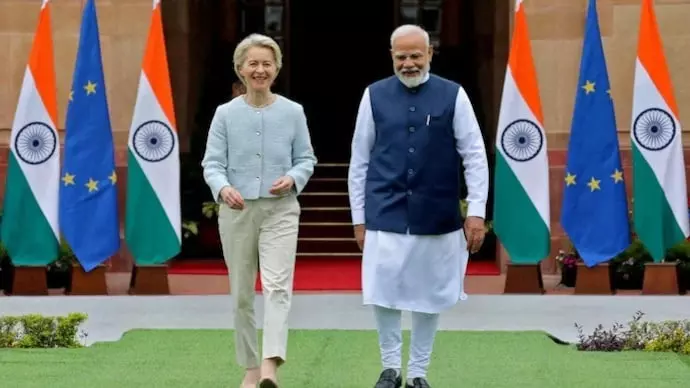
India and the European Union (EU) have finally finalized one of the world's largest free trade agreements. This historic deal was announced in the presence of European Commission President Ursula von der Leyen and Prime Minister Narendra Modi.
This agreement comes at a time when US President Donald Trump's "America First" and heavy tariff policies have created uncertainty in global trade.
This deal will connect the 27-nation European market and the Indian market, with a population of over 1.4 billion, which together account for nearly a quarter of global GDP.
India's impenetrable shield against Trump's heavy tariffs
The heavy tariffs of up to 50% imposed by Donald Trump on Indian exports have created significant difficulties for Indian companies in the US market. In such a situation, this agreement with the EU will serve as a strong alternative and a protective shield for India.
Now, Indian exporters will be able to reduce their dependence on the US and ship their goods to the prosperous markets of Europe without any additional tariffs.
This deal directly challenges Trump's protectionist policies and further strengthens India's position as an alternative trading hub on the global stage.
Indian textile and garment sector to get a boost
India's labor-intensive sectors, especially the textile industry, are expected to benefit the most under this agreement.
Indian textiles currently face a duty of approximately 10% in the European Union, which will be completely eliminated or minimized after the implementation of this agreement.
This will enhance the competitiveness of the Indian textile industry in the international market, enabling India to compete with countries like Bangladesh and Vietnam. This change will not only boost exports but also create millions of new employment opportunities within the country.
Growth will open doors for the leather industry and IT services
Europe is poised to become a large and attractive market for the leather and footwear industries in cities like Agra and Kanpur. With the availability of zero duty, demand for Indian leather products will increase rapidly in European countries.
Additionally, this agreement will prove to be a boon for India's IT sector and professional services. It will now be easier than ever for Indian software engineers and other professionals to work and provide services in Europe, leading to a significant boost in India's service exports.
The high tariff barriers on European luxury cars and wine will fall
The European Union has long demanded that India reduce the high import duties on its cars and wine.
Under this agreement, India has agreed to reduce the high duty on luxury European cars from 110% to an initial 40%, with the possibility of further reductions in the future.
This will make it easier for companies like Volkswagen, Mercedes-Benz, and BMW to expand in the Indian market. Similarly, the market for premium European wines will also open up, providing more choice to Indian consumers.
Strategic Partnership to Reduce Global Dependence on China
This agreement is not limited to trade and profits; it also encompasses a significant global strategic move. Both India and the European Union seek to reduce their supply chain dependence on China.
This deal will encourage European companies to relocate their manufacturing bases from China to India. This will significantly strengthen India's 'Make in India' campaign and establish India as a global manufacturing hub.
GI Tags and Investment Protection for Indian Products
In addition to the trade agreement, both sides are also working on investment protection and securing Geographical Indications. This means that distinctive Indian products such as Darjeeling tea, Kolhapuri chappals, and Kangra paintings will be granted legal protection in Europe.
This will prevent counterfeiting of these products and enhance their brand value internationally. In return, India will provide similar legal protection to products like champagne and specialty European cheeses in its market.
Environmental Standards and Addressing the Challenge of a Carbon Tax
The "Carbon Border Adjustment Mechanism," also known as the carbon tax, has been a complex issue throughout these negotiations, as the EU's environmental standards are very stringent.
India has consistently argued that such stringent taxes should not be imposed on developing countries. In this agreement, both sides have adopted a middle path, agreeing to strike a balance between environmental protection and trade interests.
This will ensure that the carbon tax does not have a significant negative impact on key Indian industries like steel and aluminum.