Iran’s Unraveling and What It Means for India

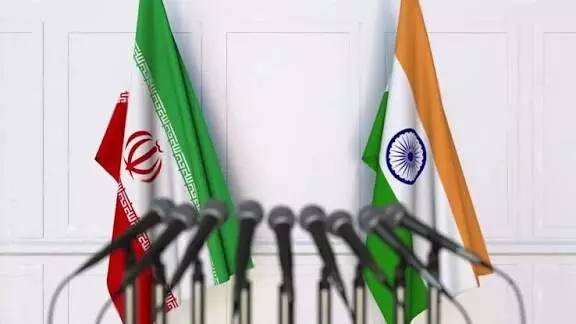
The shuttered shops of Tehran’s Grand Bazaar tell a story India cannot afford to ignore. As protests erupt across Iran over spiraling inflation and a collapsing rial, New Delhi faces an uncomfortable reality: a key strategic partner is sliding toward potential instability, and India’s carefully calibrated balancing act in the region is becoming increasingly precarious. What began as merchant protests over rising prices has evolved into a broader crisis of governance—one that carries profound implications for India’s energy security, regional connectivity ambitions, and diplomatic positioning between Washington and Tehran.
For India, Iran has never been simply another Middle Eastern state. The relationship is anchored in civilizational ties, geographic proximity, and hard strategic interests. Iran represents India’s gateway to Afghanistan and Central Asia through the Chabahar port project. It has been a crucial energy supplier, accounting for significant oil imports before U.S. sanctions forced a drastic reduction. The two nations share concerns about Sunni extremism in Afghanistan and Pakistan, and Iran offers India a counterweight to Pakistan’s alliance with Saudi Arabia and the Gulf states. This multifaceted relationship has survived revolution, war, and sanctions—but it may now face its sternest test.
The immediate concern for India is economic. Iran’s crisis has already disrupted bilateral trade, which plummeted from over $17 billion in 2018-19 to less than $2 billion in recent years. Indian refiners, once major buyers of Iranian crude, have been forced to seek alternative suppliers at higher costs. The rupee-rial trade mechanism, designed to circumvent dollar-based sanctions, has become increasingly unworkable as Iran’s currency collapses and its economy contracts. Indian investments in Iran—particularly the $500 million committed to Chabahar—face uncertainty as Tehran’s ability to fulfill commitments erodes and domestic turmoil threatens project timelines.
But the challenge runs deeper than balance sheets. India’s Iran policy has always been an exercise in strategic tightrope-walking, attempting to maintain ties with Tehran while managing relations with Washington, Israel, and the Gulf states. This became exponentially harder after the United States withdrew from the nuclear deal in 2018 and reimposed sanctions. India complied with American pressure, virtually halting oil imports from Iran and scaling back engagement—a pragmatic but humiliating capitulation that damaged trust in Tehran. Now, as Iran’s stability becomes questionable, India must ask whether it sacrificed strategic autonomy for a partnership with Washington that offers little compensation for lost Iranian opportunities.
The Chabahar conundrum exemplifies this dilemma. The port, developed with Indian assistance, was meant to provide an alternative route to Afghanistan and Central Asia, bypassing Pakistan. It represented a rare convergence of Indian, Iranian, and Afghan interests—and indeed, American interests, given that Chabahar could facilitate reconstruction efforts in Afghanistan. Yet the project has languished, hampered by sanctions, bureaucratic delays, and now the Taliban’s return to power in Afghanistan, which has complicated the strategic calculus entirely. If Iran descends further into chaos, Chabahar could become a stranded asset, and India’s Central Asian connectivity dreams would require complete rethinking.
The protests also intersect with India’s energy security concerns at a particularly sensitive moment. India remains heavily dependent on imported oil and gas, with the Gulf region supplying the bulk of its needs. Iran, even under sanctions, offered diversification—both in supply sources and in payment mechanisms that reduced dollar dependence. As India pursues its development agenda and seeks to insulate itself from Western financial leverage, losing Iran as a viable energy partner is strategically costly. Moreover, if Iran’s instability spreads or triggers regional confrontation, it could disrupt shipping through the Strait of Hormuz, through which a significant portion of India’s energy imports transit. India’s strategic petroleum reserves and maritime security capabilities would be tested by any sustained disruption.
Regional stability concerns loom equally large. Iran’s potential unraveling would not occur in a vacuum. The Revolutionary Guard, facing domestic pressure, might become more aggressive externally, escalating proxy conflicts in Yemen, Iraq, Syria, or Lebanon. Saudi Arabia and Israel might see opportunity in Iranian weakness, potentially triggering military action that could spiral unpredictably. Pakistan’s role adds another layer of complexity—Islamabad maintains complex ties with Tehran despite sectarian differences, and instability in Iran could spill into Balochistan, a region that already challenges both countries and sits on India’s western periphery.
Afghanistan casts a long shadow over this entire calculus. With the Taliban back in power, India has lost its primary partner in Kabul and faces a hostile regime with deep Pakistani ties. Iran, despite its own complicated relationship with the Taliban, shares India’s concerns about Sunni extremism and had been a tacit partner in supporting anti-Taliban forces. If Iran becomes consumed by internal crisis, it cannot play even a limited balancing role in Afghanistan, leaving India further isolated and Pakistan-backed Taliban governance unchecked.
India’s diplomatic response to Iran’s crisis has been characteristically cautious—some would say paralyzed. New Delhi has neither condemned the protests nor explicitly backed the regime, instead offering bland statements about Iran being a friendly country and hoping for stability. This studied neutrality reflects genuine policy confusion. Supporting the protesters risks antagonizing a long-term partner and aligning India with Western regime-change rhetoric that Delhi has historically opposed. Backing the regime wholeheartedly, however, would contradict India’s democratic values and potentially place it on the wrong side of history if the Islamic Republic falls.
This ambivalence is symptomatic of a broader Indian foreign policy challenge: the difficulty of maintaining strategic autonomy in an increasingly polarized world. India’s traditional non-aligned instincts serve it poorly when forced to choose between a sanctioned Iran and a sanctions-imposing America, between cultivating ties with Israel and maintaining credibility with Tehran, between energy security and alliance management. The luxury of ambiguity diminishes as crises deepen and choices become binary.
What should India do? First, it must recognize that passivity is itself a choice—and potentially a costly one. If regime change or state failure occurs in Iran, India needs relationships with potential successor forces, not just the current establishment. Quiet engagement with Iranian civil society, diaspora groups, and opposition elements—without explicitly endorsing regime change—would be prudent hedging.
Second, India should accelerate efforts to diversify both its energy supplies and its Central Asian connectivity options. This means deepening ties with Gulf states, exploring the International North-South Transport Corridor through Russia, and investing in alternative port and rail infrastructure. Chabahar should not be abandoned, but neither should it monopolize India’s regional strategy.
Third, India must have frank conversations with Washington about the costs of sanctions regimes that force Delhi to sacrifice strategic partnerships. If the U.S. expects Indian cooperation in containing China, it cannot simultaneously demand that India abandon every relationship that complicates American policy. A more mature India-U.S. partnership would accommodate Indian interests in Iran rather than simply demanding compliance.
Finally, India should prepare for humanitarian contingencies. Mass displacement from Iran, either from economic collapse or violent repression, could create refugee flows that reach India’s neighborhood. Working with international organizations to prepare relief mechanisms would be both morally necessary and strategically wise.
Iran’s crisis is a reminder that India’s rise occurs in a region of profound instability, where partnerships are fragile and certainties are few. The merchants closing their shops in Tehran are not just protesting prices—they are withdrawing consent from a system that can no longer deliver. India must watch carefully, plan prudently, and accept that the Iran it has known for decades may not be the Iran that emerges from this crucible. Strategic autonomy requires not just the freedom to choose, but the wisdom to choose well. Iran’s unraveling will test
whether India possesses both.