Missiles, Messages, and Power Plays: Kim Jong-un’s Calculated Provocation Amid Global Turbulence
North Korea’s missile launches signal a calculated provocation by Kim Jong-un as US-South Korea drills continue and global geopolitical tensions intensify.

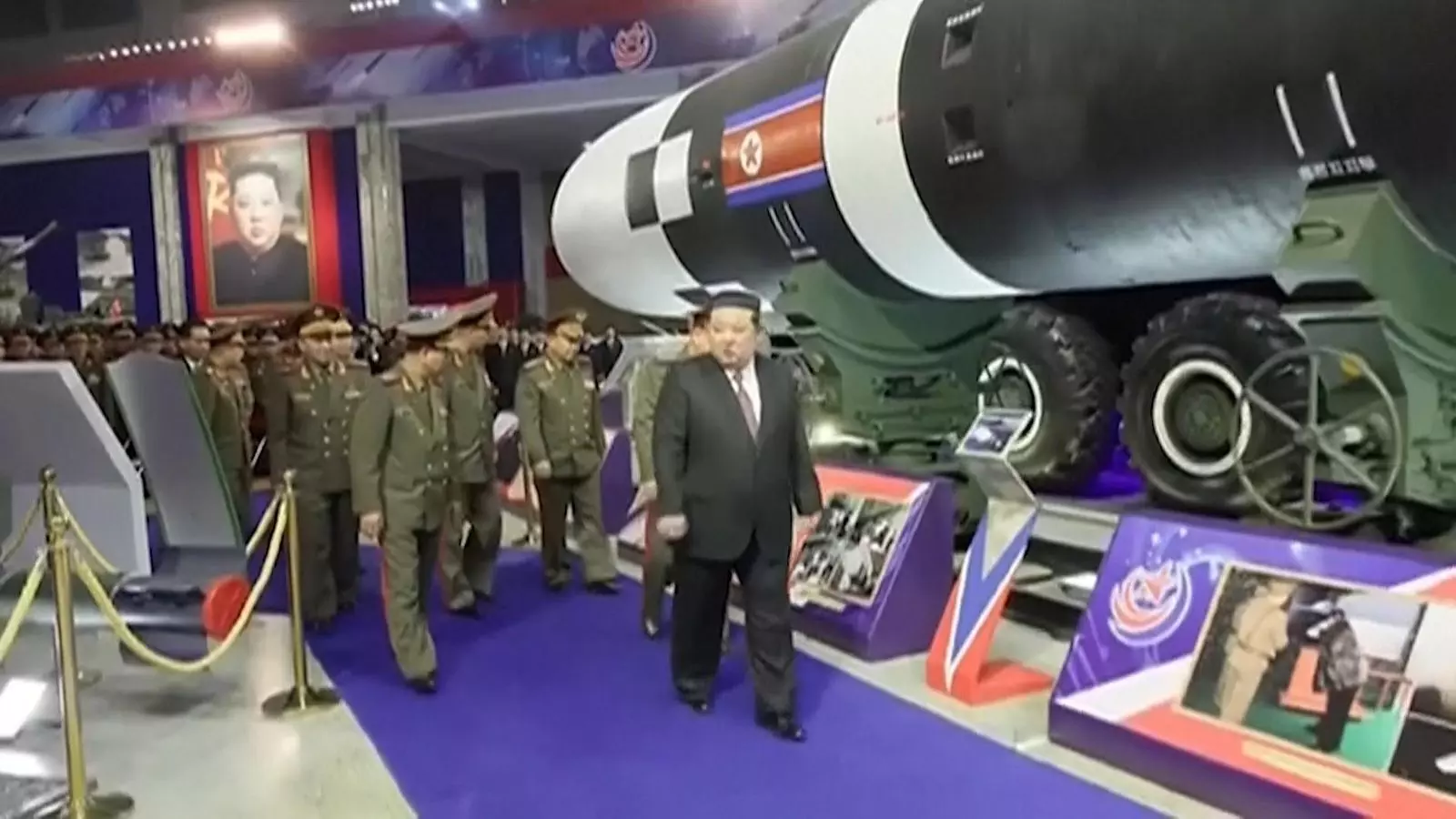
Images Credit - Sky News
In the intricate theatre of global geopolitics, timing is rarely accidental. The recent launch of multiple ballistic missiles by Kim Jong-un, coinciding with joint naval exercises between the United States and South Korea, is not merely a military manoeuvre—it is a deliberate strategic signal. At a moment when Washington’s attention remains heavily absorbed in escalating tensions in the Middle East, particularly involving Iran, Pyongyang has chosen to reassert its presence with calculated precision.
The missile launches—reportedly numbering at least ten—serve multiple purposes. At the most immediate level, they are a direct provocation aimed at Donald Trump, whose administration has long oscillated between confrontation and engagement with North Korea. The optics are unmistakable: as American warships engage in coordinated drills with Seoul, Kim responds not with rhetoric, but with a kinetic demonstration. It is a reminder that deterrence on the Korean Peninsula remains fragile, contingent, and deeply psychological.
Yet, beyond the immediate provocation lies a deeper strategic calculus. North Korea’s missile programme, particularly its focus on advanced ballistic and potentially hypersonic delivery systems, is designed to challenge evolving missile defence architectures such as the so-called “Golden Dome” initiative reportedly being developed by Washington with potential support from Japan. By testing systems that mimic or approximate the capabilities these defences are meant to counter, Pyongyang is effectively stress-testing American strategic assumptions. It is not just a display of capability, but an exercise in deterrence signalling—communicating both intent and resilience.
For Washington, the situation presents a complex dilemma. On one hand, the United States must maintain its extended deterrence commitments to allies like South Korea and Japan, reinforcing its credibility as a security guarantor in East Asia. On the other, it faces the risk of strategic overstretch. With military and diplomatic resources already engaged in the Middle East, the opening of another front—symbolic or otherwise—complicates the calculus of power projection. It is precisely this vulnerability that Pyongyang appears keen to exploit.
The shadow of China looms large over this unfolding dynamic. For the United States, any prospective engagement with North Korea is not merely about denuclearisation; it is also about reshaping regional alignments. A renewed summit between Trump and Kim—potentially even on Chinese soil—would carry significant geopolitical implications. It would signal Washington’s ability to penetrate Beijing’s sphere of influence, leveraging Pyongyang as both a diplomatic partner and a strategic variable. For China, which has traditionally exercised considerable influence over North Korea, such a development would represent both a challenge and an opportunity—forcing Beijing to recalibrate its own regional posture.
The historical context adds further nuance. The summits between Trump and Kim in 2018 and 2019, while groundbreaking in their symbolism, ultimately failed to produce substantive progress on denuclearisation. The much-publicised meeting at the Demilitarised Zone (DMZ) was widely perceived as a diplomatic spectacle rather than a policy breakthrough. Yet, the personal rapport between the two leaders has endured, creating a unique channel of communication that remains absent in more conventional diplomatic frameworks. It is this unpredictability—this blending of personal diplomacy with strategic calculation—that continues to define the US–North Korea relationship.
Meanwhile, regional actors are closely monitoring the situation. Japan, already expanding its defence capabilities and budget, views North Korea’s missile activity as a direct threat to its security architecture. Reports suggesting Tokyo’s potential involvement in advanced missile defence systems underscore a broader regional trend: the gradual militarisation of East Asia in response to evolving threats. South Korea, too, finds itself navigating a delicate balance—seeking both deterrence and dialogue, even as domestic and external pressures mount.
What makes this moment particularly volatile is the convergence of multiple geopolitical theatres. The ongoing tensions involving Iran, Israel, and the United States have already strained global security frameworks. In such a context, North Korea’s actions risk triggering a cascade of strategic reactions, amplifying uncertainty across regions. The global order, already under stress, faces yet another test of its resilience.
Interestingly, even as these high-stakes developments unfold, the digital sphere offers a contrasting narrative. Social media platforms have transformed Kim Jong-un into an unlikely subject of satire, with memes portraying him as a distant observer of global chaos. While seemingly trivial, this phenomenon reflects a deeper truth about contemporary geopolitics: the coexistence of serious strategic conflict and instantaneous digital trivialisation. In an age where perception often shapes reality, even humour becomes a form of soft commentary on power and isolation.
Ultimately, Kim Jong-un’s missile launches are not acts of impulsive defiance but components of a carefully calibrated strategy. They are messages—directed at Washington, observed by Beijing, and interpreted by the wider international community. They underscore a fundamental reality of modern geopolitics: that power is no longer exercised solely through war or diplomacy, but through the subtle interplay of timing, perception, and signalling.
For the United States, the challenge lies in crafting a response that balances deterrence with diplomacy, strength with restraint. For the broader international community, the imperative is to prevent escalation while preserving the fragile equilibrium that sustains global order. And for Kim Jong-un, the objective remains clear—to ensure that North Korea, despite its isolation, remains an indispensable actor in the geopolitical narrative.
In this unfolding drama of missiles and messages, one truth stands out: in the contemporary world, even a single launch can reverberate far beyond its trajectory, reshaping alliances, recalibrating strategies, and redefining the contours of power itself.