Sheikh Hasina Denounces Dhaka Court’s Death Sentence as “Politically Motivated”
Ousted Bangladesh PM claims the war-crimes tribunal is rigged, vows to face accusers only in an impartial judicial process.

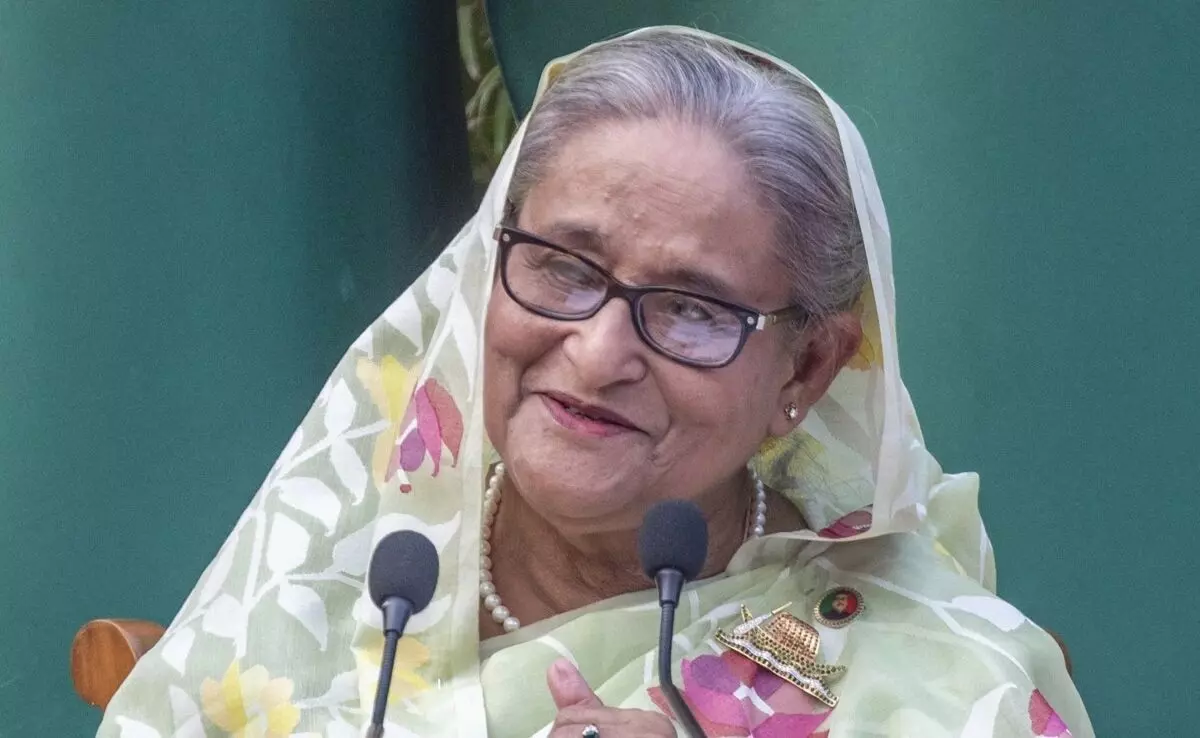
Ousted Bangladesh prime minister Sheikh Hasina on Monday slammed the Dhaka court verdict sentencing her to death, calling it “biased and politically motivated”.
In a statement released after the verdict, Hasina said the tribunal was “rigged” and run by “an unelected government with no democratic mandate”.
“The verdicts announced against me have been delivered by a rigged tribunal. They are biased and politically motivated,” she said.
She said that her government had “lost control of the situation but cannot characterize what happened as a premeditated assault on citizens.”
The International Crimes Tribunal, Bangladesh's domestic war crimes court, has sentenced former Prime Minister Sheikh Hasina to death over a crackdown on anti-government protests last year, calling it "crimes against humanity":.
Hasina, convicted of "various crimes against humanity", was tried in absentia and remains in exile in India.
Reasserting her willingness to stand trial under an impartial judicial process, she said: “I am not afraid to face my accusers in a proper tribunal where evidence can be weighed and tested fairly."
She alleged that the interim government had used the death penalty as a political tool to “nullify the Awami League as a political force”. Earlier, Hasina had dismissed the entire trial as a “farce” and denied all charges against her.
A three-judge panel ruled that Hasina "incited hundreds of extrajudicial killings carried out by law enforcement during weeks of unrest" in 2024. According to the court, approximately 1,400 protestors were killed and up to 25,000 were injured.
The former leader faced five charges, including inciting murder, ordering hangings, and authorizing the use of lethal weapons, drones, and helicopters to suppress the protests. She has, in several interviews to international media, denied all charges and pointed out that the bullets used to kill protesters were of a calibre different from that used by the Bangladesh police. Several analysts have indicated that the shots may have been fired by snipers.
Hasina's legal team has appealed to the United Nations Special Rapporteur on extrajudicial, summary, or arbitrary executions, citing "serious concerns about the lack of fair trial rights and due process."
Meanwhile, Bangladesh is set to hold national elections in February next year from which the Awami League is likely to be excluded.
The case pertains to alleged crimes committed during the July 2024 mass uprising, which triggered widespread violence and preceded the fall of the Awami League government.
Along with Sheikh Hasina, former Home Minister Asaduzzaman Khan Kamal and former Inspector General of Police Chowdhury Abdullah Al-Mamun were charged; Al-Mamun later turned approver. Trial proceedings concluded on October 23.
The July 2024 student-led uprising, sparked by economic hardship, corruption, and a job crisis, led to the toppling of Sheikh Hasina's government. On August 5, she fled to India, and the Yunus-led interim government assumed control.
The ICT, originally established by Hasina's government to prosecute war crimes from the 1971 Liberation War, has previously tried numerous Jamaat-e-Islami leaders.
The tribunal also sentenced former Home Minister Asaduzzaman Khan Kamal to death. Former Inspector General of Police Chowdhury Abdullah Al-Mamun, who turned state witness and testified against Hasina and Khan Kamal, received a five-year prison term after admitting his involvement.