The MAGA Gambit and India’s Place in a Three-Emperor Chessboard
A MAGA-style return to hard bargaining among the U.S., Russia, and China could compress global politics into a brittle triangle—testing India’s ability to convert multi-alignment into sustained leverage.

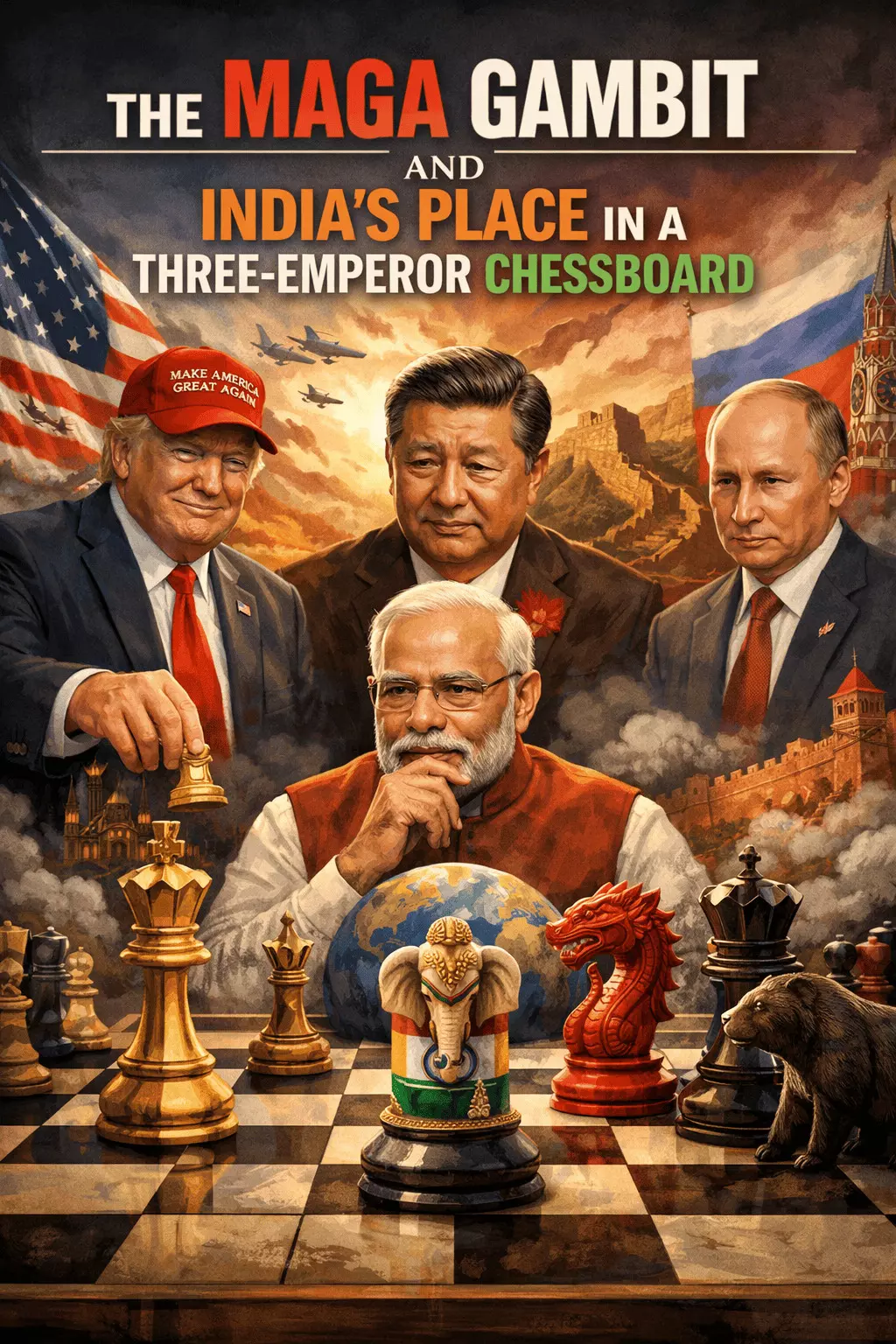
If Washington is indeed reverting to a MAGA-flavored grand strategy—transactional, tariff-forward, sovereignty-first, allergic to moralism, and open to tactical deals with rival great powers—then the geometry of world politics compresses from messy multipolarity into a hard triangular game. Imagine a Yalta 2.0 without ceremony: a deal-making United States that dangles détente to Moscow to end the Ukraine war on terms palatable to American domestic politics, and probes a ceasefire truce with Beijing to stabilize inflation, restore supply-chain predictability, and curb war risk in the Western Pacific. Where does India stand when the three imperial capitals start speaking the language of cold, steel-eyed interests rather than crusading values?
History offers the cautionary prologue. In 1971–72, Nixon and Kissinger’s triangular diplomacy split Moscow and Beijing and dragged them into separate orbits around Washington. The shock dislocated India’s security environment: Beijing emerged as a U.S. counterweight to the USSR, while Delhi, in the crucible of the Bangladesh war, signed the 1971 Treaty of Peace, Friendship and Cooperation with Moscow. From then on India’s arsenal bore Soviet DNA—MiGs to Sukhois, T-72s to Smerch—creating a dependency still visible today, with a majority of Indian platforms of Russian origin. That dependence persists even as India diversifies; the legacies of history do not dematerialize with policy speeches.
Consider the contemporary ledger. The United States is India’s largest trading partner: goods-and-services flows cresting around the $190–200 billion mark in recent years, deepening technology and capital linkages from semiconductors and critical minerals to iCET cooperation on advanced computing and space. Defense interoperability has spiked via LEMOA (2016), COMCASA (2018), and BECA (2020), with Malabar exercises and logistics access becoming routine. Yet the MAGA toolkit, as previously deployed (2017–2020), is not subtle: Section 232 steel and aluminum tariffs hit allies and partners alike; India lost its GSP benefits in 2019; H‑1B tightening signaled a nativist turn; WTO skirmishes multiplied. “America First” means exactly what it says on the label—interests de-linked from alliance etiquette, price-tags attached to every security favor, and manufacturing repatriation as a quasi-religion.
Shift to Russia. Since 2022, India has executed a cold-blooded energy pivot: discounted Urals crude, rupee-rouble clearing experiments, and a reconstituted hydrocarbons relationship that kept domestic inflation in check while Europe scrambled. Moscow remains a critical armory and a veto-wielding guarantor in forums where India prefers not to be isolated. Yet Russia’s long war has made it more beholden to China—in finance, tech, components—and that asymmetry constrains how far Moscow can tilt toward Delhi if Beijing wishes otherwise. Modi’s “This is not an era of war” remark to Putin (Samarkand, 2022) was both moral signaling and strategic hedging: India would not be dragooned into a camp nor made to pay for someone else’s maximalism.
Then China: the systemic adversary on India’s frontier. Doklam (2017) and Galwan (2020) collapsed the fiction that trade growth could firewall hard security. PLA force posture across the LAC remains fortified; the diplomatic channels are functional but brittle. India’s response—military hardening in the Himalayas, QUAD deepening with the U.S., Japan, and Australia, and supply-chain “de-risking”—is a long game. External Affairs Minister S. Jaishankar’s line captures the doctrine: India will do what India must, and Europe (read: the West) must “grow out of the mindset that its problems are the world’s” (2022). Translation: strategic autonomy 2.0, better described as multi-alignment, not nonalignment—a web of overlapping, interest-based compacts.
Now inject the hypothetical: a U.S. presidency that seeks a ceasefire-plus with Russia to end Ukraine’s hemorrhage, and a tariff-managed truce with China to corral inflation and stabilize markets. MAGA realpolitik would prize outcomes that flatter domestic optics: cheaper goods, lower fuel costs, a victory lap for “ending endless conflicts.” The rhetoric would be sovereignty over solidarity, bargaining over burden-sharing. Trump’s earlier broadsides—NATO’s “obsolete” claim (later walked back under pressure), tariff threats to partners, and public linkage of protection guarantees to 2% GDP defense spending—were not deviations; they were doctrinal tells.
This is not philanthropy; it is price discovery in geopolitics. If Washington narrows the value gap with Moscow and Beijing, India’s leverage derived from being the indispensable swing partner in an anti-China coalition could erode at the margins. A trilateral tempering among the big three could also shrink the diplomatic oxygen India has used to extract concessions: tech carve-outs, export-control flex, defense co-production, and market access. Worse, if a U.S.–China tariff armistice stabilizes supply chains without addressing coercion in the Himalayas, India’s frontline risks being discounted in the broader strategic balance-sheet.
But the nightmare of a stable Washington–Moscow–Beijing triangle is less likely than advertised. Structural contradictions abound. Russia needs Chinese capital and components but fears long-term vassalization. China wants U.S. market access but will not amputate techno-strategic ambitions in AI, chips, and dual-use sectors. The U.S. wants inflation control and industrial repatriation but will not underwrite a peer competitor’s ascendancy. Any thaw would be tactical, brittle, and partial—ripe for relapse on Taiwan, cyber, maritime brinkmanship, or sanctions.
That fragility is where India can and must maneuver. The playbook should be unapologetically interest-maximizing, anchored in five steel bolts:
- Remove single-point failures. Cut legacy overdependence on Russian spares by accelerated indigenization and Western/Japanese/Korean co-production. The S‑400 and nuclear cooperation with Russia continue, but the future magazine must be mixed-caliber.
- Convert QUAD from theater to throughput. Maritime domain awareness, anti-submarine warfare data-sharing, resilient logistics nodes in the Indian Ocean, and a hard focus on undersea cables and chokepoints from Malacca to Mozambique should advance irrespective of Washington’s mood swings. QUAD exists precisely to outlast personalities.
- Weaponize market gravity. India’s demographic and consumption curve is leverage. Use phased, performance-linked incentives to pull electronics, EV, solar, and pharma supply chains from China-plus-one to India-plus-allies. Trade is strategy by other means.
- Insure against tariff cyclones. If MAGA 2.0 revives broad tariffs, India can negotiate sectoral safe harbors—defense offsets, critical minerals, vaccine and biopharma cooperation—in exchange for targeted access and security deliverables. Make every concession a swap, never a gift.
- Make the continental deterrent undeniable. Infrastructure, ISR, and fires along the LAC must raise the cost of salami-slicing to prohibitive levels. When borders are hardened, diplomacy has ballast.
The philosophical core matters too. Gandhi is not a tariff schedule, but India’s civilizational statecraft has long preferred persuasion over coercion. That is why Delhi mediates without announcing it, buys oil without apologizing for it, and speaks to all sides without sentimentalizing any of them. Nonalignment was once a sermon; multi-alignment is a spreadsheet. The moral grammar persists, but the verbs have changed.
Facts on the ground support this posture. India’s defense budget has climbed into the mid‑$70 billions, still modest for a two-front contingency but increasingly lethal per rupee spent. Energy security has diversified: Middle East volumes hedged by Russian barrels, LNG contracts locked, and renewables scaling. Trade with the U.S. outpaces that with China, even as critical imports from China (pharma APIs, electronics components) remain sticky—hence the urgency of domestic capacity.
What of the fear that a MAGA White House “abandons democracy and philanthropy”? Strip the adjectives. American foreign policy has always braided ideals with interests; the weave tightens or loosens by administration. India should plan for interest-forward America as a constant, not an exception. In that world, sentimentality is expensive. Delhi must be the buyer and seller of options: energy from Russia, chips with the U.S. and Japan, hydrocarbons transit with the Gulf and Africa, logistics with France in the Western Indian Ocean, and quiet understandings with ASEAN to keep the Indo-Pacific commercially navigable.
Nehru warned against “becoming a camp follower”; Jaishankar updated it to “do what is in India’s interests.” Modi told Putin it is not an era of war; the subtext was that it is an era of calculus. If Washington seeks quick wins with Moscow and a tariff truce with Beijing, India should nod, take notes, and add weight where the balance tips our way. The three emperors may try to redraw the chessboard. India’s task is simpler and harder: keep the pieces mobile, the alliances modular, and the deterrents visible. Great powers negotiate spheres; civilizational states survive them.
IDN Investigative News