Tianjin SCO Summit: Modi, Xi, Putin’s smiles, Pakistan sidelined
At the SCO summit in Tianjin, Modi, Xi and Putin showcased unity, but their divergent strategies and Pakistan’s marginalisation revealed deeper fractures.

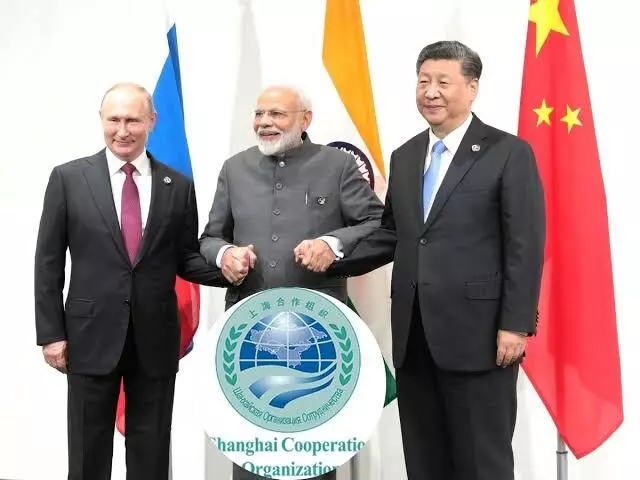
When the leaders of India, China and Russia — Narendra Modi, Xi Jinping and Vladimir Putin — appeared together at the Shanghai Cooperation Organisation (SCO) summit in Tianjin on September 1, 2025, the images quickly dominated news cycles. Smiles, handshakes and carefully choreographed frames suggested improbable Eurasian harmony. Just as striking, though less photographed, was Pakistan’s absence from the central frame. For a country that once saw the SCO as a bridge to great-power respectability, the symbolism was brutal.
But beyond the optics, what did the “Modi–Xi–Putin minus Pakistan” moment actually mean?
A photo-op, not a pivot
The SCO thrives on spectacle. Unlike NATO or the EU, it has no binding defence commitments or enforceable economic mechanisms. Its strength lies in projecting the impression of unity across Eurasia — Tianjin was no exception.
Xi Jinping positioned the SCO as the champion of “true multilateralism” against Western “bloc politics,” backed by promises of aid and infrastructure financing for Central Asia. For Beijing, the SCO is less a forum than a tool of legitimacy.
Putin used the stage to signal Russia’s diplomatic relevance despite Ukraine. Standing alongside Xi and Modi allowed him to project resilience in a hostile climate.
Modi’s approach was more calibrated: warmth with Russia, civility with China, and a refusal to endorse Beijing’s connectivity projects.
Three smiles, then, but three very different strategies.
Pakistan’s marginalisation
For Islamabad, Tianjin was another reminder of how much ground it has lost. Its interventions barely resonated, while coverage focused more on images of its absence from the “main stage” than on its inputs.
This decline is not accidental. Pakistan’s overdependence on China, economic fragility and habit of using forums to air grievances against India have eroded its credibility. Within the SCO, Islamabad appears less a stakeholder and more a spoiler.
For India, this was a quiet win. With Pakistan sidelined, New Delhi had more space to maneuver. Yet even without Pakistan, the SCO’s institutional weaknesses remain deep.
Expansion, divergence, paralysis
The SCO has expanded — Iran joined in 2023, Belarus in 2024 — but not strengthened. Each entrant added baggage of sanctions, instability and diverging threat perceptions. Consensus-based decision-making only deepens paralysis.
Central Asian members welcome Chinese and Russian financing but worry about overdependence. They prefer multipolar balancing, not bloc politics. The SCO, however, increasingly mirrors Beijing’s geopolitical imagination — leaving them wary.
What India gained — and what it must guard against
For Modi, Tianjin served three immediate purposes:
1. Blocking adverse narratives: Pakistan could not hijack the agenda; the final declaration retained terrorism language.
2. Maintaining Russia ties: Warmth with Putin reassured Moscow, even as India expands links with the West.
3. Managing China pragmatically: Civility with Xi kept communication open, without endorsing Belt and Road corridors.
But risks loom. China will continue using the SCO to entrench influence in Central Asia. Russia, dependent on Beijing, may nudge India closer than it should. And domestically, images of Modi-Xi warmth could be misread as alignment unless carefully framed.
Policy course: SCO minimalism, regional maximalism
India should treat the SCO as a platform for low-sensitivity cooperation — counter-terrorism data, narcotics control, disaster relief — while keeping strategic issues bilateral or minilateral. No SCO declaration should bind India to Chinese-led projects.
Outside the SCO, New Delhi must go big: quick, transparent projects in Central Asia — renewable microgrids, digital public goods, agro-logistics — with multilateral financing. Reimagining the Northeast as the hinge of Eurasian connectivity is key: multimodal routes via Bangladesh and Chabahar can link Assam and Tripura directly to Central Asia, bypassing China-centric corridors.
On Russia, India must compartmentalise: steady on defence and energy, cautious on finance and technology, alert to sanctions risks.
The real meaning of Tianjin
The Tianjin summit gave memorable images, but images are not strategy. Xi used the SCO to buy influence. Putin used it to claim relevance. Modi used it to manage risks and extract narrow gains. Pakistan, once loud, was simply absent.
The SCO remains more spectacle than substance. For India, the task is to look past the smiles, leverage Pakistan’s marginalisation, and build a Eurasian architecture outside the SCO’s hollow stage.