Trump’s Tariff Threat Pushes Modi Closer to China, Signals Shift in India’s Foreign Policy
India and China are expected to restart direct flight services as early as next month, according to sources familiar with the negotiations, Bloomberg reported.

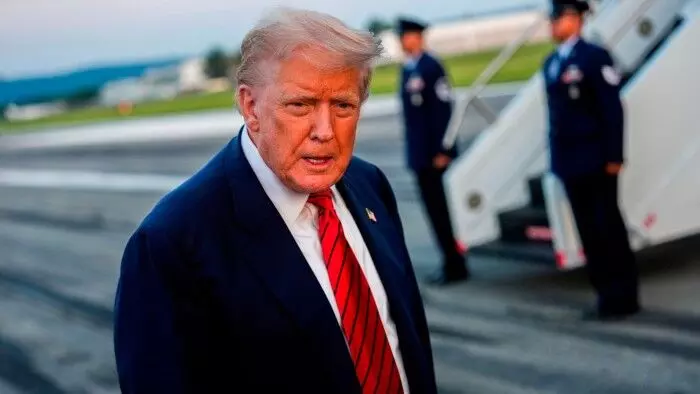
US presidential hopeful Donald Trump’s threat to slap a 50% tariff on Indian goods is prompting a strategic recalibration in New Delhi, nudging Prime Minister Narendra Modi closer to BRICS allies—particularly China. The move marks a significant shift in India-China relations, which hit rock bottom in 2020 after the deadly Galwan Valley clash.
Amid rising trade tensions with Washington, Modi is reportedly preparing to restore direct flights between India and China as early as next month, according to sources familiar with the matter who spoke to Bloomberg. The decision could be officially announced during Modi’s expected visit to China later this month, where he may meet President Xi Jinping on the sidelines of the Shanghai Cooperation Organisation (SCO) summit in Tianjin, scheduled from August 31.
Airlines in India have been instructed to prepare for short-notice flight resumptions, ending a pause in direct connectivity that began during the Covid-19 pandemic. That suspension coincided with the Galwan incident, which claimed the lives of 20 Indian soldiers and an undisclosed number of Chinese troops, freezing ties for years.
But relations appear to be thawing. Henry Wang, president of the Beijing-based Center for China and Globalization, said India-China ties are in an “up cycle,” with both countries assuming leadership roles in the Global South. “Trump’s tariff war on India has made India realise it needs strategic autonomy,” he noted.
China, which has also been a major target of Trump’s trade aggression, appears open to warming ties. This month, Beijing eased restrictions on urea exports to India, the world’s top importer of the fertilizer. While initial volumes are limited, the move could signal growing economic cooperation between the two Asian giants, potentially easing global supply issues.
Adding to this momentum, the Adani Group is reportedly in early talks with Chinese electric vehicle giant BYD Co. for a potential partnership to produce batteries in India—another sign of deepening commercial interests.
Chinese Ambassador to India Xu Feihong even appeared to back Modi publicly over Trump’s tariff threats. Quoting Foreign Minister Wang Yi’s remarks against economic bullying, Xu posted on X: “Give the bully an inch, he will take a mile.”
Former US National Security Advisor John Bolton has warned that Trump’s approach could backfire. “His tariffs, meant to hurt Russia, could end up pushing India closer to both Moscow and Beijing,” Bolton said in an interview with CNN. He added that Trump’s “leniency on China and heavy-handedness with India” could unravel years of US efforts to build a strategic partnership with New Delhi.
India’s economic considerations shifted significantly this month when Trump doubled tariffs on Indian goods to 50%, citing India’s continued purchase of Russian oil as the reason. Trump’s incendiary comments—calling India’s economy “dead” and its trade barriers “obnoxious”—further soured ties.
While Washington has long viewed India as a critical counterbalance to China in the Indo-Pacific, Trump’s latest stance may be weakening that foundation—ironically drawing India and China into a closer, if cautious, alignment.