Trump’s Tariffs vs Modi’s Defiance: Economic Sovereignty at Stake
Trump’s Tariff Gambit and Modi’s Defiant Diplomacy: A Clash of Economic Sovereignty and Political Identity

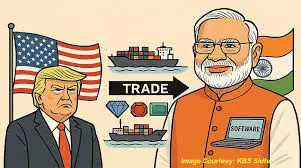
The imposition of steep tariffs by former U.S. President Donald Trump on Indian exports—rising to a staggering 50%—has reignited a complex web of geopolitical tensions, economic recalibrations, and personal political narratives between two of the world’s most prominent leaders: Donald Trump and Narendra Modi. While tariffs are traditionally viewed as instruments of trade policy, this particular episode transcends economics and ventures into the realm of strategic diplomacy, domestic political survival, and global power realignment.
At the heart of the conflict lies Trump’s decision to penalize India for its continued purchase of Russian crude oil amid the Ukraine war. The U.S. administration framed the tariffs as a coercive measure to pressure India into aligning with Western sanctions against Moscow. However, Prime Minister Modi’s response was not one of concession but of calculated defiance. In a series of public addresses, Modi declared that India would never compromise on the interests of its farmers, fishermen, and dairy producers—even if it meant paying a heavy political and economic price. This stance was not merely rhetorical; it was a strategic pivot rooted in India’s recent history of agrarian unrest and Modi’s need to reclaim credibility among rural constituencies.
The backdrop to Modi’s resistance is the prolonged farmers’ agitation that gripped India between 2020 and 2021, triggered by controversial farm laws that were eventually repealed. That episode left a deep scar on Modi’s political image, particularly among the agrarian class. Allowing unfettered access to American agro and dairy products, as Trump reportedly demanded during stalled trade negotiations, would have risked reigniting those tensions. Modi’s refusal to yield, therefore, was not just a matter of national pride—it was a political necessity.
Trump, on the other hand, has long viewed tariffs as a multipurpose tool: a lever for economic dominance, a bargaining chip in diplomacy, and a symbol of his “America First” doctrine. His administration’s rationale for targeting India was twofold: punishing New Delhi for its energy ties with Russia and retaliating against what he perceived as discriminatory digital service taxes and tech regulations. But the fallout of this approach has been far-reaching. India, which exported $60.2 billion worth of goods to the U.S. in FY2025, now faces disruptions in labor-intensive sectors such as textiles, seafood, gems, and leather. Goldman Sachs estimates a GDP growth reduction of up to 0.6% for India in FY2026.
Yet, Modi’s response has been anything but passive. Rather than retaliate with counter-tariffs, India has leveraged the crisis to deepen its strategic autonomy. The revival of the Russia-India-China (RIC) axis within the BRICS framework is a case in point. Modi’s diplomatic engagements with Russian President Vladimir Putin and Chinese President Xi Jinping signal a recalibration of India’s foreign policy—one that balances Western partnerships with Eastern alliances. This multipolar strategy not only cushions India against economic shocks but also enhances its leverage in global negotiations.
From a geopolitical lens, Trump’s tariff war appears to be accelerating the very shift he sought to prevent: the erosion of U.S. centrality in global trade. In 2000, the U.S. accounted for 20% of global imports; today, that figure has dropped to around 12%. Countries like Brazil, Canada, and South Korea are responding with their own stimulus plans, retaliatory tariffs, and diversification strategies. India’s push for “Atmanirbhar Bharat” (self-reliant India) and its manufacturing mantra “Daam kam, dum zyaada” (low cost, high strength) are emblematic of this global trend away from American economic hegemony.
The personal dynamics between Trump and Modi add another layer of complexity. Once hailed as populist allies with mutual admiration, their relationship has soured under the weight of conflicting national interests. Trump’s public statements, often laced with veiled threats and accusations, have taken on a tone of personal grievance. Modi, in contrast, has opted for strategic silence, choosing to rally domestic support and international allies rather than engage in direct confrontation. This divergence in style underscores a broader philosophical split: Trump’s transactional diplomacy versus Modi’s narrative-driven statecraft.
Ultimately, the real casualties of this tariff war are the citizens and economies of both nations. Indian exporters face declining competitiveness, job losses, and supply chain disruptions. American consumers, meanwhile, may encounter higher prices and reduced access to Indian goods. The broader risk is that such unilateralism undermines the spirit of multilateralism and cooperation that global trade depends on.
In conclusion, the Trump-Modi tariff standoff is more than a bilateral dispute—it is a microcosm of the shifting global order. It reflects the tensions between protectionism and globalization, between personal politics and national interest, and between economic coercion and strategic resilience. As both leaders navigate their respective domestic landscapes, the choices they make will not only shape U.S.-India relations but also influence the trajectory of global diplomacy in the years to come.