US Missile Sale to Pakistan: A Strategic Jolt to India’s Diplomatic Posture

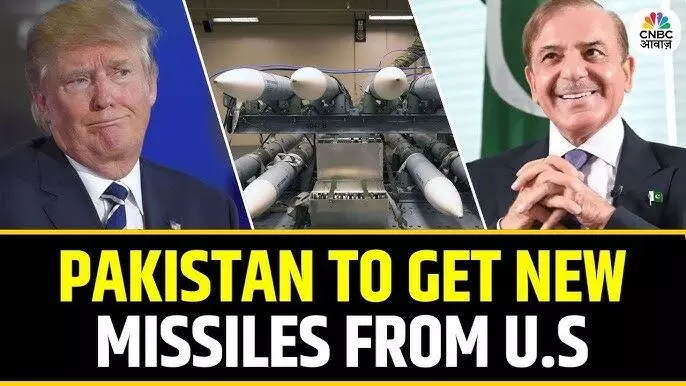
Imges Credit -CNBC AWAAZ
The reported inclusion of Pakistan in the United States’ foreign military sales contract for AIM-120 Advanced Medium-Range Air-to-Air Missiles (AMRAAM) marks a significant shift in South Asia’s strategic landscape and poses a serious diplomatic challenge for India. The development, confirmed through a September 30 notification by the US Department of War, has triggered concern in New Delhi—not merely for its military implications but for what it signals about the evolving US-Pakistan relationship under President Donald Trump.
The AMRAAM missile, manufactured by Raytheon, is a high-precision, radar-guided weapon compatible with Pakistan’s F-16 fighter jets. Historically, this missile was used by the Pakistan Air Force (PAF) during the 2019 aerial engagement with India, notably in the downing of Wing Commander Abhinandan Varthaman’s MiG-21. The inclusion of Pakistan in the latest $2.51 billion contract—alongside NATO allies and strategic partners—suggests a recalibration of Washington’s South Asia priorities, one that appears to sideline India’s strategic sensitivities.
India’s diplomatic establishment has long sought to deepen ties with the United States, especially in the defence and technology sectors. The Modi government’s outreach to the Trump administration was marked by high-profile summits, defence agreements, and shared Indo-Pacific objectives. However, the missile sale to Pakistan, coupled with recent trade and mineral agreements between Islamabad and Washington, indicates that India’s efforts have not yielded the strategic insulation it hoped for. Instead, the US appears to be hedging its bets—reviving ties with Pakistan at a time when China’s influence in the region is growing and Saudi Arabia has signed a Strategic Mutual Defence Agreement with Islamabad.
The timing of the missile deal is particularly sensitive. It follows a four-day military confrontation between India and Pakistan in May and comes amid reports of Pakistani Prime Minister Shehbaz Sharif and Army Chief Field Marshal Asim Munir holding direct meetings with President Trump, including a rare one-on-one Oval Office session. These engagements, along with Pakistan’s endorsement of Trump for a Nobel Peace Prize, reflect a diplomatic choreography aimed at repositioning Islamabad as a key interlocutor in regional stability—one that Washington appears willing to entertain.
For India, the implications are manifold. First, the potential upgrade of Pakistan’s F-16 fleet with newer AMRAAM variants such as the C8 and D3 could alter the tactical balance in the region. While the exact quantity of missiles to be delivered remains unclear, the precedent of Pakistan’s earlier acquisition of 700 AMRAAMs in 2007 underscores the scale of such deals. Second, the revival of US-Pakistan defence ties may embolden Islamabad diplomatically, especially in forums where India has traditionally sought to isolate Pakistan on issues of cross-border terrorism and regional aggression.
The Congress party has already termed the development a diplomatic setback, with senior leader Jairam Ramesh highlighting the rapid accumulation of foreign policy reversals under the Modi administration. His remarks point to a broader concern—that India’s strategic autonomy is being compromised by its over-reliance on symbolic diplomacy rather than substantive leverage. The fact that Pakistan was not part of the May 7 notification listing missile recipients but was added in the September 30 update suggests a deliberate shift in US policy—one that India may not have anticipated or effectively countered.
Adding to the complexity is Pakistan’s recent shipment of rare earth minerals to the US, part of a Memorandum of Understanding signed between the Frontier Works Organisation and US Strategic Metals. This move not only strengthens Pakistan’s economic ties with Washington but also positions it as a resource partner in critical supply chains—an area where India has been trying to assert itself through its own strategic mineral initiatives. Furthermore, the July trade agreement between the two countries, aimed at developing Pakistan’s oil reserves and lowering tariffs, signals a broader economic engagement that could dilute India’s influence in bilateral and multilateral platforms.
India’s official position remains that the ceasefire with Pakistan was brokered through direct military channels, not external mediation. However, Trump’s repeated claims of having facilitated the truce—and Pakistan’s public endorsement of those claims—have created a narrative that challenges India’s diplomatic framing. In this context, the missile sale becomes more than a defence transaction; it becomes a symbol of shifting allegiances and contested narratives.
Strategic experts argue that India must now reassess its foreign policy posture, especially its assumptions about US support in regional conflicts. The sale of AMRAAMs to Pakistan, the deepening of US-Pakistan economic ties, and the diplomatic optics surrounding Trump’s engagement with Islamabad all point to a need for recalibration. India must strengthen its defence preparedness, diversify its strategic partnerships, and assert its regional interests with greater clarity and consistency.
In the evolving chessboard of South Asian geopolitics, the US missile sale to Pakistan is not just a setback—it is a signal. A signal that strategic favour is fluid, and that diplomatic capital must be earned not merely through summits and slogans, but through sustained, multidimensional engagement. For India, the challenge is not merely to respond, but to reimagine its place in a region where old certainties are giving way to new alignments.