The Power of Not Choosing: How India Is Redefining Global Economic Strategy
India redefines global power dynamics with economic non-alignment, leveraging its scale, potential, and flexibility to navigate US-China tensions and emerge as a strategic middle power.

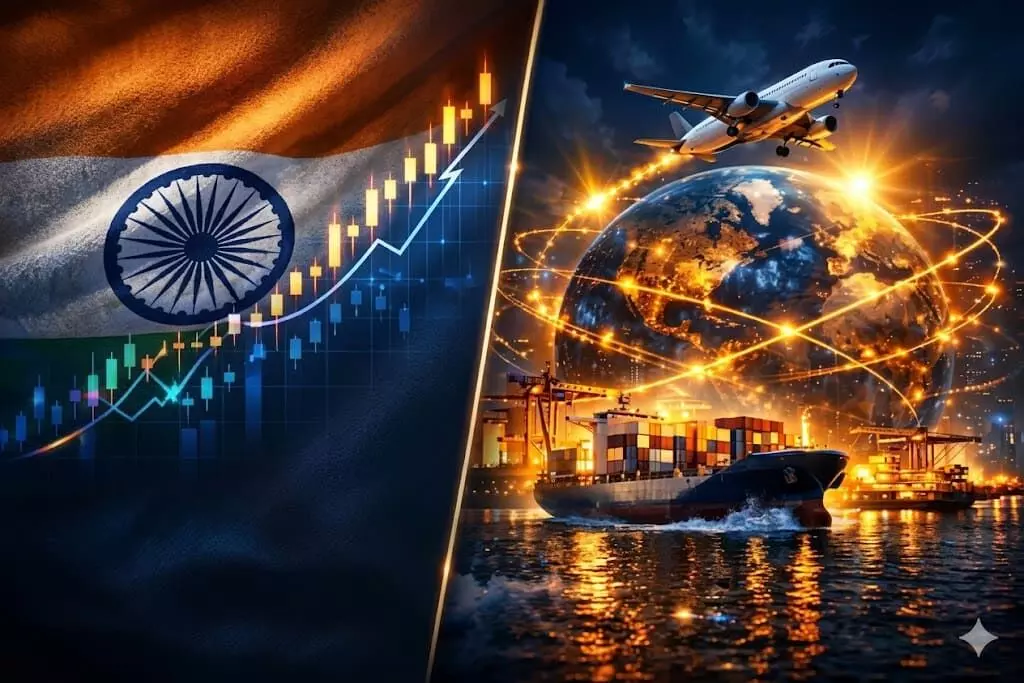
There was a time when global power was defined by allegiance. You were either aligned or you were irrelevant. India is rewriting that rule.
In today’s fractured geopolitical landscape, with the United States and China locked in a contest that is as economic as it is ideological, India has quietly positioned itself not as a follower, but as a balancer. Not by accident, but by design.
This is not the non-alignment of the Cold War era. That was moral posturing. This is something far more pragmatic: economic non-alignment driven by strategic self-interest.
India buys discounted oil from Russia while deepening trade ties with the West. It participates in QUAD dialogues even as it maintains autonomy in defense procurement. It speaks the language of the Global South while building bridges with advanced economies looking to de-risk from China.
To some, this may appear contradictory. In reality, it is India’s biggest strength. Because in a world of rigid blocs, flexibility is power.
The global supply chain reset, caused first by the pandemic and then accelerated by geopolitical tensions, has created a rare opening. Multinationals are actively seeking alternatives to China. The so-called “China+1 strategy” is no longer a boardroom buzzword; it is a strategic necessity.
India stands out not merely because of its scale, but because of its potential. A large domestic market. A young workforce. A rapidly digitizing economy. And perhaps most importantly, a political system that, despite its imperfections, offers greater predictability than many emerging markets.
India’s digital public infrastructure, from identity systems to real-time payments, is quietly becoming a form of soft power. It signals not only technological capability but also governance innovation. It is something many developing nations are now seeking to replicate. Yet, India’s rise is not just about what it is building internally. It concerns how it positions itself externally.
Unlike smaller economies that must align to survive, India has the luxury and the discipline to engage on its own terms. It can negotiate, hedge, and recalibrate without being constrained to a single camp.
That is what makes it a strategic middle power.
But this balancing act is not without risk.
As geopolitical tensions sharpen, the pressure to “choose sides” will intensify. Trade dependencies, security partnerships, and technological ecosystems are all becoming more polarized. The space for neutrality is shrinking.
The question India must confront is not whether it can balance, but for how long, because economic non-alignment works best in a world that still tolerates ambiguity.
If the future becomes more binary, India’s greatest strength, its flexibility, could become its greatest test.
For now, however, India occupies a rare position in global economics: trusted by many, owned by none. And in an age of division, that may well be the most powerful place to stand.
(The writer is Head-Strategic Alliances, Urban Money, a seasoned Banker and Mortgage Specialist working for India’s largest loan distributor company. He writes about financial policy, digital services, and public infrastructure in India.)