Battle-Tested & In Demand: India’s BrahMos Missile Fuels Defence Export Boom
India's defence exports surge following Operation Sindoor, with BrahMos missile leading the charge, and negotiations underway with Vietnam, Brazil, and UAE.

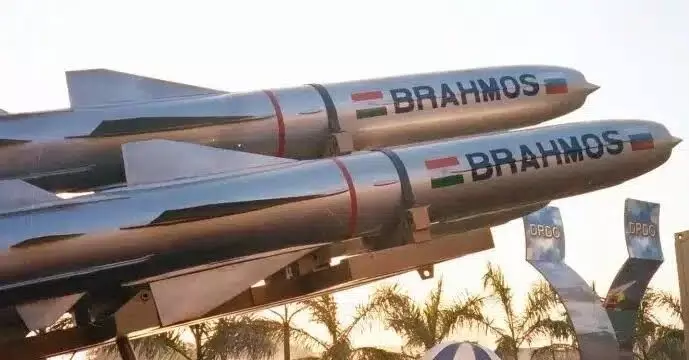
India’s defence exports are witnessing a sharp upswing following the successful execution of Operation Sindoor, a coordinated military offensive launched on May 7, 2025, in response to a terror attack in Jammu and Kashmir’s Pahalgam region. The operation, which deployed India’s indigenous weapons systems in live combat, has accelerated global interest in platforms like the BrahMos supersonic cruise missile, developed jointly by India’s DRDO and Russia’s NPOM.
The BrahMos missile played a central role in targeted strikes on terrorist infrastructure in Pakistan-occupied territories during the operation. Capable of traveling at speeds close to Mach 2.8, the missile demonstrated both precision and reliability under battlefield conditions. Following its performance, countries including Vietnam, Brazil, and the UAE have entered advanced-level talks with India to acquire the system, according to officials familiar with the matter.
In April 2025, the Philippines, which signed a $375 million agreement for the BrahMos system in 2022, had received the second batch of BrahMos, including two missile batteries. Defence officials in Manila have termed the acquisition a “milestone” in their security modernization efforts.
Speaking after the operation, DRDO Chairman Dr. Samir V. Kamat said the deployment of Indian-developed systems during Operation Sindoor has “validated their performance and credibility in real-world scenarios,” giving a significant boost to export prospects. India’s total defence exports for FY 2024–25 stood at ₹23,622 crore (~$2.8 billion), a 34-fold increase compared to FY 2013–14, with exports now reaching over 80 countries.
Other platforms showcased during the operation include the Akash surface-to-air missile system, the Akashteer integrated air defence command-and-control platform, and the VajraShot directed-energy anti-drone gun. These systems were deployed in coordinated formations, successfully neutralizing drone and missile threats, and are now being evaluated by multiple countries in Southeast Asia, Africa, and the Middle East.
Officials from the Ministry of Defence confirmed that India is actively positioning these indigenous systems as cost-effective, combat-tested alternatives in global markets. The government has set an ambitious target of reaching ₹50,000 crore in defence exports by 2029, intending to become one of the top arms exporters globally by 2047.
India’s export efforts are being supported by both public sector undertakings and private defence manufacturers, many of whom are involved in component and subsystem production for these platforms. Since May 2025, several private-sector firms have reported a spike in international enquiries, particularly for BrahMos-related technologies.
Strategic outreach, facilitated through embassies, defence attachés, and multilateral forums, has also been intensified to build long-term security partnerships. According to officials, Operation Sindoor not only marked a turning point in India's counter-terrorism posture but also established “combat credibility” for its domestically produced weaponry, a critical factor in international arms procurement.
India’s defence diplomacy now finds itself at the intersection of geopolitical influence and technological self-reliance. With negotiations progressing and deliveries underway, the momentum behind India’s defence exports, especially the BrahMos missile, shows no signs of slowing.
(The writer is a seasoned Banker and Mortgage Specialist working for India’s largest loan distributor company and covers financial policy, digital services, and public infrastructure in India.)