Credibility of Democracy: Whose Responsibility Is It—Anyway?
Free and fair elections are the backbone of India’s democracy. Dr (Lt Col) Atul Tyagi examines electoral credibility, Election Commission powers, Supreme Court rulings and constitutional morality amid allegations of vote theft.

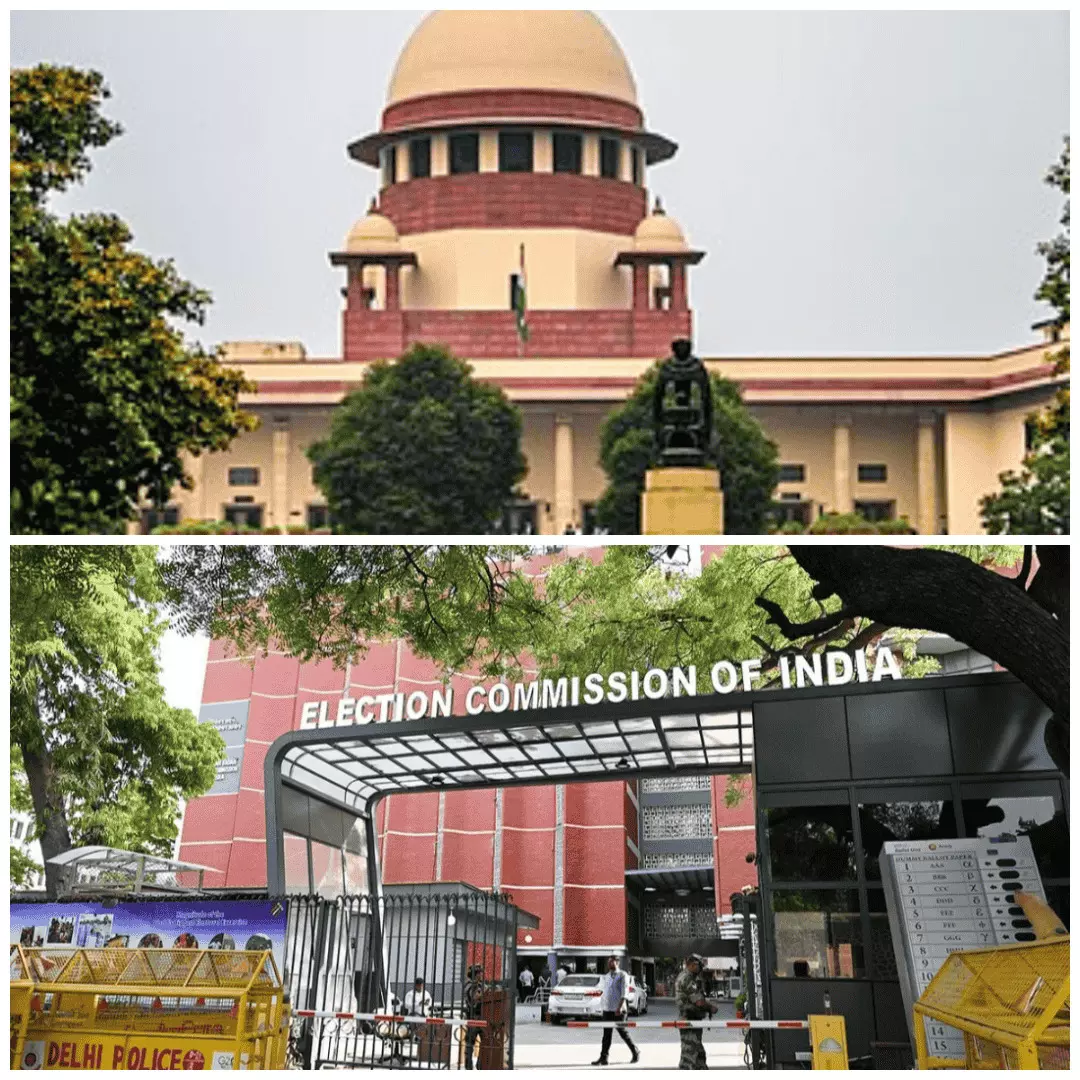
The credibility of a constitutional democracy rests not merely on periodic elections but on sustained public trust in the institutions that conduct, supervise, adjudicate electoral processes & run the writ of the Government of the day. Of late, a trend has surfaced amongst political parties to disown electoral rejection by the public in a thorough election process and attribute the reason on some external occurrence. In this year, the main Opposition party has articulated blame upon the Election commission, of course, without adducing evidence and taking recourse to statutory remedies. This article examines the credibility of democracy in the light of role of various stake holders envisaged by the constitutional scheme. Anchored in Supreme Court jurisprudence, the article argues that while free and fair elections form part of the basic structure of the Constitution, democratic legitimacy is equally dependent on constitutional morality, institutional restraint, and acceptance of electoral outcomes.
The credibility of a democracy does not rest on slogans, street rhetoric, or post-result outrage. It rests on institutions, constitutional conduct, political maturity, and public trust. Democracy thrives on dissent but dissent if degenerates into danger if rhetoric crosses into threats against constitutional bodies. Dissent if not embellished with well-defined contours of limits and reasonable restrictions proves to be impediment to democratic journey. The slogan “Vote Chor, Gaddi Chod” has been echoing for some time now in a selective manner, raised irrespective of the manner in which elections are conducted or the outcome declared.
One is compelled to ask: Is there ever an end to this narrative? And if not, who bears responsibility for the erosion of democratic credibility? At the heart of a constitutional democracy lies a delicate equilibrium between popular sovereignty and institutional trust. Elections are the most visible expression of that sovereignty but their credibility is sustained not merely by outcomes; it is sustained by constitutional institutions, procedural integrity, and democratic temperament.
The recurring allegation encapsulated in the slogan “Vote Chor, Gaddi Chod”, raised irrespective of electoral conduct or adjudicative findings, raises a profound constitutional question: Who bears responsibility for preserving the credibility of democracy?
A worrying trend in recent years is the tendency to accord political colours to every governmental exercise be it revision of electoral rolls, or amendment to any law, or any national reform, seeing the same with eye of suspicion has become our political habit. Democracy under the Constitution of India is not a transient political arrangement but a constitutional value grounded in popular sovereignty, rule of law, and institutional accountability.
This article interrogates a central question: Whose responsibility is the credibility of democracy? When a political leader casually speaks of a bomb explosion against the Chief Election Commissioner, is it not a perilous assault on the very heart of India’s democratic order? Is it not an attack on the very Constitution? Is opposition to electoral roll cleansing process not a wilful attempt to divert the attention of the public at large and mixed up with the question of citizenship which is natural fall out of a legally & constitutionally correct electoral process?
Free and Fair Elections as a Basic Structure Principle
The Supreme Court has consistently recognised free and fair elections as an essential feature of the basic structure of the Constitution. In Indira Nehru Gandhi v. Raj Narain, Justice H.R. Khanna underscored that democracy postulates periodic, genuine elections conducted in an atmosphere free from coercion and arbitrariness. This principle draws sustenance from the broader doctrine articulated in Keshavananda Bharati v. State of Kerala, wherein democracy and the rule of law were affirmed as inviolable constitutional fundamentals.
The constitutionalisation of electoral fairness elevates election-related disputes from the realm of political disagreement to that of constitutional adjudication. Consequently, challenges to electoral integrity must conform to constitutional discipline and legally recognised procedures.
The Election Commission of India: Independence and Authority
Article 324 of the Constitution vests the superintendence, direction, and control of elections in the ECI. In Mohinder Singh Gill v. Chief Election Commissioner, the Court characterised Article 324 as a reservoir of plenary powers, enabling the Commission to act where statutory law is silent to ensure free and fair elections.
The institutional independence of the ECI was further reinforced in T.N. Seshan v. Union of India, where the Court held that the Commission’s constitutional status was designed to insulate it from executive or political pressure. In Election Commission v State of Haryana (1984), the Supreme Court reaffirmed that the Election Commission enjoys plenary powers to safeguard purity of elections.
Allegations of Electoral Malpractice and the Burden of Proof
Election disputes in India are governed by a strict statutory framework under the Representation of the People Act, 1951. The Supreme Court has repeatedly emphasised that an election petition is not a common law right but a statutory remedy requiring rigorous pleading and proof. In Jyoti Basu v. Debi Ghosal, the Court cautioned against diluting these standards.
Similarly, in Ram Sukh v. Dinesh Aggarwal, the Court rejected vague and general allegations, holding that unsubstantiated claims cannot form the basis of invalidating an electoral mandate. These decisions underscore a constitutional principle: allegations without evidence do not merely fail legally; they corrode democratic legitimacy.
Some body produced aptly a data in context of Bihar where the main national opposition party secured 29 seats in 1995, with loss of deposits at 167 seats; 23 seats in 2000; 9 seats in 2005; 4 seats in 2010 with loss of deposit at 216 seats. How did it arrive at a speculative assessment of “Vote Chori.” The base of even a conjecture is missing. If a political party or two demonize a constitutional body & use anarchic imagery, they not only undermine the commission but also weaken the threads of precious democracy & shreds the constitution into pieces.
Judicial Restraint and Electoral Continuity
The judiciary’s role in electoral matters is marked by calibrated restraint. In N.P. Ponnuswami v. Returning Officer, the Court held that election law constitutes a self-contained code and that premature judicial intervention could disrupt the democratic process. This approach was reaffirmed in Ashok Kumar v. Union of India, where the Court balanced the need for judicial oversight against the imperative of uninterrupted elections.
Judicial restraint in this domain reflects an understanding that democracy depends as much on procedural continuity as on corrective adjudication. The Apex Court left no stone unturned in elaborating the constitutional proprietary of the Election Commission & its constitutionally mandated role.
Democratic Temperament and Constitutional Morality
Beyond institutional design, democratic credibility is sustained by what the Supreme Court has termed constitutional morality. In Manoj Narula v. Union of India, the Court observed that constitutional morality must guide both governance and political conduct, transcending mere numerical majorities.
Acceptance of electoral defeat, therefore, is not a matter of political grace but a constitutional expectation. Indian electoral history demonstrates that prolonged exclusion from power—whether of the main national opposition party in certain states, or of other national and regional parties at different times—was traditionally met with institutional engagement rather than systemic delegitimisation. This democratic temperament has been central to India’s constitutional stability.
Since 2000, EVMs have been used in all elections. Five Lok Sabha elections and 122 legislative assembly elections have seen 315 crore votes cast through EVM. On request of some political parties, Voter Verifiable Paper Audit Trail was integrated through notification and amendment of Conduct of Elections Rules, 1961 in 2013. The Apex Court has already declined reversing from EVM to ballot papers in 2018. The memory of forced & forged ballot papers & plundering of electoral boxes is Is it not the collective responsibility of all stakeholders to include citizens, political parties, Election Commission, Judiciary and Administrative machinery of the state.
Transparency, Informed Choice, and Citizen Responsibility
The credibility of elections is also linked to voter awareness and transparency. In Union of India v. Association for Democratic Reforms and PUCL v. Union of India, the Supreme Court held that the voter’s right to know forms part of Article 19(1)(a), reinforcing the participatory dimension of democracy. An electorate serves as a constitutional counterweight to both institutional opacity and populist misinformation.
Conclusion
Democracy is not delegitimised by electoral defeat; it is delegitimised when defeat is refused as a mandatory constitutional acceptance. The Constitution of India provides remedies, forums, and standards for addressing electoral grievances. To substitute these with rhetoric is to replace constitutionalism with populism.
The credibility of democracy is thus a shared constitutional responsibility of political parties to exercise restraint, of institutions to maintain integrity, of Courts to adjudicate on proof, and of citizens to uphold constitutional values. Free and fair elections, institutional independence, and democratic acceptance of defeat together form the constitutional trinity of Indian democracy. Democracy demands debate, dissent and dialogue.
The people of Bihar known for poverty & illiteracy have demonstrated that they carry much higher worldly wisdom and acumen which can overshadow and outshine deliberate attempt to rhetoric’s & reckless sloganeering.
---
Footnotes
Indira Nehru Gandhi v. Raj Narain, (1975) Supp SCC 1 : AIR 1975 SC 2299, paras 195–197.
Keshavananda Bharati v. State of Kerala, (1973) 4 SCC 225, paras 291–292, 597, 610.
Mohinder Singh Gill v. Chief Election Commissioner, (1978) 1 SCC 405, paras 23–25, 41–42.
T.N. Seshan v. Union of India, (1995) 4 SCC 611, paras 10–13, 37–38.
Jyoti Basu v. Debi Ghosal, (1982) 1 SCC 691, paras 8–9.
Ram Sukh v. Dinesh Aggarwal, (2009) 10 SCC 541, paras 19–21.
N.P. Ponnuswami v. Returning Officer, AIR 1952 SC 64, paras 7–8.
Ashok Kumar v. Union of India, (2000) 8 SCC 216, paras 32–34.
Manoj Narula v. Union of India, (2014) 9 SCC 1, paras 74–75, 100.
Union of India v. Association for Democratic Reforms, (2002) 5 SCC 294, paras 22, 38; People’s Union for Civil Liberties (PUCL) v. Union of India, (2003) 4 SCC 399, paras 44–45, 48.
Authored by Dr (Lt Col) Atul Tyagi, Advocate, Member, Supreme Court of India, Visiting Faculty, Author
Contact: 95406520