India’s Education Loan System Is Expanding But Leaving the Neediest Behind
India's education loan system faces criticism for favouring those with financial backing, leaving rural and low-income students struggling to access higher education.

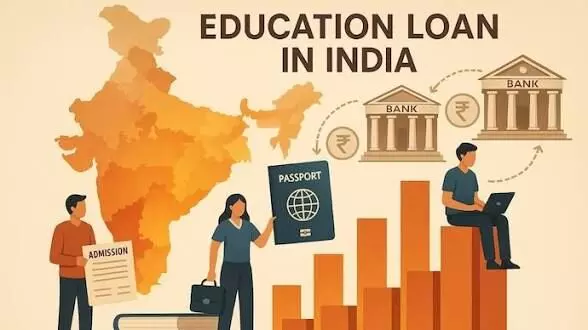
There was a time when an education loan in India was seen as a ladder, an enabler that could lift a student beyond the constraints of family income. Today, that ladder still exists, but for many, it has quietly been pulled out of reach.
India’s higher education ecosystem is increasingly being financed by debt. Yet, beneath the rising credit numbers lies a contradiction that policymakers can no longer ignore. A 2025 Parliamentary Standing Committee report reveals that the number of active education loan accounts has declined from 23.36 lakh in 2014 to about 20.6 lakh in 2025, even as the total loan value has surged from ₹52,327 crore to ₹1.37 lakh crore. In simple terms, fewer students are getting loans, but those who do are borrowing far more. This is not a marginal distortion. It is a structural signal.
A System Built for Safety, Not Access
India’s education loan framework continues to operate with the instincts of a traditional lender. Risk is minimized, not redistributed.
In practice, this translates into a system that leans heavily on collateral, demands financially stable co-applicants, and ties loan approvals to parental income rather than student potential. Even schemes designed to democratize access are falling short. Under the PM Vidyalaxmi scheme, only about 21,967 loans were disbursed out of more than 55,000 applications in 2025. This gap reflects not just procedural friction, but structural exclusion.
The outcome is predictable. Credit flows, but it flows safely to those who already have financial backing.
The Geography of Inequality
The inequity in India’s education loan system is not just economic; it is deeply geographical.
States such as Tamil Nadu, Kerala, and Maharashtra dominate loan disbursals, while large parts of northern and rural India remain on the margins. This imbalance is not merely about banking penetration but more about awareness. Many students in rural and semi-urban regions are unaware of available schemes or lack the guidance to navigate them. What emerges is a two-layered exclusion: first, from information; second, from approval.
Who Gets Left Behind?
The real success of a system is gauged by not who it serves, but who it leaves behind. Students from low-income families, particularly those without collateral or formal financial records, face immediate barriers. Rural students encounter both limited access and limited awareness. Those pursuing degrees outside elite institutions are viewed as higher risk, regardless of individual merit. And students from informal sector households, without strong co-applicants, often find themselves excluded altogether. In each of these cases, the pattern is clear: the system does not evaluate potential; it evaluates protection, and therein lies the irony.
A Philosophical Mismatch
At the heart of the issue lies a fundamental misalignment in how education loans are perceived. In India, they are still treated as retail credit products rather than investments in human capital. Banks ask whether a family can repay a loan today, rather than whether a student will be able to repay it tomorrow. This distinction is critical. In a country that seeks to leverage its demographic dividend, access to education finance should expand opportunity, not reinforce existing inequalities. The Parliamentary Committee itself has pointed to this disconnect, urging reforms such as income-linked repayment models and broader credit guarantees. These are not radical ideas but necessary corrections.
The Road Ahead
India’s education loan ecosystem is not broken but misaligned. As loan volumes grow, inclusivity is shrinking. Without meaningful reform in the form of higher collateral-free limits, outcome-based lending models, simplified processes, and targeted rural outreach, the system risks becoming a closed loop, serving the same segments while excluding those who need it most.
The consequences extend beyond individual aspiration. They shape the country’s economic trajectory. Because when access to education depends on access to credit, which, in turn, depends on existing privilege, the promise of education as an equalizer begins to fade.
And when that promise weakens, so does the foundation of India’s growth story.
(The writer is Head-Strategic Alliances, Urban Money, a seasoned Banker and Mortgage Specialist working for India’s largest loan distributor company. He writes about financial policy, digital services, and public infrastructure in India.)